Opera Forward Festival 2026 Review: Requiem For Mariza
Meriç Artaç’s Attempt To Dramatize The Requiem Is Only Partially Successful
By Alan Neilson(Photo: Bart Grietens)
Amsterdam’s Opera Forward Festival seeks to challenge our understanding of what constitutes an opera, to push at its accepted boundaries, and to discover new pathways in which the art form can develop, both in its form and its content as well as its mode of presentation. Over the past ten years, the festival has met with many successes. Of the four operas on offer at this year’s festival, it was Meriç Artaç‘s “Requiem for Mariza” that, at least on paper, appeared to be the most adventurous.
A Requiem Imagined as Drama
Although over recent years productions of well-known requiems by composers such as Mozart, Britten and Brahms have been performed by major opera companies with varying degrees of success, they have generally required a fundamental recontextualization and an imaginative presentation in order to provide them with the necessary dramatic and theatrical momentum to convince on an opera stage. Artaç and her librettist Sarah Sluimer, however, went a step further, aiming from the outset to provide the necessary characteristics for a successful staged production. In fact, they actually refer to the work as an opera. Originally composed for the November Festival in the Netherlands, the Opera Forward Festival marked the world premiere of the staged version.
Rather than a traditional requiem, in which a community partakes in a religious ritual to pray for the soul of the departed as it transitions from the material to the afterworld, Artaç and Sluimer took a very different perspective, focusing on the dead person’s experience as they transform from a state of life into a state of death. The requiem is thus changed into a personal experience, in which the moment of death is turned into a slow-motion event, of which the dying person, that is, Mariza, is fully aware.
The opera opens with Mariza falling downwards into a void and calling out for help but soon realizes that something is wrong; she never reaches the ground. A mysterious figure called Ra appears and tries to convince her to follow him, but she has not yet finished with her life and resists. She is assailed by memories, good and bad, of her relationships with significant people in her life, such as her mother, people she has loved, and relationships that never formed, like with the child she never had, and memories that never were. She feels trapped in a long, never-ending valley. As her requiem progresses, she starts to lose understanding; even the meaning of words starts to disintegrate. Her mind begins to drift, and her body loses form as she passes through the five stages of mourning: denial, anger, bargaining, depression and finally acceptance. Eventually, it dawns on Mariza that the life she has lived was enough and that she is part of something far bigger, and surrenders herself to what has to be. She understands that it is possible to live a full life without meeting any of your goals; the most important thing is what you have meant to the people around you. Ra then moves on to greet the next arrival who is making the transition from life to death.
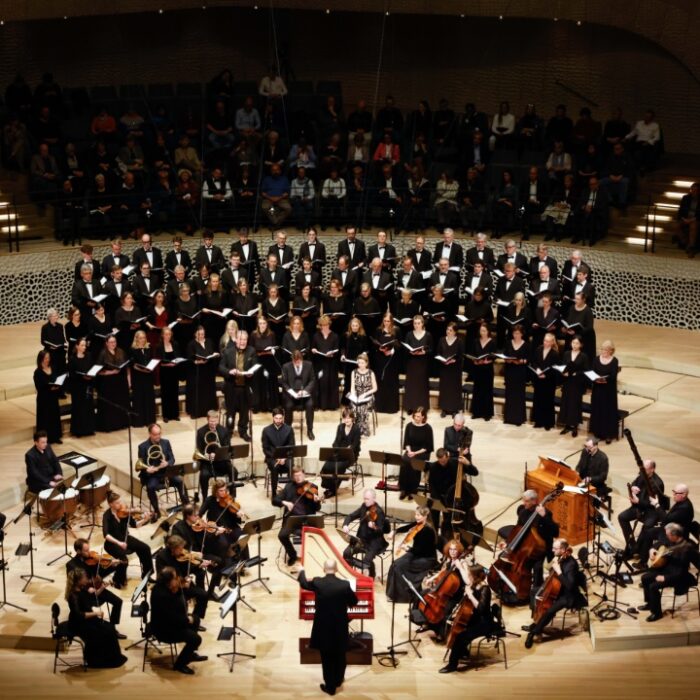
The chorus provides a crucial role in supporting Mariza’s transition to the afterlife through its incantation of a requiem to the traditional Latin text. The effect was to create a work operating simultaneously on two planes, which was reflected in the music. Firstly, there was Mariza in her confused, emotionally heightened state searching for answers and trying to make sense of her shifting memories, which created a dramatic narrative that lent itself to theatrical treatment. And secondly, there was the religious element, confined exclusively to the choral parts, that interwove its way through the work, almost distinct from Mariza’s personal struggle, yet intimately connected to the process of transition.
It is, in effect, an intriguing and fascinating narrative offering the stage director plenty of scope for a thought-provoking, emotionally gripping presentation. Unfortunately, it did not turn out that way!
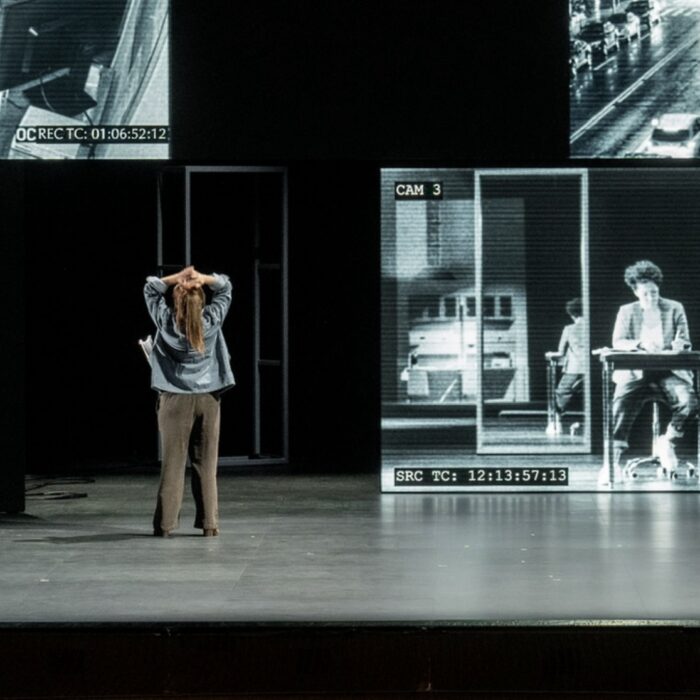
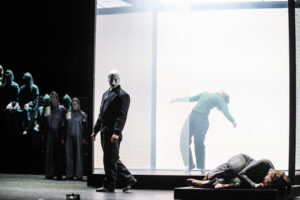
The primary reason for the failure lay with the stage director, Silvia Costa, whose interpretation tended to obscure the abstract concepts and ideas about the afterlife upon which the whole work is founded, rather than providing an accessible presentation with clear signals for the audience to follow. Central to her vision was a cube, positioned in the center of the stage, upon which AI-generated non-literal images, designed by Lorem and Francesco D’Abbraccio, depicting the twilight that exists between life and death. Colorful images continually twisted and turned, morphing slowly or sharply into new ideas and, for the first 15 minutes or so, they managed to hold the attention, but having to attach a meaning to them quickly became a tiring and futile experience, and they became increasingly uninteresting, punctuated only with the occasional impressive idea that added a degree of clarity.
Added to the opaque nature of Costa’s interpretation was her static presentation of the chorus. Rarely did it engage in an animated fashion with Mariza; rather, it took up highly stylized postures, making them appear present yet distant, often acting as an observer rather than an immediate support to Mariza’s traumatic experience. Although it was a reflection of their role as the singers of the requiem, her treatment exacerbated their static effect. Their medieval cum sci-fi inspired religious costumes in bold block colors, also designed by Costa, however, proved to be one of the few successful aspects of the staging. Not only did they provide one of the few visual indications of the work’s subject matter, but it also added an atmospheric dimension that was largely absent from the rest of the production, tied up as it was with abstract notions.
The costumes for Mariza and Ra were completely forgettable: a green jumper and jeans for Mariza and a black jacket and trousers for Ra.
Musically, it was an ambitious work that attempted to meld the distinct forms of music drama with that of a requiem into a single piece. And it was partially successful. While the music for the requiem was suitably religious in tone and generated an elevated sense of the spiritual, the dramatic side struggled to assert itself. There were certainly instances in which Mariza’s emotional turbulence was captured in the music, but generally it had a tendency to drift; it possessed neither the necessary sensitivity, intensity nor the force to carry the drama. Where Artaç did excel, however, was in writing for the voice. The choral parts were delicately fashioned and pleasing on the ear, while her writing for both Mariza and Ra offered the singers plenty of opportunity to express themselves.
Strong Performances from the Soloists
The two solo roles were played by mezzo-soprano Nina van Essen and countertenor Maayan Licht.
Mariza is a demanding role in that she is required to move through a variety of emotionally distinct states that have been generated internally. The focus is always on her; the chorus and Ra are there for her only in supportive roles. She is first seen in a state of confusion, not knowing what is happening to her. With her realization she passes through five stages of mourning: denial, anger, bargaining, depression and acceptance. Van Essen produced a compelling portrait, molding her voice expertly to capture the changing emotions, which were expressed with subtlety, nuance, depth and sometimes a rawness that reflected the emotional extremes of her experience. The expressivity and force with which she was able to promote her character were impressive indeed, although it has to be said that it felt at times that she was carrying Artaç’s music.
Licht portrayed Ra as a mysterious figure with a presence that suggested malign intent. For the first part of the performance, he was perched on top of the cube, watching dispassionately as Mariza’s emotional turmoil unfolded. He showed no sympathy for her situation. As her requiem progressed, he became more actively involved, and in doing so, displayed his benign nature by helping Mariza accept her transition to the afterlife by playing out the roles of significant figures in her life. He never, however, bonds with her; he is just performing his role. His voice was wonderfully suited to his spirit-like character, its clear, almost icy tone capturing the idea of a disembodied entity. In fact, Artaç chose a countertenor so that Ra’s voice would partner Mariza, as “they sound the same and yet are different,” to emphasize their different physical states.
The musical director, Sora Elisabeth Lee, produced a neatly balanced performance from the New European Ensemble, in which the chorus and soloists were given the necessary space and support.
Overall, this was not a particularly convincing piece. Whether this was a result of Costa’s static, obtuse interpretation or a structural problem with the score itself is difficult to ascertain on a single viewing. Yes, there were a number of positives, notably the music for the requiem within the drama and the performance of the soloists, but ultimately it did not possess the musical drive or content to sustain an hour and forty minutes. After an hour, one’s interest began to fade fairly rapidly.