Opera Australia 2026 Review: Turandot
By Gordon Williams(Photo credit: Keith Saunders)
Puccini famously left the score of “Turandot” incomplete at his death in 1924, and its last minutes have been completed by other composers such as Franco Alfano (1926) and most recently Luciano Berio (2002). Arturo Toscanini conducting the premiere a century ago simply put down his baton at the point where Puccini had stopped composing and said something like, “here the work ends, because at this point the master died.”
Arguably, Alfano’s ending gives the audience a rousing climax in keeping with Puccini’s audience-friendly style while Berio tried to resolve incongruities in the plot by maintaining Puccini’s higher-than-usual level of dissonance (symbolic of greater ambivalence) right through to the end.
In this new production at the Sydney Opera House, developed by Opera Conference (Australia’s national partnership of professional opera companies) and performed first by Opera Australia as part of their summer series in association with the Sydney Festival, director Ann Yee, in her Australian debut, has attempted her own dramaturgical solutions to those “incongruities.” (This production has the Alfano ending.)
So, what are these incongruities?
They’re not necessarily due to incompleteness of the score which is arguably easier to resolve than plot threads concerning the whole opera which were left somewhat unresolved by Puccini and his collaborators earlier in the creation process.
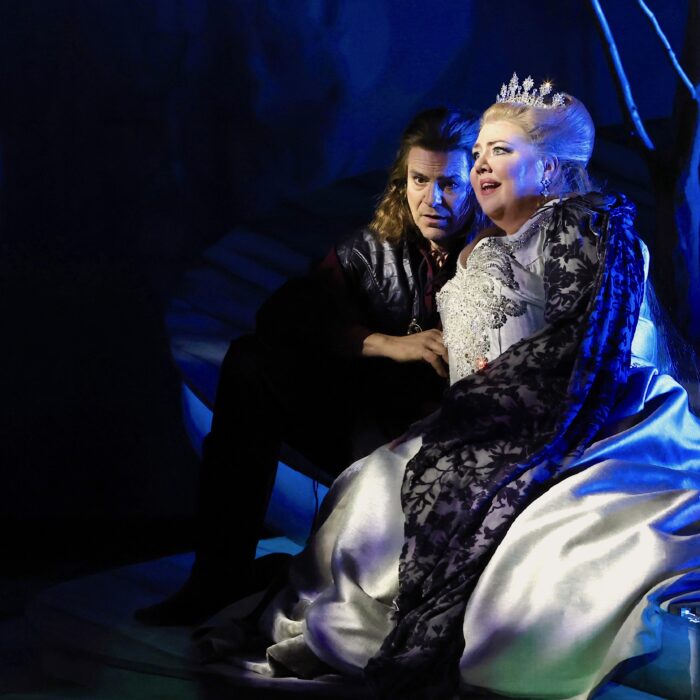
This very much concerns the portrayal of Turandot, so cold and brutal throughout much of the opera, who suddenly, minutes before the end, mellows for Calaf, the tenor hero, here played by Young Woo Kim, whose ardor has terrified her until now. With a conversion at risk of being unconvincing so close to the conclusion of the opera after hearing about and witnessing Turandot putting to death previous unsuccessful suitors, it might even have been consistent for Puccini and his collaborators Adami and Simoni to have Turandot (here played by soprano Rebecca Nash) put Calaf to death. After all, he has given her an “out” from the stipulation to discover his name by giving away the name, himself. The opera, however, has a happy ending.
But the answer might be to sow the seeds of that conversion earlier and make Turandot a more sympathetic character sooner. Certainly, in Rebecca Nash’s interpretation we had early-on sensed Turandot’s horror at the thought of being prey to a man. But what Ann Yee has done is very interesting. She explains in her director’s note in the printed program that the opera’s main premise is “pain healed by love” and that Turandot holds “profound intergenerational trauma.” Certainly, Turandot sings of it, telling the audience in Turandot’s great Act two aria, “In questa reggia,” how she has been affected by the rape and murder of her ancestress Lou-Ling, centuries ago. (Turandot wears black rather than the sort of spectacular costume one might expect from a more traditional presentation of the opera.)
This is why Turandot is so brutal and ice-cold to would-be male suitors, requiring them first to answer three riddles on pain of death and killing them when they cannot, which is what has always previously happened “in the story so far.” But singing about Lou-Ling in an aria is “telling, not showing,” no matter how compellingly Nash sings of her. Would it not be more powerful to let the audience see this event?
And one of Yee’s ideas was to “cast” Lou-Ling, who is not usually an onstage character, and allow the audience to see the wound that lives in Turandot. This performance thus began with a wonderfully writhing dance performed by Hoyori Maruo, expressive of Lou-Ling’s assault. (The program credits Ann Yee and Charmene Yap as choreographers.)
It might be asked how successfully this could be integrated since there is no Puccini music for it. As the dance concluded, the Opera Australia Orchestra under Henrik Nánási, also making his Australian debut, began with Puccini’s familiarly arresting beginning, complete with the color of gong and xylophone. Could it be argued that Puccini meant to plunge an unprepared audience into a different world, exotic and tantalizing, more so than the interior-ness of a psychological state? It must be said that conductor Nánási educed very detailed and persuasive playing which rewarded attention on the pit.
Lou-Ling’s first appearance could have occurred later perhaps, covered by music, when Turandot is singing about her (in “In questa reggia”). On the other hand, as a first appearance, that may have been too late to make the impact Ann Yee intended. Lou-Ling did recur as physical embodiment of memory at later points, but possibly the idea of her appearing from the outset was to establish incipiently the pall her memory casts over an oppressed kingdom.
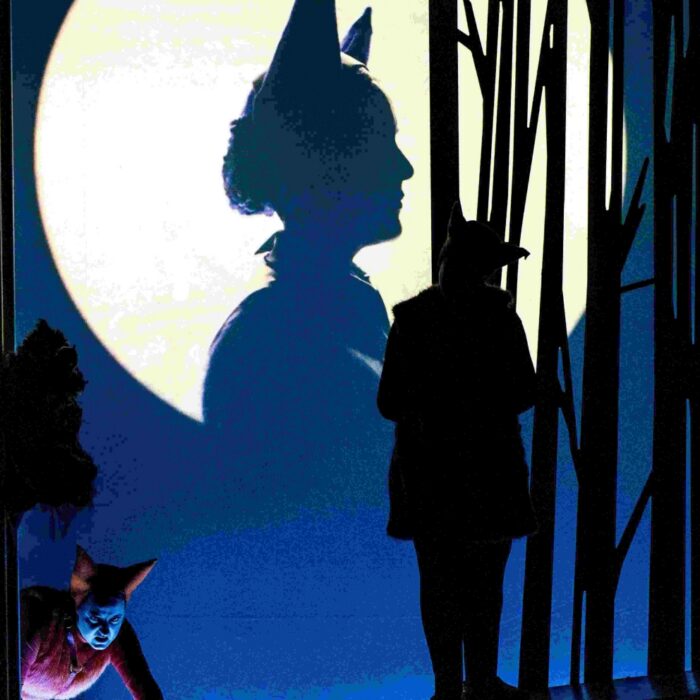
Lou-Ling and Turandot embrace in this prologue and walk away under an avatar of Turandot that then manifests to dominate the stage for much of the rest of this performance. The avatar created by Andrew Thomas Huang, who has directed videos for the likes of Charli XCX, Björk and FKA Twigs, and the team at Collider was actually quite disturbing – unreal but it blinks – as if to say, “You are being watched.”
And then there is the question of what to do with Liù, the servant-girl (a lovely portrayal of heartfelt, even radiant, simplicity by soprano Maria-Teresa Leva) who has accompanied Calaf’s father Timur (bass Richard Anderson) into exile from his kingdom and found themselves in Turandot’s domain.
Liù is probably the most sympathetic character in Puccini’s conception. She knows Calaf’s name but is so loyal to Calaf, who once smiled at her, that she commits suicide rather than reveal his secret. The tormenting of Liù so late in the piece (her funeral march was, apparently, the last music Puccini composed) can tend to further alienate an audience from Turandot, compounding the difficulty of making her last minute conversion to “love” convincing. But Yee’s use of stage movement convinces, and this makes her third act quite successful in resolving the opera’s “problems.” There is striking positioning – Liù and Lou-Ling positioned in a line with Turandot at one point, expressing Yee’s view of those two women being “pivotal to [Turandot’s] journey.” There was even a moment when Yee’s blocking seemed to express Turandot’s awe for the power of Liù’s love, as Nash as Turandot, in a supplicating posture, genuinely asked about Liù’s reserve of an emotion unfamiliar to Turandot until now.
So, Yee has responded to incongruities in the plot. Is there an additional hurdle posed by the music? What prompts might be there?
Puccini made “Turandot” his richest and most colorful score. (Another conductor once told me he could hear Puccini grasping for some of the 20th century’s most advanced techniques in this music.) Opera Australia’s media release acknowledges “Turandot” as ‘[t]he largest choral piece in his repertoire’ and the Opera Australia Chorus, under the direction of Paul Fitzsimon was wonderful to listen to in its highly-varied responses to the action, a stirring immensity of sound, for example, when they all clustered together centre-stage. The media release goes on: the score also draws on traditional Chinese music with the orchestra featuring 13 tuned Chinese gongs and percussion instruments including tubular bells and an on-stage wood block. And it’s not just forces involved that suggest something exotic. It’s the busy-ness of the orchestral parts, the range of combinations and variety of scales, harmonies and harmonic voicings.
Faithfully taking the clue from Turandot’s trauma to paint a picture of a dark, forbidding kingdom, set designer Elizabeth Gadsby and costume designer David Fleischer gave the audience a very powerful sense of the oppressiveness of the traumatized Turandot’s domain. It gives the audience more of the sense of an eastern bloc Communist state of a few decades ago, rather than the spectacle of traditional “Chinese” productions of “Turandot.” One could plausibly ask, “Is that what the music asks for? Why is so much going on down there in the pit?”
Costume-wise, mightn’t Calaf, his father Timur and the faithful servant girl Liù, as visitors (or refugees) to this kingdom, have promised a more colorful world that awaits Turandot’s kingdom once the pall of bitter memory has been lifted?
Among the more colorful stagings, however, was the beginning of Act two with Ping, Pong, and Pang, the vaguely comical characters usually understood as court councilors, described in the program booklet’s synopsis as Turandot’s “administrators” who “code her Avatar.” They appeared before large computer banks – a separate bank of colored lights for each. If the production was specifically located anywhere, it was in the early years of the modern tech world. Ping, Pong, and Pang were tech nerds; Turandot’s father the Emperor Altoum (tenor Gregory Brown) looked like Steve Jobs. This was making an additional point, connecting us with the cauterized emotions of Turandot since we all “insulate ourselves…through our screens, through our communications on social media, through our protected and projected selves” (the director’s note, again).
It would be interesting to hear how this resonated with audience-members. But the lovely trio where the three “administrators” reminisce about their homes in the country, far from the capital (Puccini’s ‘Peking’), somehow seemed aloof from poignancy, although, wistfully and aching with nostalgia, baritone Luke Gabbedy (Ping) sang of his lake-house in Honan, tenor John Longmuir (Pong) sang of his forests near Tsiang, and tenor Michael Petruccelli (Pang) sang of his garden near Kiù.
Tenor Young Woo Kim thrilled the audience with his portrayal of Calaf, providing all the excitement an audience could wish for from this character. The program booklet proclaimed of Calaf’s hit number “Nessun dorma:” “It’s bigger than big, it’s the biggest.” There were lovely subtleties in Kim’s interpretation – compelling flow, the shading on the repeated phrases. But with Kim’s each utterance throughout the night, the music came to the fore. And together, he and Nash made the riddling scene and the final duet: “Princess of death! Princess of ice” gripping.
Lest this review might be thought to be overstating the questions about this production, Ann Yee’s explorations might still suggest a way forward for solving “the “Turandot” problem.”
After all, the opera is, in a sense, still being worked on; Luciano Berio’s completion was premiered in 2002. How far-fetched would it be to commission a composer to write music for a new beginning to cover Lou-Ling’s dance? Something that would segue into Puccini’s beginning as if it was the intention all along and avoid the sense of pre-beginning? Admittedly, this might need the permission or blessing of Puccini’s publisher and/or heirs.
Or why not turn to spectacle a few minutes before the end as a quasi-musical cadence or fulfillment of what’s been promised by the vivid sounds emerging from the pit? This might exacerbate the problem of Turandot’s sudden “conversion,” but not if she’s dressed for marriage earlier, albeit against her will until her final realization?
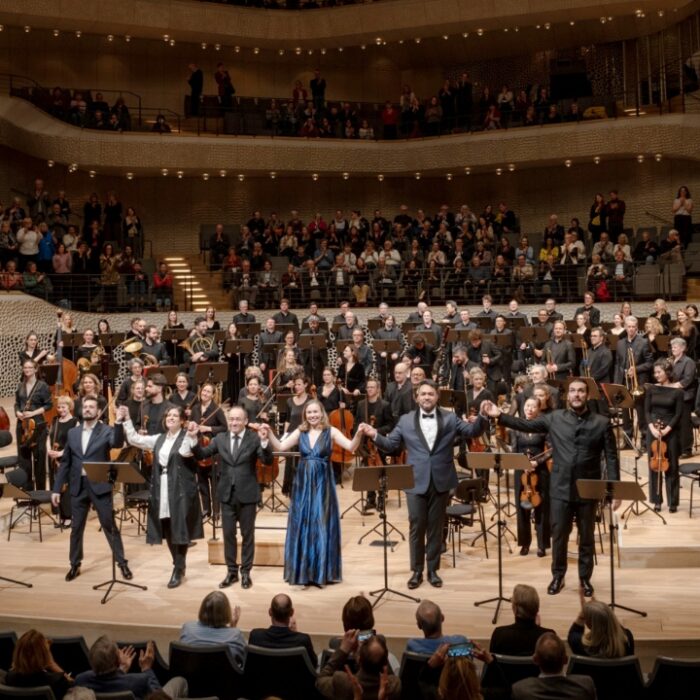
These suggestions are made in the spirit of ongoing discussion. Opera Australia is running “Turandot” in tandem with Puccini’s earlier opera, “Madam Butterfly,” a work that could be regarded as almost perfect in its balance of musical and dramatic plot; music and plot tell the story. Meanwhile, “Turandot” contains some of the repertoire’s most interesting problems. Often enough during this performance I felt that Ann Yee and her team were onto something. The audience on opening night January 15 gave the performance a standing ovation.