Opera Australia 2026 Review: Eugene Onegin
By Gordon Williams(Photo credit: Keith Saunders)
While Tchaikovsky may be one of the most popular composers of the symphonic repertoire and certainly one of the great ballet composers, his operas have, arguably, not reached similar stature or popularity in the West. Commentator David Garrett canvasses some of the difficulties of conveying Tchaikovsky’s “Eugene Onegin” to non-Russian audiences in an essay on his website “Notes from the Garrett.” He wonders “whether there was something inaccessible about the Russianness of this opera, something lost in translation or cultural transplantation.” Is it the reason why we might say that “Eugene Onegin,” though rated highly by the cognoscenti, is not one of the most loved of otherwise highly-rated operas? Maybe it has something to do broadly with tone. “Eugene Onegin” is not packed with high drama or even spectacle, apart from some set dances and one scene where Onegin shoots his young friend Lensky dead in a duel. Even Tchaikovsky conceded that its content “is very unsophisticated, there are no scenic effects, the music lacks brilliance and rhetorical effectiveness.”
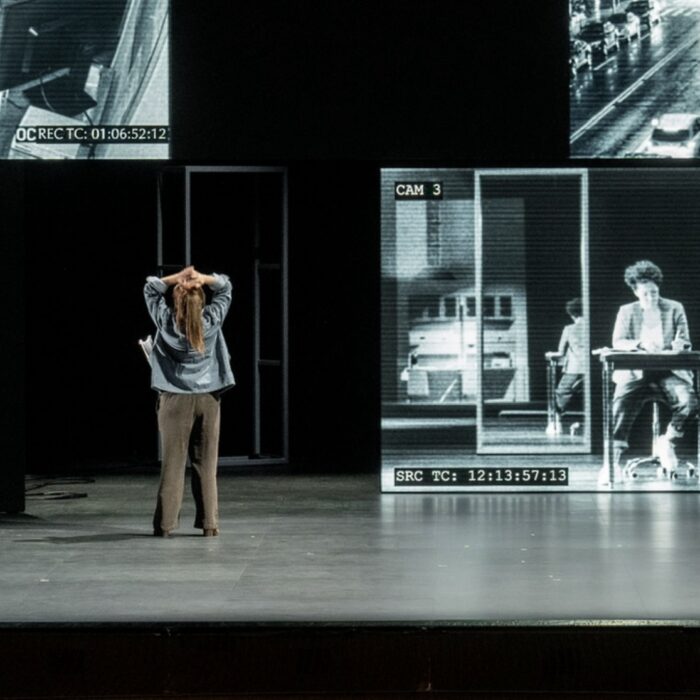
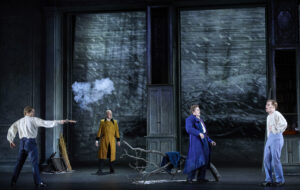
But this production of “Eugene Onegin,” which opened on March 17 as the final production of this year’s Opera Australia summer season, seemed to put us very effectively in sympathy with this world. It is a revival by Heather Fairbairn of a production by Kasper Holten that has also been seen at Covent Garden, London, and Teatro Regio, Turin. Holten’s production made a very strong case for seeing this opera as a valid, closely-observed drama.
How might a non-Russian viewer have gauged this production’s sense of authenticity? Ultimately, it provided a feeling that we were being granted a glimpse into another world, foreign in time and clime, with which we were not familiar and maybe even out of step. This was most apparent in the opening scenes and the conversations revolving around romantic idealism among female members of the Larin household — wonderful vignettes provided by soprano Lauren Fagan and mezzo-soprano Sian Sharp as sisters Tatyana and Olga, mezzo-soprano Helen Sherman as Mme Larina, and mezzo-soprano Angela Hogan as the household servant Filipyevna.
Also revelatory was the depiction of the workers from the Larins’ fields. “Oh yes,” a listener realized at the joyful singing of the Opera Australia Chorus in Scene One, “harvest time must have been one of the great highlights in the calendar of this 19th century agrarian society.” Among the most impressive musical moments of this production was the way the vocal balance was maintained by the chorus, who began out in the fields (offstage), before entering the Larins’ house one-by-one, populating the stage.
Tchaikovsky’s opera is based on the famous early 19th-century verse novel by Alexander Pushkin about the ambivalent and dissolute title character, who was here played by baritone Andrei Bondarenko. Onegin comes to regret his rather offhand rejection of the lovelorn Tatyana when he meets her years later, now transformed into a beautiful and accomplished young woman married to Prince Gremin — here played by bass David Parkin. In the words of Tchaikovsky, it is a story of a “cold dandy penetrated to the marrow with worldly bon ton,” who fails to grasp life’s offerings in the full flush of rightness and comes away empty-handed. He has even shot dead his friend Lensky — played by tenor Nicholas Jones — in a duel after he flirted with Lensky’s fiancée, Olga.
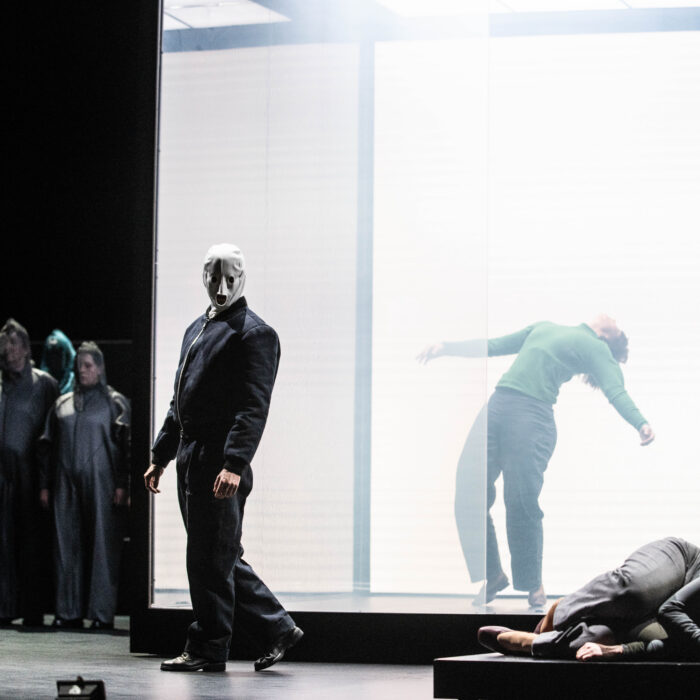
Jones’ personification of Lensky was one of the most attractive musical features of the production. Not only did his clear ringing tenor perfectly suit Lensky’s charming youthfulness, he conveyed impetuous ardor in importuning Olga, even down to scooting across the floor on one knee when reiterating a declaration. The way Jones lay onstage from the moment of Lensky’s death throughout the rest of the second half of the opera was one of this production’s most grimly-effective reminders of past events that cannot be erased. Also effective was the depiction of the future Tatyana during Tchaikovsky’s opening orchestral prelude. She was decked out in the finery of the future wife of Prince Gremin — a pantomime offering a “flash forward” to the future, where Onegin will pursue the Tatyana he rejected so decisively in the beginning. In effect, the audience got to see the woman Onegin was too shallow to initially perceive.
The singing Tatyana and Onegin were occasionally shadowed by dancers Keeley Tennyson and Brayden Harry depicting a Tatyana and Onegin (respectively) of different ages, illustrating the story’s mordant observation on the progress of time. This was arguably a device that added texture to an opera that Tchaikovsky conceded was low in “scenic effect.” There was also something masterly in the way this production continued to take its cues from Tchaikovsky’s preeminence in ballet, illustrating the Act Three Scene Six prelude choreographically through Onegin’s sequential pairings with members of a female corps de ballet. After shooting Lensky, who has taken offence at Onegin’s cynical flirting with Olga, the bereft Onegin wanders the world. We got a strong sense of Onegin’s dissipated wanderings as all the girls — presumably the ones he has had “in every port” — wilt in his arms.
This production’s success had much to do with these production decisions, but also Mia Stensgaard’s sets, Katrina Lindsay’s costumes, and Wolfgang Göbbel’s lighting. The color scheme was simple, even stark. Richard Taruskin, writing in “The New Groves Dictionary of Music and Musicians,” ends his article by pointing out that “Eugene Onegin” “makes its strongest impression” in plain surroundings. Prince Gremin’s blue military uniform, contrasting with the rest of the often-russet color scheme, was enough to signal the decisive role he would play in Onegin’s come-uppance. In his aria “Lyubvi vse vozrastï pokorni,” Parkin gave the prince — an important but largely functional role — three-dimensional life, heartfelt and simple.
The cornerstone of the entire work, and the music with which Tchaikovsky commenced work on his adaptation of Pushkin’s poetic novel, is Tatyana’s Letter Scene in which she unguardedly pours out her feelings for Onegin. Thanks to Fagan, returning to Opera Australia after unforgettable performances as Puccini’s Sister Angelica two years ago, the audience received a convincing picture of the mature Tatyana and was compellingly carried through the various paragraphs of the letter written, perhaps rashly, by a younger, more naïve Tatyana. Onegin responds, of course, by telling her he can only love her as a brother and Bondarenko conveyed this “cold fish” aspect to Onegin with a nice extra touch of alienating severity.
Tchaikovsky’s score can be divided into three acts, but he also described the work as lyrical scenes and Holten’s synopsis, published in the program booklet, does not suggest act divisions. Using the score’s Act Two Scene One (the fourth of the seven lyrical scenes) with its famously buoyant waltz to lead us into the interval made sense, turning this supposed “act beginning” into an Italianate concertato finale complete with chorus. This was a great way to amplify Tchaikovsky’s own attempts to inject musical moments into the score. The quintet of soloists standing out from the chorus well-delineated the harmony, in contrast to the earlier sparsely-accompanied Act One Scene One quartet (Lensky-Olga-Tatyana-Onegin) which seemed, to my ears, lacking in similar gradation and pointing of lines.
In no small measure the sense of authenticity lent to the production was due to conductor Anna Skryleva making her Opera Australia debut. She educed the refreshingly clear colors of Tchaikovsky’s orchestration from the playing of the Opera Australia Orchestra’s principals. “I’m not sick; I’m in love,” sang Olga, and her words and sentiments were echoed by the ardor of solo cello Teije Hylkema.
This was a production that made Tchaikovsky and Pushkin’s characters, and their very particular world, accessible and convincing.