Monteverdi Festival Cremona 2026 Review: Soprano Silvia Frigato & Ensemble Mare Nostrum in Concert
Music of Stradella, Pasquini & Monteverdi in Cremona’s Famous Museo del Violino’s Arvedi Auditorium
By Jennifer E. PyronMonteverdi Festival Cremona hosted “La Dea Delle Scene,” (The Goddess of the Scene) at the Museo del Violino’s Giovanni Arvedi Auditorium, featuring Italian soprano Silvia Frigato and director Andrea De Carlo with Ensemble Mare Nostrum performing works by Stradella, Pasquini, and Monteverdi.
Museo del Violino’s Giovanni Arvedi Auditorium
For five centuries Cremona has been renowned as the world capital for making string instruments. The Museo del Violino, located in the heart of Cremona, displays the world’s most exclusive collection of Stradivarius violins. Their “Friends of Stradivari” foundation began in 2009, creating a network for anyone who owns and wants to support the development of violinmaking (lutherie).
Also part of the museum is the Musical Acoustics Laboratory, established in 2013, which specializes in the Image and Sound Processing Group (ISPG) of the Department of Electronics, Information, and Bioengineering (DEIB) at the Polytechnic University of Milan, in collaboration with the Department of Mechanical Engineering, and with funding from the Arvedi Buschini Foundation and the Cariplo Foundation (Cremona Cultural District Project). In this laboratory important data is collected through multidisciplinary research to improve Cremonese violinmaking and support its cultural valorization.
The Giovanni Arvedi Auditorium, which hosted this festival performance, was specifically designed to provide the highest quality reverberation of the instruments and allow for further research and development on resonance performance. Its tulip-shaped structure provides excellent balance and creates a once-in-a-lifetime listening experience.
Here is an example of documented reverberation in the hall:
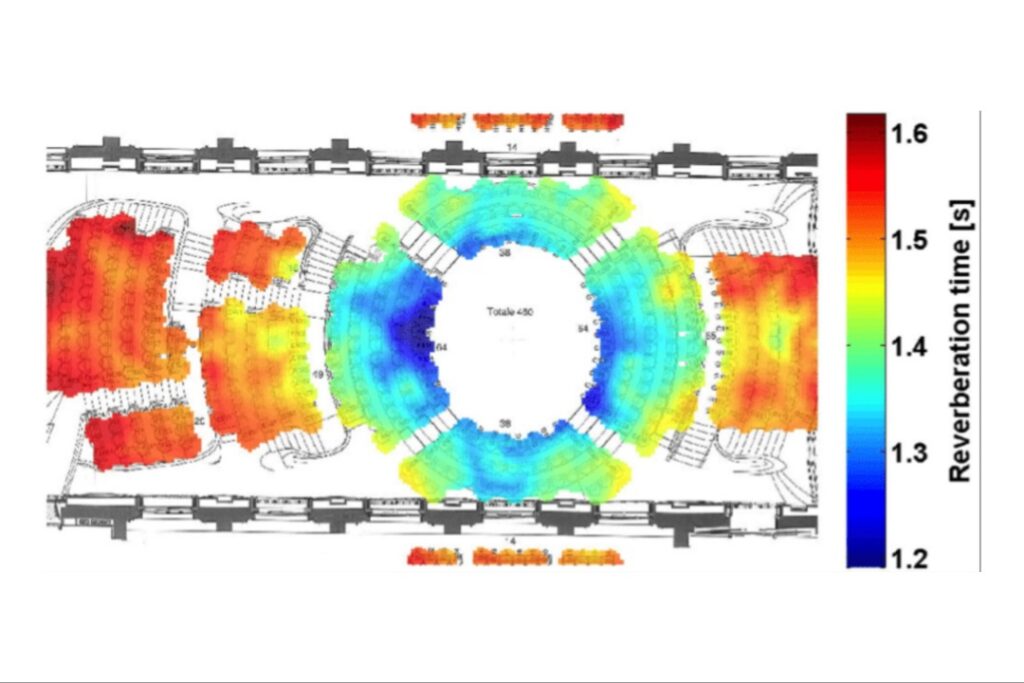
(Photo: Museo del Violino’s Musical Acoustics Laboratory website)
“La Dea Delle Scene” Musical Highlights
The program was inspired by Caterina Angela Botteghi, also known as “La Centoventi” (One Hundred and Twenty), who was a highly paid and much sought-after performer in 17th century Italian opera. She has been linked to Bernardo Pasquini’s “Amor per vendetta, o vero l’Alcasta” (1673) and was defined by Alessandro Stradella as “the goddess of the stage” in 1679.
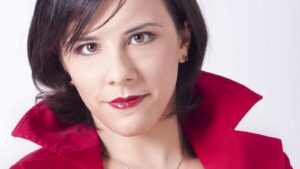
Soprano Silvia Frigato took on the role of this legendary woman for a special tribute to Italian Baroque. Frigato is a leading Italian voice in Baroque music who regularly collaborates with conductors such as John Eliot Gardiner, Rinaldo Alessandrini, Fabio Biondi, and Ottavio Dantone. She has two volume recordings of The Stradella Project: “Il Trespolo tutore” (A475, 2020) and “Amare e fingere” (A493, 2021). Frigato and Ensemble Nostre Mare also have a recording titled “Stradella: Un angelo del Paradiso – The Orrigoni Songbook” (2024). OperaWire reviewed her performance at the Innsbruck Festival of Early Music in 2024 during her performance alongside mezzo-soprano Mathilde Ortscheidt and Akademie für Alte Musik Berlin for an evening titled “Händel & Greber.”
Frigato’s voice was in perfect balance with the Ensemble Mare Nostrum musicians: Ignacio Ramal Viejo (violin), Margherita Pupulin (violin), Giulio Falzone (theorbo), Claudio Martin Poblete (archlute), Marie Domitille Murez (double harp), Bianca Cucini (viola da gamba), Thomas Chigioni (violoncello), Amleto Matteucci (double bass), Lucia Adelaide Di Nicola (harpsichord and organ).
The first half of the performance featured pieces from Alessandro Stradella’s (1643-1682) “Il Trespolo Tutore” (1679). According to the program notes by Alberto Mattioli, Stradella’s “most successful melodrama” was his own scandalous life. The ensemble opened with “Sinfonia avanti l’Opera,” a lively work to welcome listeners is the hall. Frigato performed “Quando mai fra tanti e tanti” with fresh energy and excitement. Her diction was like listening to a masterclass. The acoustics in the hall supported the clarity and precision of her voice with aplomb.
Stradella’s “La forza dell’amor paterno” (1678) was rich in legato phrases with breathtaking string music that really illuminated Frigato’s top notes. Her vocal technique, especially during her pianissimo moments, awakened the emotionality of this work. “Quanto tardate, oh quanto?,” “Correte momenti,” “Fuggi, fuggi dal mio cuor,” and “Aria Fra speranza e fra timore” from “La forza dell’amor paterno” were all full of dramatics and illustrious ensemble playing. The tempi of this work was thrilling and Frigato’s vocal agility was key. The ensemble playing was especially moving. It felt like a moment of blissful baroque improvisation where all players seamlessly flowed together as one instrument.
“Sinfonia avanti il Prologo, Balletto” from “La Laurinda Overo Il Biante” (1671?) rounded out this showcase of Stradella’s works with a mesmerizing finish by the ensemble with De Carlo’s masterful direction.
Bernardo Pasquini’s (1637-1710) “Di costanza armati, oh cor,” Stradella’s “Dolce gioia del mio core,” and Claudio Monteverdi’s (1567-1643) “Ohimé ch’io cado” further highlighted the program, concluding with Frigato and Ensemble Mare Nostrum’s outstanding collaboration. The audience applauded generously for the encore.