Metropolitan Opera 2026-27 Review: Lincoln in the Bardo
By David Salazar(Credit: Karen Almond / Met Opera)
A blue curtain draped the Met Opera’s stage. The color of sadness. The color of the sky. The color of water. That choice already shifts the mood. But in addition to the color, the moment you entered the hallowed hall, electronic sounds permeated the space.
These are the first sensations of the “Lincoln in the Bardo” at the Metropolitan Opera. This carefully curated experience spoke to the level of detail and care put into the overall experience which would continue with said curtain rising alongside the famed crystalline lights, the space dimming. Amidst the chitchatting, the orchestra tuned, but once those lights went out, you could hear a pin drop.
At that point, the opera commenced without added ceremony, reinforcing the sense of a seamless experience. The formality, the ceremony if you will, of a typical opera experience was done away with completely in lieu of something far more spiritual. This isn’t the first opera to do this mind you, but given the subject matter, it is by the far the opera production to best incorporate it with its thematic ideas and emotions.
The opera, based on the eponymous, award-winning novel by George Saunders, sits in a liminal space. A community of characters populate the titular Bardo, in denial or ignorance of their own demise. Amongst them is the recently deceased Willie, son of President Abraham Lincoln. Throughout the opera, he encounters a colorful array of characters who help him on his journey toward letting go and accepting the ever-after, whatever it may be.
Strong Story Structure Coupled With Simplistic Text
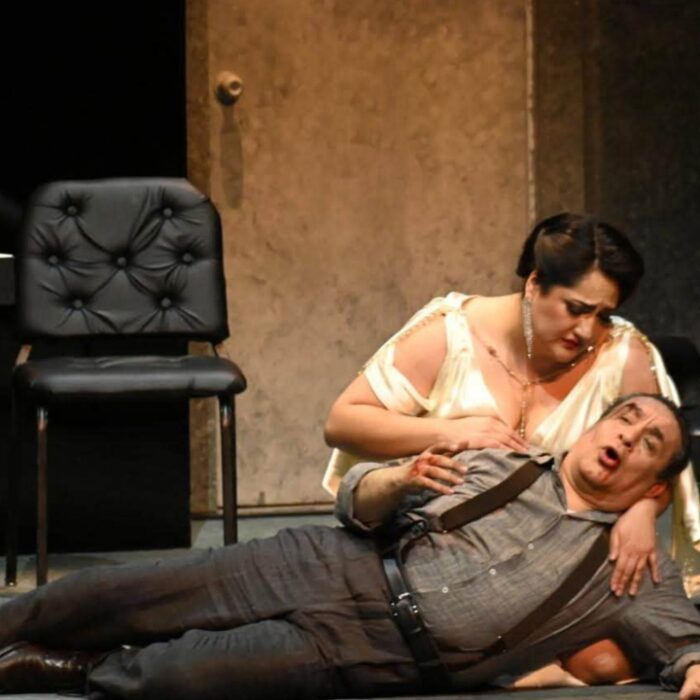
Written by Royce Vavrek, the story’s structure and how it unspools is precise and well-paced. We meet characters gradually, get some background on them (some tragic, others hilarious, others infuriating), and then see how they support and relate to Willie. Each character not only introduces a new angle on death but also on the world itself. The rules are thus revealed bit by bit, the audience trusted to piece together the information to build a cohesive picture of this surreal world. There are exposition dumps, but most are aligned with the characters and their stories themselves so that the act of telling also becomes one of showing; we see this in how concepts like “matterlightblooming” are introduced through Miss Traynor; this concept is mentioned before her scene and then reinforced by it. As an added bonus, we learn about tendrils and the consequences of sticking around the Bardo as a child. This allows the pace of the opera to remain tight and propulsive in its two-plus hours without the feeling of any wasted moments or scenes. The shifts between comedic and tragedy also give the work weight. The original novel famously has 166 ghost characters so Vavrek’s decision to trim it back to a dozen or so was necessary. Which dozen he chose to focus on is where the craftsmanship comes through. You have the duo of Vollman and Bevins, the former a dick joke (more later) and the latter a victim of homophobia. You have the Reverend, the moral center of the piece. You have the shape-shifting Miss Elise Traynor who is tied down by tendrils from the netherworld. Then you have Thomas Havens, a formerly enslaved man who seems at peace with his situation; countering him is the vengeful Mrs. Francis Hodge, a Black woman furious about her children being stolen from her. She is also accompanied by a silent Black woman, Litzie, also facing some trauma. There’s also a boisterous and seemingly racist couple added to the mix. The world of the opera feels full, complex, contradictory, and also insightful on the time period it is set in.
Vavrek’s ability to structure the story is strong, but his language seems to follow the norm of contemporary American opera that is opting for the most simplistic and basic use of the English language. Save for a few evocative moments near the end of the piece, lyricism and poetry, especially given the liminal setting of the work, is nowhere to be found. Some might claim that you don’t need Shakespeare or Tennesse Williams level of sophistication from librettists (though why not aspire to the best the English language can offer), but at minimum, the language should be a tool for characterization, especially when Abraham Lincoln, of all people, is at the core of your story. It is one thing for characters like Vollman to be crude, especially since he is at the center of a massive dick joke (pun intended), or for Willie, a child, to be simplistic in their expression and vocabulary. But for Lincoln, a man known for his eloquence and refinement, to lack any of that, is a misfire. Yes, he is grieving, so there isn’t an expectation to hear any semblance of his wit. But the libretto chooses to let him narrate moments and memories with Willie and those are the moments where Lincoln’s eloquence could come through. Lincoln is the biggest issue in this regard, but it’s not exclusive to him. The Reverend gets a long soliloquy to open Act two, but there is nothing in his vocabulary or use of words that differentiates him from the other characters. Perhaps in one-to-one interactions we can overlook this, but in private moments? That’s when people get a chance to reveal themselves and the Reverend never comes off as a reverend. Save for a dick joke about Vollman being “engorged” or other similar college humor jokes (which to be fair this is an American opera for an American audience that clearly ate them all up), word play and wit is generally rather absent in the text. At times, the incessant repetition of monosyllabic words also overly simplified the libretto, feeling more as if needing space to fill rather than being absolutely necessary or diegetic. Because of this, the language itself lacked in personality and individuality.
A Revelatory Score & Magical Production
Thankfully, the things missing from Vavrek’s text are lifted up by Missy Mazzoli’s score. I identified the Lincoln characterization problem in the second half of the opera; it didn’t bother me in the first half and the main reason was because the music made me believe and feel that this was in fact the most celebrated President in U.S. history. The vocal writing was pristine, the lines elegant and flowing. Despite expressing sorrow, there was composure in the music. The characterization was spot on. And this level of care was given to each and every other character and how their music fit their individual personalities. While the bickering couple got wildly rhythmic pattering, Thomas gets a gorgeous solo that shifts from a rapid-fire rhythmic passage with the word “Tom” repeated ad nauseum (one of Vavrek’s best uses of word repetition in the entire libretto) to something more reflective, more intimate; this contrast between the world he lived and the dreamed of is beautifully expressed by this musical contrast. Ditto for Mrs. Francis Hodge who gets an accented line with a few well-placed high notes to drill home the fury and unsettle the listener. In a world where composers seem to have a high note fetish to the detriment of the singers and the impact that high notes themselves have in the music, Mazzoli’s use is calculated and intermittent, allowing them to have more impact as a result. At the end of the opera, when he finally says “Willie is dead,” Lincoln’s line is written at the upper extreme, allowing the moment to truly resonate because it is the first time we hear him sing up there. Orchestration is consistent and flowing, the music all feeling like it’s part of one complex tapestry. At the core is a solo violin that opens both acts of the opera almost like a narrator, reminiscent of Rimsky-Korsakov’s “Scheherazade.”
Then there’s the production by director Lileana Blain-Cruz and set designer Adam Rigg. No expense seemed to be spared as every possible bit of space is employed masterfully. Characters enter vertically on a swinging branch. Just when you think that the use of depth onstage has been poorly mishandled, the second act opens with brilliant use of depth with Willie’s crypt entering from stage left. The lightning design by Yi Zhao and Stacey Derosier allows for the mood of the Bardo to remain mysterious, foreboding. Projections are used sparingly to add to the element of fantasy, never overstaying their welcome or becoming distractions. And then there are the pyrotechnics which signal departures to potent effect. It all comes together to create a world teeming with energy and life, despite the fact that the characters are in fact dead. If the text itself lacks in poetry, the music and stagecraft more than fill in those blanks. The lone blemish might have been the dick joke during which Vollman narrates his death while a large penis is erected beside him by another stage performer. As he monologues about the ups and downs of his conjugal night, the appendage correspondingly ascends and descends. Is it vulgar? Yes. Does it work? The audience certainly laughed. But the bigger issue was that nothing else in the rest of the production toyed with this kind of physical or visual storytelling. If it had been a part of the overall texture of production then it would have made sense. But it was so disconnected and in retrospect it felt like a cheap laugh.
A Glorious Cast
Then there’s the cast. I want to start with Everett Sobers, who plays Willie. It’s one thing to have a youth performer in an opera; it’s another to have him almost carrying it at moments. Willie isn’t on the peripheral figure in the story; if anything, he’s at the center of it. He’s the inciting incident. He’s the character everyone is trying to change. He’s then the character everyone is trying to save. And at the end of the opera, he’s the one who not only has the big revelation, but he bestows it upon the others. His decision to accept his death becomes the catalyst for others to follow in his stead. He becomes every bit the leader his father is known to be and he gets two prominent solo moments in the process. Most other composers would write this role as a pants role. But Mazzoli and Vavrek bet on a young boy and Sobers proved more than up to the task. Understandably mic’d, he nonetheless managed to deliver his passage with vocal clarity and assuredness, especially during an extended passage in which he insists on waiting for his father’s return. Surrounded by titans of the opera world, he still remained a solid presence and very much proved that he belonged.
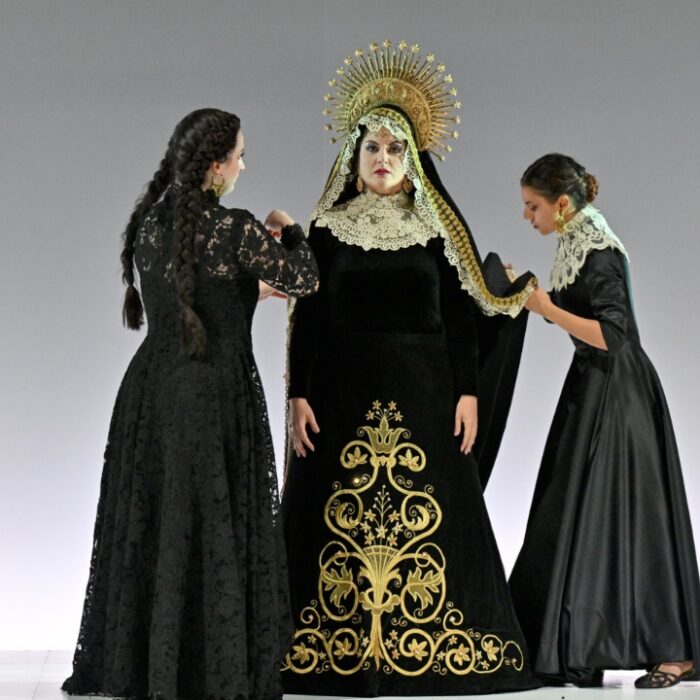
As the Reverend, Christine Goerke had her most impressive performance at the Met to date, the voice clear, elegant, and potent in the space. There was delicacy mixed with a more sardonic edge throughout the Act two monologue and tenderness in the interactions with Willie. But that aside, and perhaps most impressive was that I didn’t recognize Goerke onstage. The costume design by Montana Levi Blanco and makeup team did tremendous heavy lifting here, but Goerke’s physicality must also be spotlighted and commended. She was not just playing a character but viscerally inhabiting it.
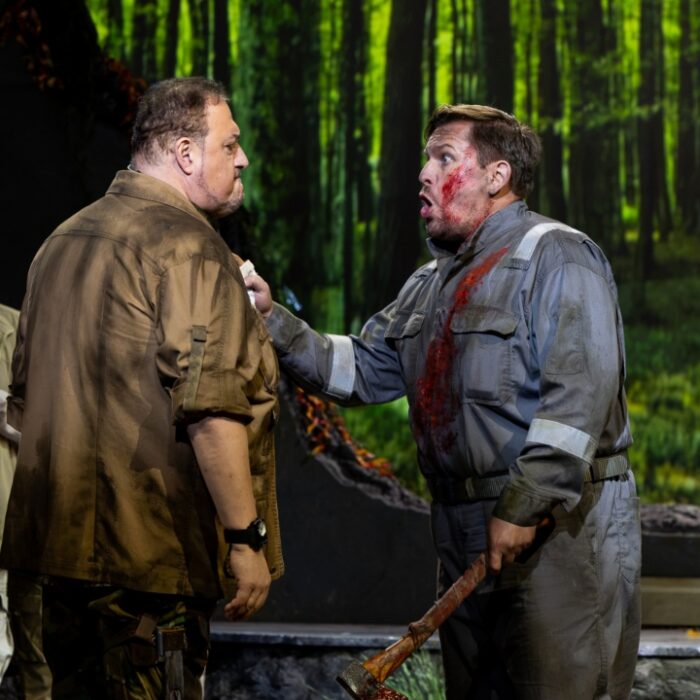
Ryan McKinny and Jonah Hoskins proved a tremendous duo, playing off each other well, their voices melding well with one another. Ditto for Stephanie Blythe and Craig Colclough as the bickering couple whose more accented singing added a unique texture to the soundscape.
Scott Scully got a humorous moment as the doodler, making the most of the bright “Doo Doo Doo’s” in his brief vocal line.
As Miss Elise Traynor, Anthony Roth Costanzo’s voice filled the hall even though there was an unevenness to his approach which oscillated between straight tone to notably wide vibrato on the same phrases. Elise Traynor is in distress and rebelling against being pinned down, so the sporadic vocal approach might express it, but the intention was unclear from moment to moment.
Joshua Blue had a revelatory performance as Thomas Havens, not only with the precision of his aria’s faster sections, but also gentle legato he displayed in its second half. During all of his appearances, he let his honeyed tenor shine with ease and he brought a tranquility and longing to the musical mosaic. In the final scene of the opera, during which the three Black characters commune with Lincoln and declare their hope for a better future, his voice coalesced well with Mattei’s.
This scene was easily one of the most impactful of the night due to how it develops (another of Vavrek’s strong sense of dramatic development). Just after Willie declares his decision to accept death and several other characters join him, the story feels like it has come to a natural conclusion. But then Mrs. Francis Hodge arrives frustrated, reminding us that there is but one major story thread that hasn’t been addressed fully – the feelings of enslaved people. Janai Brugger who in her two appearances dominated the space with a tremendously voluminous voice and generous high notes, stood out because of the intensity of her singing. While most of the cast retained a more whimsical feel (substantiated by the music), hers is full of the passion and rawness. Brugger dug into this, providing a perfect counterpoint to Blue’s more gentle tenor, but by the end of the scene as they commune with Lincoln, her voice settled into a similarly delicate quality.
And to add to it all, we finally get to hear Viviana Goodwin sing. She only gets a few phrases, but Goodwin’s singing was lush and full, her phrasing silk and smooth. Her character laments that she’s only just found her voice, a feeling that as a listener one could identify with. I wanted to listen to her singing and learn more about her character.
Other soloists, including Christopher Job and Daniel Clark Smith were strong in their brief appearances.
The major ensembles, including the Gilberts and the Tendrils, all did commendable work in very complex passages. The chorus itself was, as usual, fantastic, especially in sections where the music can sound like controlled chaos, the voices layering over each other.
I didn’t forget about Peter Mattei as Lincoln. It’s surprising that for a story in which he is the titular character, how peripheral he seems to the proceedings. He effectively has a handful of scenes and doesn’t sing much in some of them, but his presence looms large, literally and figuratively. We await his arrival. Willie pines for his return. Characters scheme around that return. And eventually, he comes to the realization that he has to accept his son’s death. His arc mirrors Willie’s in this way (again, brilliant story structure). I can’t imagine anyone else besides Mattei in this role. Not only is the baritone’s physical nature perfect for the famously tall Commander-in-Chief, but his calm and collected demeanor, coupled with a flawless voice, is nothing short of Presidential. His singing, while composed, was full of stinging melancholy. As he wept for his song and repeated his “I promise,” you could sense the composure breaking, the pain giving way. But the most powerful moments came at the close – as he comes to terms with how broken everyone is, Mattei lets his Lincoln weep and the falsetto evocations of “Willie is dead,” were the most affecting moment of the entire night. Credit Mazzoli for taking the risk to write that vocal line and Mattei for pulling them off with such care and vulnerability.
Contemporary opera is a tough gamble that audiences often take for granted. In an age where opera budget cuts mean fewer operas presented per season, new opera that gets put on the stage has to face greater pressure to prove its worth. “Lincoln in the Bardo” is amongst those that definitely does. Solid story structure, a brilliant production, and, above all, a glorious score imbued with life by a fantastic cast make this a must-see showcase at the Met.