Kaufman Music Center 2026 Review: The 2026 George & Nora London Competition Finals
By Chris Ruel(Photo: Beth Bergman)
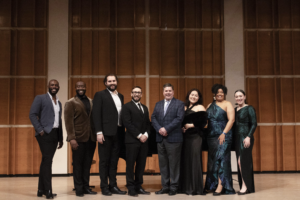
On Friday, February 20, 2026, the Kaufman Music Center hosted the finals of the George and Nora London Foundation Competition. Ten up-and-coming vocalists from the U.S. and Canada took the stage, hoping to win cash prizes and earn bragging rights in one of the top singing contests.
Since 1971, the George and Nora London Foundation Competition has awarded over 300 prizes and more than $2 million to American and Canadian opera singers, many of whom—like Joyce DiDonato, Renée Fleming, Lawrence Brownlee, and Ryan Speedo Green—have earned international acclaim.
The 2026 finalists aged 23 to 32, and performed works ranging from Wagner to Rachmaninoff. All gave strong performances, but only six received $12,000 prizes while four earned $2,000 Encouragement Awards. Those winning the Encouragement may return to the competition for another shot at a winning performance.
The 2026 George London Award winners are: sopranos Tiffany Choe (29, Orange County, CA), Adia Evans (32, Baltimore, MD), Anna Thompson (26, Rochester, MI); baritones Trevor Haumschilt-Rocha (26, San Diego, CA), Korin Thomas-Smith (29, Toronto, Canada); and bass-baritone Nicholas Newton (32, San Diego, CA). Encouragement Awards went to soprano Jennifer Robinson (23, Lakeland, FL), mezzo-sopranos Grace Ryan (25, Bartlett, IL) and Maiya Williams (26, Hutto, TX), and tenor Matthew Sink (29, Las Vegas, NV).
Individual Performances: George London Award Winners
Tiffany Choe, soprano, sang “Senza mamma” from Puccini’s “Suor Angelica” – George London Award in memory of Lloyd E. Rigler, sponsored by The Lloyd E. Rigler and Lawrence E. Deutsch Foundation, James D. Rigler, President
Choe, with her dramatic soprano voice, showed impressive maturity in her performance. Even though Puccini typically prefers lighter voices, her tone brought an appropriate sense of tragedy to the music. She displayed strength in her singing yet maintained control, much like a powerful car that could race ahead but chooses to cruise calmly, confident in its abilities.
Adia Evans, soprano, performed “Es gibt ein Reich” from Strauss’s “Ariadne auf Naxos” – George London Award in memory of Leonie Rysanek, sponsored by Thurmond Smithgall
Evans was one of the older participants in her group, and this was evident in her remarkable command of her lower vocal range, which reached into the mezzo-soprano register. She highlighted this strength by choosing a Strauss piece that showcased her lower notes rather than opting for an aria with a higher tessitura. This decision benefited her, as it gave the judges a fresh perspective compared to the usual soprano performances that focus on high, rapid passages.
Nicholas Newton, bass-baritone, sang “Aleko’s Cavatina” from Rachmaninoff’s “Aleko” – George London Award in memory of Kirsten Flagstad, sponsored by the New York Community Trust and the George and Nora London Foundation for Singers
Newton projected his voice, utilizing the lower register of his bass-baritone range. The tonal quality produced from the stage evoked associations with roles typically portrayed as antagonists, such as Scarpia. Likewise, Wagnerian roles like Kurwenal appeared suitable. His timbre is well-suited to characters that require gravitas and seriousness, though it may not suit basso profundo roles, such as Sarastro, for now. Given the time required for deeper bass voices to mature, such repertoire could become accessible to him in the future.
Trevor Haumschilt-Rocha, baritone, performed “Mein Sehnen, mein Wähnen” from Korngold’s “Die tote Stadt” – George London Award in memory of Lawrence E. Deutsch, sponsored by The Lloyd E. Rigler and Lawrence E. Deutsch Foundation, James D. Rigler, President
Haumschilt-Rocha has a unique voice, blending qualities reminiscent of Michael Spyres, and fits into the bari-tenor category—known as Lyrischer Bariton within the Fach system. His tone carries a distinctive metallic quality, and his mastery of the upper register stands out, which was mostly highlighted in this piece. Although his performance was less expressive than that of the other contestants, this did not hinder his success, as his scores with the judges secured him a winning position.
Korin Thomas-Smith, baritone, sang “Come un’ape ne’ giorni d’aprile” from Rossini’s “La Cenerentola” – George London Award in memory of Norma Newton, sponsored by the George and Nora London Foundation for Singers
Thomas-Smith delivered a powerful performance, demonstrating that his deep baritone could navigate Rossini’s ornamentations with clarity and precision. His tone stayed playful, and his control during the cavatina was lively and accurate. His presence and expressiveness animated his performance as much as the music itself.
Anna Thompson, soprano, performed “Dis-moi que je suis belle” from Massenet’s “Thaïs” – George London Award in memory of Mary Palumbo, sponsored by Donald Palumbo
Thompson was the first vocalist to appear on stage that afternoon, and she showed expressive stage presence and possessed a resonant, full voice well-suited to the Metropolitan Opera House—while vocal power was common among all the contestants, Thompson’s projection was notably impressive. Her delivery exhibited ringing squillo with apparent ease, as she showed no signs of strain and conveyed a capacity for even greater range. She effectively transformed a potentially disadvantageous position in the program into an asset, presenting a benchmark for those who followed.
Encouragement Award Winners
Jennifer Robinson, soprano, performed “Care compagne” from Bellini’s “La Sonnambula.”– Award in memory of Dr. Herbert Appel, sponsored by Susan Appel
Robinson impressed with her lyrical touch and natural vibrato in the Bellini piece. Her expressive voice and movements showed notable power.
Grace Ryan, mezzo-soprano, sang “Sgombra è la sacra selva” from Bellini’s “Norma.”– Award in memory of J. Donald McNamara, sponsored by Lynn Broward McNamara
Ryan performed a second Bellini aria, displaying both her contralto depth and impressive upper range. Her powerful voice resonated throughout, making for an enjoyable performance.
Matthew Sink, tenor, performed “Mein Lieber Schwan” from Wagner’s “Lohengrin.”– Award in memory of Louis D’Angelo, sponsored by Robert Lombardo
Sink took on Wagner confidently, delivering a smooth, full sound and handling the music with ease. His tone’s tragic quality marked him as a promising Wagnerian.
Maiya Williams, mezzo-soprano, sang “Margaret’s Lullaby” from Richard Danielpour’s “Margaret Garner.”– Award in memory of Nora London, sponsored by Ene Riisna
Williams delivered one of the afternoon’s most beautiful performances, though she did not advance to the top six. Her lullaby aria highlighted her smooth, calm mezzo tone rather than vocal fireworks. Dressed in black with sparkling accents, she performed with a soothing presence that could ease any restless sleeper into a wonderful slumber.