Isabella Stewart Gardner Museum 2025 Review: Sasha Cooke & Myra Huang Recital
By João Marcos Copertino(Photo: Ally Schmaling)
Call me elitist, but any song recital focused largely on works written in American English makes my forehead wrinkle. The American songbook is great, and despite the common complaint, English can work beautifully when sung lyrically. The issue is that these recitals often flirt with a certain campiness—especially the Broadway-musical kind—that very few opera singers can convincingly pull off. Nevertheless, if there is a group of singers who can make this work, it is mezzo-sopranos (Susan Graham, Cathy Berberian, Lorraine Hunt). Does Sasha Cooke belong to this group?
Musical Details
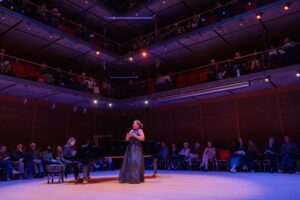
The recital seemed built around a political motivation: most songs, in their own way, made the American project the subject of debate—and made one question the implications of trying to live in a community such as the United States. Songs by Gershwin, Sondheim, and Copland were paired with more contemporary works by Michael Tilson Thomas and Jake Heggie, and with a newly commissioned work by Jasmine Barnes on a very sanitized version of a Langston Hughes poem. To Cooke’s advantage, she was partnered with one of the pianists who understands the voice best in America, Myra Huang. To her disadvantage, the heterogeneity of the repertoire made the experience of attending the recital uneven.
Sasha Cooke is one of those mezzo-sopranos with a rich and rounded voice—especially in the middle register—which makes her an excellent chamber musician, where vocal beauty is more valuable than it is on stage. While most of the recital was in English, not all the words were crystal clear. Cooke knows well the concessions one must make with the language in order to sing a line smoothly, especially in the higher register. The problem is: when singing English-language songs in America, one either goes big or does not go at all. Cooke seemed very concerned with keeping things refined, but for many reasons the recital felt too moderate: not vocally austere enough to mesmerize through musical “frugality,” yet not campy enough to be lavishly entertaining. It is a tricky balance.
Let me give an example: she sang one of the world’s most glorious songs, “Give Me Jesus.” It is one of those spirituals that achieves miracles with very little: the piano must remain austere, the phrasing deeply vernacular, and the singer must create an infinitude of vocal colors in each verse—often repeating the text again and again. Cooke has the vocal warmth for the piece. She also, following modern decorum, sang “I come to die” instead of the program’s “I comes to die”—understandably avoiding the controversy of a white singer emulating Black English. Still, all her fermatas were slightly too short, and a certain sense of solemnity and devotion was missing. The repeated verses felt too similar, never revealing a new expressive purpose.
When singing Barnes’s “American Lament” (“Let America Be America Again”), things were even more interesting. On the one hand, Cooke understood the musical premise well, phrasing the lines in a way that made operatic English sound natural within the small song cycle. When she sang the second “America” of the title phrase, she made the “e” extremely affected and closed, reminding us of a certain utopian ideal embedded in the very vowel of the word America. I was still uncertain whether the song ultimately sounded like music of promise or an overly elaborate operatic approach to a Hughes poem that is, in its original form, far spicier and freer than the sanitized version used here. Beyond the omission of racially marked language, the textual purification creates greater distance. “Let America Be America Again” stands in dialogue with the same tradition that gave us “Howl” and “Leaves of Grass;” the freedom of the verse goes hand in hand with a prophetic voice speaking in vernacular language. Barnes’s song seems to aim for that spirit, but with restrictions. Cooke, for her part, appears slightly reluctant to embody that prophetic tone. Trying to find a middle ground of moderation, I fear she could have gone either more or less in that direction. But this is ultimately a matter of taste. Whether the song catches on will depend on other performers. It did not help that the program notes presented the poem using a very heterodox system of brackets to indicate textual changes. Would not it have been better to simply print the text cleanly and credit both Hughes and Barnes?
In many cases, this moderation came across as a kind of theatrical stiffness. In one of the few songs not in English, Cooke performed one of Weill’s best: “Youkali.” Her French was very good, but in a song shaped so strongly by performers who treat it almost as a Brechtian monologue, Cooke and Huang felt a bit too distant from the cabaret idiom to make it land at lunch time on a cold Sunday. I have even heard there was once a law in East Germany forbidding Weill’s songs from being performed before sunset. I fear that, in this regard, they may have been right.
Illuminating Moments
There were, however, some gems. Rachmaninov’s “Lilacs” offered a truly sensitive moment, as did Alma Mahler’s “Laue Sommernacht.” And it is very easy to see why Cooke is so often in demand when she sings John Musto’s “Recuerdo.” In that somewhat Barber-and-Menotti vein of American music, she revealed her strengths: beyond the beauty of her voice, a certain moderation that makes her the embodiment of a rare artistic archetype. If I were casting a voice for Isabel Archer or Verena Tarrant, I would imagine Cooke. In short: Cooke is at her best in repertoire that thrives on understatement.
By the end of the afternoon, it was evident that Cooke is a singer who is always pleasant to hear. What I am less certain about is whether her recitalist personality remains fully in sync with the best of her vocal and artistic gifts. Yet to contemplate such a plural panorama of America through a song recital is undoubtedly a bold and worthy endeavor.