Highmark Mann Center for the Performing Arts 2026 Review: A Hundred Years On
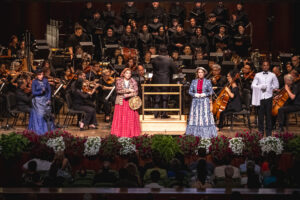
By Maayan Voss de Bettancourt(Photo Credit: Jordan August Photography, Courtesy of Highmark Mann.)
When an artistic institution plans a 250th U.S. birthday concert in a political atmosphere like the one we find ourselves in today, the question is: where do they plan to fall on the balancing act spectrum of patriotism and honesty? It’s exceedingly hard to nail, and despite putting on a truly excellent concert, I’m not sure the Highmark Mann Center for the Performing Arts quite hit the balance they were aiming for.
Production & Musical Details
For a mid-week orchestral concert, this was quite well attended. The famous lawn was comfortably patchworked with attendees, and even the higher priced seats were relatively full. The Highmark Mann had special prices for this concert, with tickets costing either $18.76 in honor of the Centennial Expo or $50 in honor of the performing arts center’s 50th anniversary.
The Philadelphia Orchestra is considered one of the top orchestras in the U.S. for a reason. They delivered gorgeous, clean, and expressive playing from top to bottom. They clearly had fun, which we could tell since there were cameras capturing live close-ups. Getting closer visuals of the orchestra was a nice touch—it made them feel more immediate and personal, and I loved when it caught a moment where the entire brass section swiftly reached forward in unison to turn the page mid-piece.
The best part of having a live video feed was being able to clearly see Maestro Anthony Parnther at work. He was ELEGANT. Just beautiful conducting. He had this regal bearing that gave him such presence and steadiness, and his gestures were so light and deliberate. Nothing was wasted, and one could feel a certain electricity moving through him. If you’ve ever seen that video of Bernstein conducting with just his face and the occasional small gesture, that’s the energy. You could feel the beat and intention, even when he was “doing nothing.”
The concert opened with Mayor Cherelle Parker conducting “The Star-Spangled Banner.” Appropriate and nicely done. The real opening was “Liberty Fanfare” by John Williams and, oh boy, was that a great way to start. The piece was ebullient, with Williams’s signature satisfying orchestration and a delightful forward energy. There were wonderful sparkly bell lines for the percussion, the strings were so lush throughout, and the opening brass fanfare was so clean and sharp I think Williams himself would’ve been delighted to hear his music nailed so pristinely and joyfully.
The second piece on the concert was, to my surprise (and runaway) favorite, “Liberty Bell” by Julia Wolfe. This piece perfectly encapsulates the energy, hope and struggle of our imperfect union—despite our cracks and turmoil, we can still make something special. It starts with this wonderfully off-kilter sound like a steam engine lurching to life and pulling out of the station. The sounds of industry are a theme throughout, with tons of metallic percussion and some sections having a train-like ostinato. The soundscape shifts constantly, never spending too long in one place. Your ear never gets tired, and each section is equally beautiful or intriguing. Wolfe really played to each instrument’s strengths and the whole piece feels delightfully fresh. Obviously the percussion is a huge element to this, and the whole section rose to the occasion. Again, the close camera view really added to the experience of being able to observe parts of the orchestra that are usually hidden in the back. In addition to the unique pitched bell plates, there is a cool moment featuring a drum kit, and the piece appropriately ends with a single bell ringing out. Brava to Wolfe and bravi to the orchestra.
Then came the classic “The Stars and Stripes Forever” March by Sousa. Standard fun fare, but they put an excellent twist on it by having the piccolos and then the brass stand up to bring out their lines in later reiterations of the iconic bop. This gave it a nice visual interest, and brought out the countermelodies that sometimes get a bit buried in some renditions.
A Hundred Years On
The flagship piece of the concert was a brand new commission by Peter Boyer and Mark Campbell called “A Hundred Years On,” an oratorio centered around the story of the Centennial Exposition held in Philadelphia in 1876. A truly excellent subject for this piece, it combined the idea of celebrating America as an ideal, America as a community that can achieve amazing things, and Philadelphian history and pride, all mixed with the question of “how do you celebrate America in the midst of internal strife?” The Centennial Expo was held just 10 years after the Civil War, and the tensions of that period feel very relevant to our current zeitgeist.
I had the pleasure of attending the pre-concert talk hosted by CEO Catherine M. Cahill with composer-librettist team Peter Boyer and Mark Campbell. They clearly have a lot of love for this piece (all three teared up at one point or another), and a complicated love for our quarter-millennia-old nation. They discussed the multi-year process of writing the piece, with Campbell (appropriately sporting a trans flag pin and another that read “ICE OUT”) specifically mentioning that he went back to revise the libretto after our current president was reelected to reflect his darker feelings on our democracy. I kept waiting for that darker moment to come during the concert, but I didn’t really find it. The text throughout was overall interesting, but the more emotionally complex rhetoric felt around the level of a college discussion on the quad. Simple, declarative statements and beginner level sentiments that were over before you knew it. There is a certain American Elegance to that kind of simplicity, but I felt that the creative team could have dug a little deeper throughout. In a full oratorio, you have the time and the freedom. Not being tied to an action-oriented narrative, this was the ideal forum to get more philosophical, poetic, and internal in your work.
Oddly, had I not had context for the piece from the creative team ahead of time, I might have enjoyed it more, engaging with it as-is instead of seeing what it could have been. Though I’m not sure I would have picked up on the nuance they hoped to capture. It read as “wow technology,” “hope for and believe in America,” and “here are vignettes of some people at the expo.” It opens with jubilant syncopation that feels very Copland Americana in the best way. Throughout, Boyer’s music very much captures the optimism and joy of America, the hope for what it can be. He also did a terrific job embodying the forward energy that we’re known for both musically and societally.
Unfortunately, I have to mention the aspect that ruined the experience: the use of AI in the projections. The team used it to “animate” actual photographs and drawings from the time à la your great-aunt on Facebook. This made the whole piece very difficult to sit through. The awkward motion of the ghouls on screen was at odds with the music and quite distracting. On a personal note, watching AI videos makes me physically nauseous, so I spent a lot of the piece fighting with my stomach and avoiding looking at the main screen. The archival art, architectural drawings, photos, letters, and actual film were so amazing, and sloppifying them gave the impression that the creative team didn’t trust the audience to be sufficiently thrilled by these depictions of a lesser-known part of our history. Trust yourself, trust your audience, trust the art. Don’t cheapen it with lazy garbage. It was especially jarring because the AI-free moments were legitimately great—there were some very good designs, and the visuals did strengthen the atmosphere and complement well. I was especially grateful for the aforementioned live feed during the more discomfiting moments; I was able to direct my attention to the side screens and still see the subtitles and the real artists on stage.
Vocal Performances
The singing was overall excellent. The Crossing navigated this piece as well as you would expect from a group of their caliber, though they were mildly sabotaged by the mic placement and balance. They easily rattled off the “list choruses” as Boyer called them, which was one of my favorite recurring tropes in the piece. They were fun, exciting, and educational, with some great musical gestures to punctuate various items and events. One of my favorite moments was when the chorus sang snippets of actual letters from home based on real attendees in multiple languages. It perfectly encapsulated American multiculturalism and the music was gorgeous.
As for the soloists, this piece has a very arresting entrance for them, with a lush, beautiful interwoven ensemble number to start. It brought to mind “Make Our Garden Grow” from “Candide.” The hope, the coming together of motifs, the strength, and the warmth were moving. I was pleased when there was a reprise at the tail end of the piece. The music for the line “the promise of promise” was one of my favorite moments of the whole work.
Mary Dunleavy as the character Amelia Dunning, a mother who lost her son in the Civil War and is mournfully watching children climb and play on a decommissioned cannon, started the solo numbers with some solid acting. Her voice felt a little thin and raspy in the middle and low registers, giving the impression that she recently recovered from a cold, but once she got a chance to show off her higher register, she shone beautifully. She had great high notes and got to comfortably ride the lovely melodies later in the aria.
Next up was Meredith Lustig as the character Susan McCormick, a housewife from Ohio visiting the Women’s Pavilion. She confidently delivered her music with a winsome crossover sound, and had a very engaging and authentic stage presence. This was one part of the piece where I did feel the complexity the creative team was reaching for, the conflict between her pride in women’s inventions and her disappointment in them all being related to domestic duties. The story of the Women’s Pavilion is an interesting one in the history of the expo and I’d encourage readers to delve into it further.
David Portillo as Horace Clarke, a young man seeing the brand-new telephone, which debuted to the public for the first time at the Centennial Expo, was adorable. He had one of the more fun moments, with bouncy arpeggiated lines and a speedy exciting energy. I could see this going into the modern aria rotation for lyric tenor recitals based on its range and the fact that the music would translate extremely well to a piano reduction. Portillo made it sound easy, flitting between registers and effortlessly tossing out the higher notes.
Malcolm J. Merriweather as Ignatius Thomas, a Black man working at the Restaurant of the South, was a treat with his gorgeous, modern baritone sound—that delightfully balanced mix of warmth, vibrancy, and flexibility. He brought a lot of passion to the character, but despite his emotional delivery, this aria as written doesn’t quite land. While pretty and Gershwin-esque, the music didn’t have the tension or authenticity to support the story it was trying to tell. There’s a lack of depth to the exploration of Ignatius’s inner world. He describes his circumstances, but we don’t get a sense of who he is. Is he a northerner, or is he originally from the south? We know he wouldn’t have been allowed to attend the Expo despite working there since Black people were barred, but what else? What future does he envision? This character had a ton of unexplored potential as an intimately grounded exploration of the pain inherent in the American Paradox, that dissonance one lives in where one’s lofty national ideals collide with reality.
Eve Gigliotti as Marion Jozwiak, a Polish immigrant viewing the Expo from the top of the Statue of Liberty’s torch, ended the night on a (metaphorical) high note. She was very funny when her aria called for it, then brought real tenderness in the hopeful parts. Her warm voice carried the emotion well and her low notes were powerful. This is also the most emotionally connected music of the whole piece. You can tell Campbell was moved by the photo that inspired this character and that Boyer really resonated with it as well.
Millie Hiibel’s costumes were well done—they captured and evoked the period, amplified the characterizations, and looked really nice on everyone. I enjoyed the hats The Crossing were wearing, that was a fun touch.
All in all, this was a lovely evening. Even though they missed the mark on some aspects of the execution, the overall bar was high, the music was excellent, and it was all done with good-heart and intention.