Glyndebourne Festival 2026 Review: Ariadne auf Naxos
By Mike Hardy(Photo: © Glyndebourne Productions Ltd. Photo: Tristram Kenton)
My first thought on reviewing the timetable for Glyndebourne’s new production of Richard Strauss’s “Ariadne auf Naxos” was that they’d missed a huge trick! For the lengthy, 90-minute interval, (customary at Glyndebourne to enable opera goers to partake in a picnic or meal among their glorious grounds in the summer season), was scheduled to end at the exact same time as the solar eclipse was about to begin. In other words, the rare, astronomical event was unfolding just as the artists were taking to the stage to commence their second, or main Act!
Fortunately, nothing could eclipse the absolute stellar ensemble that took part in presenting Laurent Pelly’s stunning production.
Production Details
Strauss was undoubtedly the leading exponent of creating something new at the turn of the 20th century, where the drama and romanticism of verismo, in the late Romantic era, began to make way for experimentation in the form of modernism and expressionism.
“Ariadne auf Naxos” is an opera in one act with a prologue that deliberately incorporates commedia dell’arte characters and conventions.
The prologue tells the tale of a wealthy patron and his appointing of two performing companies to entertain him and his guests at his 18th century Viennese mansion; only his request is that they perform at the same time. This gets complicated further by the fact that one company is a traditional, serious opera outfit and the other is a comedy troupe. Chaos and hilarity ensue, as each role vies for the right to take centre stage, to have THEIR performance take precedence over the other. Eventually, they all agree to try and make it work, if only for the sake of the remuneration being paid to them.
The second Act, or the actual opera itself, “Ariadne auf Naxos,” sees Ariadne, desolate on the rocky island of Naxos, where she is mourning her lost love who has abandoned her. She awaits Hermes, the messenger of death, to release her from her anguish. Her heartbroken musings and protestations are frequently interrupted by clowns, nymphs and the leader of the commedia dell’arte group, Zerbinetta, whose comedic interjections contrast sharply with the gravity of the proceedings unfolding within the opera.
Originally conceived as a short divertissement or amusing 30 minute augmentation to a larger performance, the creation of “Ariadne auf Naxos” was probably as fraught, tension laden and chaotic as the story itself. Artistic friction abounded, particularly between Strauss and librettist Hugo von Hofmannsthal who clashed over how best to present the obvious divergent and conflict inherent in this tragic comedy, and over artistic choices and even required voice types.
It’s 1912 premiere was completely confusing and, in consequence, pretty disastrous. It wasn’t until its rewritten form included the prologue which better served to explain the work more clearly, that it went on to enjoy a triumphant reprisal in 1916, cementing the version that is performed today.
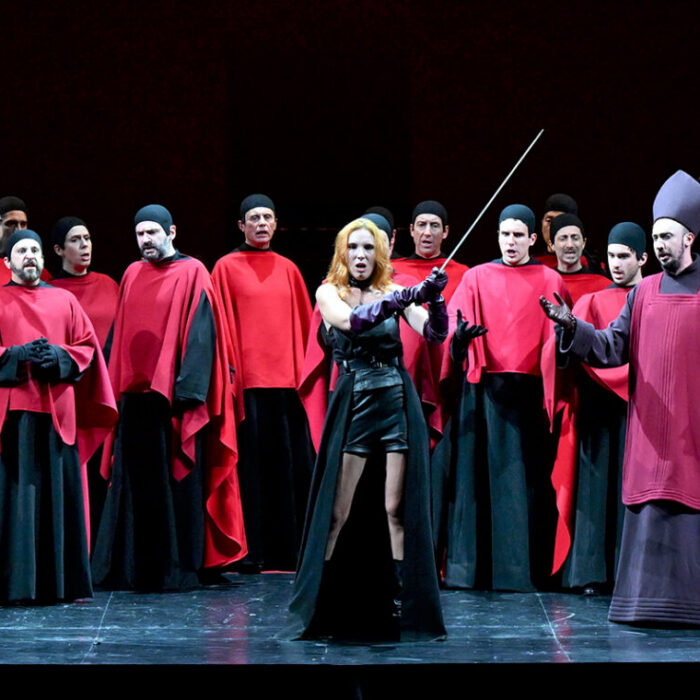
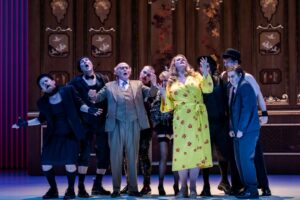
Set designer Massimo Troncanetti opted to create simple but most impactful stage sets. A tall, wooden paneled ornate, rococo façade serves as the grand entrance to the wealthy Viennese patrons’ residence complimented by a slatted and expansive backdrop and avant-garde, candelabra-like lighting in the prologue. For the main Act itself, he conjures up a rather precarious-looking, rocky volcanic outcrop, on which several of the artists were observed taking great care as they moved around the stage. The sets were wonderfully accentuated, courtesy of the stark and effective lighting by Marco Giusti which created a magic lantern effect through the corrugated backdrop in the prologue, an all-enveloping crimson wash at one stage and in the closing moments, a stunning sunrise reveal.
Musical & Cast Highlights
Strauss’s score is quite divine, beautifully recreated by the London Philharmonic Orchestra, under the baton of Robin Ticciati. The whole work is a curious contrast, a hybrid, musically, of singing and spoken-word, of lush orchestration and exquisite strings contrasting with giddy waltzes and comedic, vaudeville-style passages.
American soprano Rachel Willis-Sørensen as Ariadne portrayed a difficult character, in which she had to assume the temperament of an affronted prima-donna in the prologue before resorting to a classical, desolate, spurned lover in the main second section. It is a testament to Willis-Sørensen’s acting that she accomplished both with aplomb and conviction. Furthermore, she performed with a rich, velvety instrument; exhibiting her fine artistry in the softer passages and displaying ample power in the upper register. Her “Ein Schönes war,” in which she sang of her devastation at being abandoned, was sublime and her “Es gibt ein Reich,” in which she longed for her release, was equally exquisite.
But perhaps the most difficult part of the role of Ariadne is knowing that you have, effectively, to play second fiddle to the role of Zerbinetta, the coquettish, impish leader of the comedy troupe whose duration on stage surpasses, by far, that of any other character in the opera. Coloratura soprano Alina Wunderlin as Zerinetta was remarkably dextrous and agile throughout the whole opera. She possessed splendid comedic timing and expressiveness. Her famous aria, “Grossmächtige Prinzessin,” was the most astonishing display of vocal acrobatics, runs, trills and rapid ornamentation. The lengthy aria, sung in between two quintets, has a most demanding tessitura, incorporating six high D’s, (D6), rising to E-natural, (E6), multiple times; yet requiring a strong, resonant middle register to maintain audibility above the orchestra. I have experienced some deeply serious renditions of this aria, sung with pathos, but what stood out most about Wunderlin’s performance was how she brought her character’s nonchalant, devil-may-care and frequently hilarious personality to the piece. She sang of her multiple lovers, throwing a cappella trills to the audience, ostensibly directed at individual patrons in the theatre, to illustrate her carefreeness. The conclusion of the piece elicited such a rapturous response from the audience that the applause was only interrupted when another artist entered the stage to continue proceedings.
David Butt Philip as Bacchus made a huge impression. He sang with great resonance and dramatic intensity. Together with Willis-Sørensen, he sang the most powerful and emotive passages at the close of the opera where he rescued Ariadne from Naxos Island, won her affections and walked, (quite literally), off into a giant sunrise. He sang with a rich and dark hue. His heldentenor effortlessly rose above the orchestra. The role is ostensibly a short one, but is clearly demanding and requires huge vocal resources.
Samantha Hankey as Composer gave a remarkable portrayal of an angst ridden, eccentric. Wonderfully melodramatic, expressing anger and disdain at having to share her creation with a comedy outfit, she sang only in the prologue but made frequent appearances in the main opera, watching on, surreptitiously engaging and mentally directing proceedings. Strauss and von Hofmannsthal did not write for the Composer to have any stage time in the main opera, her role being exclusive to the prologue only. That he does so here serves well in reinforcing the underlying tale: high-art serious classical opera juxtaposed with low-art vaudevillian style comedy. It served to ensure that Hankey’s incredible singing from the prologue remained fresh in the mind. It was truly incredible. Her “Sein wir wieder gut,” in which her character sings of music being a sacred art, having transcended the frustration and rage he felt at having to share the stage with commedia dell’arte, was quite moving. Given that this was her final singing to be performed in the opera, she performed with a compelling and impassioned manner that left no doubt that to continue another act singing in that manner would have been impossible. The audience showed their true appreciation at the prologue curtain.
More Illuminating Cast
Ru Charlesworth as the dancing master, replete with sparkly trousers and a vivid purple jacket, sang with a polished bright tenor voice. Baritone Michael Kraus as the music master performed with fabulous clarity and sonority.
The commedia dell’arte actors were not only resplendent, vocally, but Liam Bonthrone, Caspar Singh, Liam James Karai & Mikhail Timoshenko were riotously entertaining in their own right. Likewise, the mythological nymphs, Anna Denisova as Naiad, Ekaterina Chayka-Rubinstein as Dryad and Eirin Rognerud as Echo were genuinely angelic, not just individually but especially supremely harmonious together.