Deutsche Oper Berlin 2026-27 Review: Der fliegende Holländer
Milo Rau’s ‘Road Movie’ Production Investigates the History of Germany’s Relationship With Israel
By Zenaida des Aubris(Photo: Matthias Horn)
Richard Wagner’s Dutchman is condemned to sail the oceans until a woman’s unconditional fidelity releases him from his curse. At the Deutsche Oper Berlin, Swiss director Milo Rau has assigned the unfortunate mariner an altogether different framework: from the Holocaust to the founding of Israel, from the 1972 Munich Olympics to Berlin’s Holocaust Memorial, with the contemporary Israeli-Palestinian conflict.
What emerges is an exercise in political theater that has almost everything except theater, let alone opera: documentary footage, historical reenactments, projected slogans and patent explanations, flag waving, ideological pronouncements, and a bewildering assortment of symbols. Wagner’s music occasionally makes itself heard beneath this accumulation of cultural and political baggage. His opera, however, all but disappears.
Rau’s premise is not without intellectual justification. Wagner himself associated the Dutchman with Ahasuerus, the legendary Wandering Jew condemned to eternal exile, a figure embedded in centuries of Christian antisemitism. Given the composer’s acknowledged antisemitism and the subsequent appropriation of his music by the Nazis, an investigation of historical responsibility through “Der fliegende Holländer” might even yield genuine insights. But Rau is less interested in asking questions than in supplying his purposefully recalcitrant opinions. His production has the moralizing tone that will not bear any argumentation, since the conclusions have already been established before the show even starts.
(Photo: Matthias Horn)
History as Allegory
Rau’s political equation is simple enough: The Dutchman embodies Germany’s unredeemed guilt for the Holocaust. Senta represents Israel, whose love or forgiveness might finally release Germany from its historical burden. Erik becomes a Palestinian figure, excluded from the relationship between the other two. Daland acquires the attributes of Israel’s founding generation.
The difficulties are immediately apparent. Wagner’s drama of obsession, longing, fidelity, and transcendence is transformed into an allegorical negotiation between nations. Individuals cease to possess autonomous emotional lives; instead, they are required to carry the historical responsibilities of entire peoples.
More troubling is the implication that Israel should somehow provide absolution for Germany. The Palestinian dimension, ostensibly introduced to complicate this equation, becomes another component of a fundamentally German preoccupation with its own conscience. The considerable suffering and conflicting aspirations of real individuals are subordinated to the needs of a European morality play. That is a precarious foundation upon which to construct an opera production, particularly one that claims to confront the dangers of historical simplification.
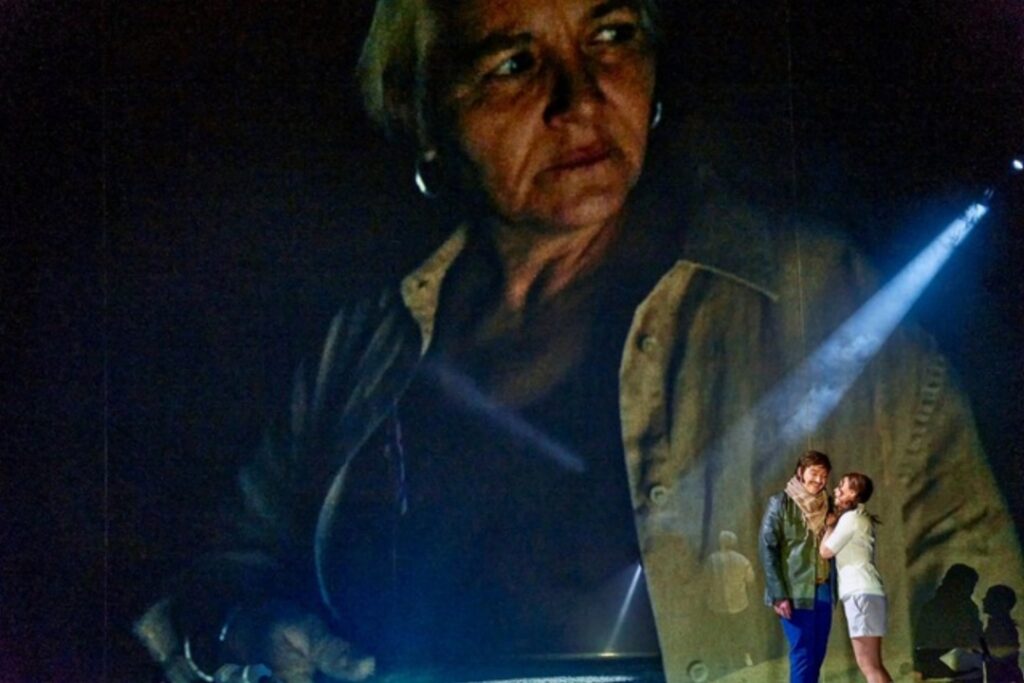
Rau supplements his interpretation with documentary material filmed during a roadtrip through Israel, where he and his collaborators brought Wagner’s music into public spaces and recorded people’s reactions. Given the composer’s history of fraught reception in Israel, this is an undertaking with genuine documentary interest – in its own time and space.
Two Israeli performers, Sarah von Schwarze and Shlomi Moto Wagner, appear as narrators, recounting their purported personal histories and introducing the film material. Their experiences – whether real or scripted – and those of the people encountered during the journey, offer glimpses into the complicated relationship between cultural inheritance and collective memory.
Unfortunately, these testimonies also expose the inadequacy of Rau’s theatrical method. The individuals on film are more interesting than the allegorical figures inhabiting the stage.
(Photo: Matthias Horn)
An Opera Buried Beneath Its Documentation
Even before the overture, the audience is confronted with explanations and documentary footage. Once the orchestra begins, the visual instruction continues.
With basically an empty stage, Anton Lukas’s set only materializes during the last Act with monumental stone blocks recalling Berlin’s Memorial to the Murdered Jews of Europe. Moritz von Dungern shows images of persecution and death, supplemented by live video and historical references, alongside completely banal footage of modern airport terminals and pedestrian shopping areas on the stage wide screen. The performers are introduced through projected biographical phrases, while the audience is left to decode the moving pictures.
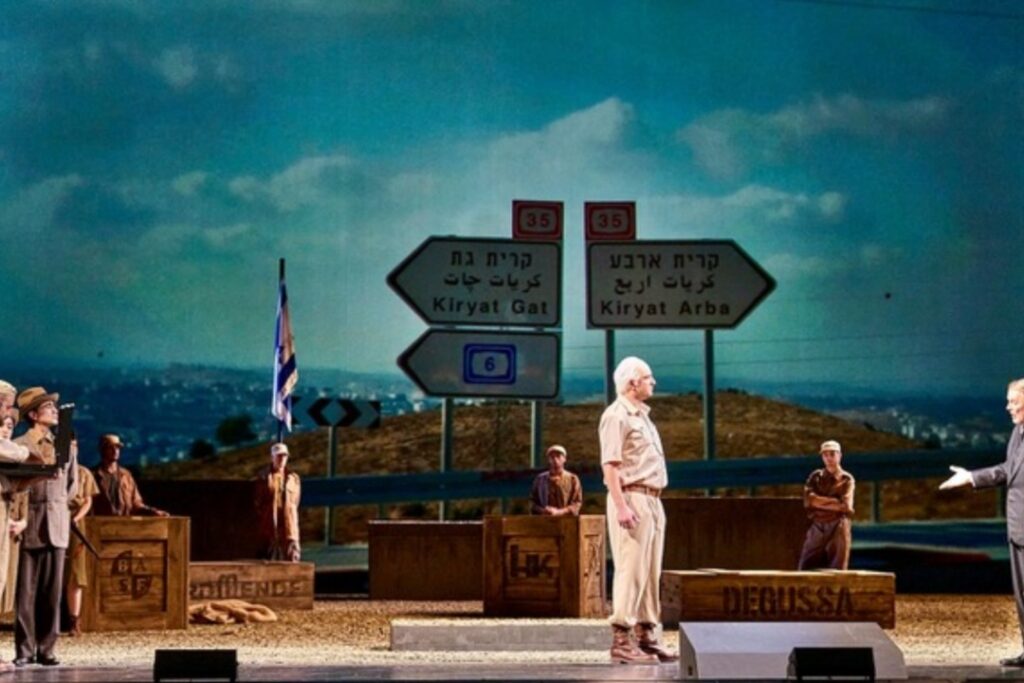
In the first Act, the Dutchman’s arrival is transferred to the period of German-Israeli diplomatic rapprochement. Wearing a black leather coat and military-style cap, he resembles a distinctly sinister representative of Germany’s past. A German flag is raised, and the treasure with which he seeks to acquire Senta is packed in crates bearing the names of German industrial companies, including BASF and Degussa. Daland does not question where this wealth comes from. The visual shorthand could scarcely be more explicit.
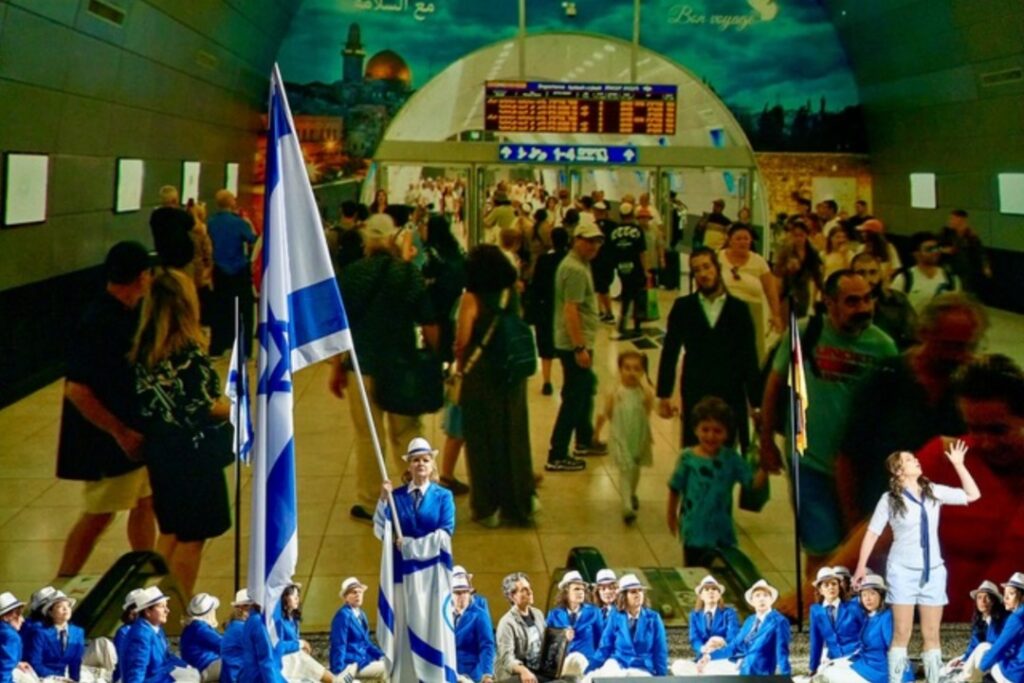
The second Act relocates the action to the terrorist attack on Israeli athletes during the Munich Olympics of 1972. The women’s spinning room gives way to a historical reenactment of the ladies in their Israeli Olympic uniforms, complete with a flag-waving Mary and projected hostage-taking testimony amidst close-ups of the dead.
By the third Act, the scene has shifted to the inauguration of Berlin’s Holocaust Memorial in 2005. Neo-Nazi imagery and right-wing political references crowd the stage. Men in bomber jackets and combat boots wear blue caps bearing the slogan “Never again,” an all-too-obvious appropriation of contemporary political branding.
The historical references accumulate, but accumulation is not interpretation. Again and again, Rau appears to confuse the recognition of a symbol with the development of an argument. The audience is expected to respond to the moral weight of events whose significance is already established, rather than discover anything through the interaction of character, language, and music.
There is scarcely any meaningful direction of the singers. These are left to stand and gesture as best they please and can, downstage, clueless, through situations whose political meanings are being projected behind them on screen. Their motivations are supplied by captions and documentary sequences, with no reference to the drama itself.
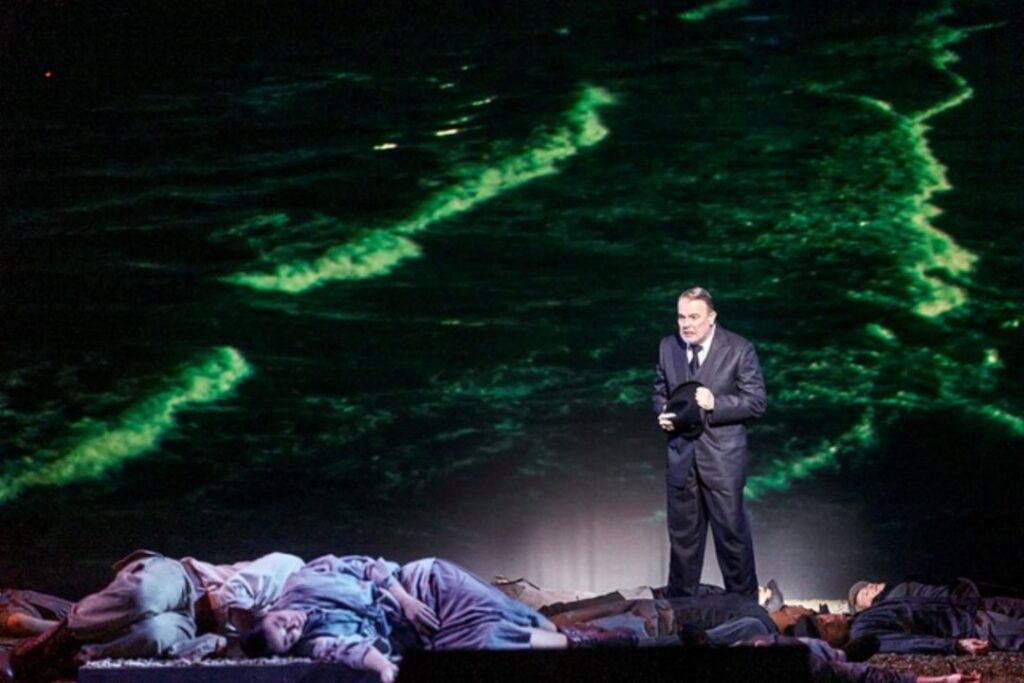
There is one occasion during which the different worlds briefly converge: When the Dutchman sings of being denied even a grave while surrounded by the stone blocks of the memorial, text, image, and music achieve a genuinely unsettling correspondence. For a brief instant, the production allows Wagner to illuminate an idea rather than merely accompany it.
The real problem is not that Rau has politicized Wagner. Opera has always possessed political implications, and the history of Wagner’s reception demands serious examination. The problem is that Rau’s politics are theatrically reductive. Historical events become illustrative material, while the ambiguities that might make them dramatically productive are systematically eliminated.
One begins to wonder whether the opera is being performed at all, or whether the Deutsche Oper has become the venue for an elaborate multimedia lecture with incidental musical accompaniment.
When the Music Loses Its Bearings
Under Giedrė Šlekytė, making her Wagner debut, the excellent orchestra of the Deutsche Oper Berlin unfortunately failed to provide the dramatic momentum conspicuously absent from the stage.
“Der fliegende Holländer“ may be early Wagner, but it already demonstrates the composer’s remarkable ability to translate psychological obsession into orchestral motion. The violent propulsion of the overture, the restless maritime rhythms, the opposition between the Dutchman’s despair and Senta’s redemptive vision: these are not merely atmospheric effects. They form the architecture of the drama.
Šlekytė’s reading rarely captured that architecture. Passages of considerable beauty emerged, but the music too frequently lacked sustained tension and an overarching trajectory. Climaxes turned into accumulated volume without necessarily generating excitement. The orchestra seemed reduced to providing a soundtrack for the incessant visual narrative rather than propelling a music drama on its own terms.
On the side of the vocal performers – these offered little consistent compensation. Tomasz Konieczny, an experienced Wagnerian, was audibly indisposed as the Dutchman. His vocal difficulties became increasingly apparent until, during the main duet with Senta, he was unable to continue singing. Seamlessly, Derek Welton took over the vocal part from the side of the stage while Konieczny continued to act the role. Welton’s impressive vocal authority and professionalism deserved the enthusiastic reception he received.
(Photo: Matthias Horn)
Aušrinė Stundytė, making her role debut as Senta, encountered serious difficulties with the demands of the part. Her often pressured upper register, unstable intonation, and occasionally harsh vocal production compromised the character’s emotional trajectory. Most disappointing was her Ballad, the dramatic and musical center of the opera, which never acquired any hypnotic intensity necessary to explain Senta’s extraordinary identification with the Dutchman. Without that identification, her final declaration of fidelity became little more than another theatrical assertion. Mezzo-soprano Kai Rüütel-Pajula was the only one who, given a large Israeli flag to wave, asserted herself downstage as an indignant representative at the head of the Israeli Olympic delegation.
Tareq Nazmi brought imposing presence and considerable vocal authority to Daland, notwithstanding indications of vocal strain. Tenor Attilio Glaser offered a commendably secure and dramatically engaged Erik, even if his tenor occasionally acquired a nasal edge. Omar Mancini’s lightweight Steuermann was barely noticeable under the weight of the visuals taking place behind him.
The outstanding musical contribution came from the chorus of the Deutsche Oper Berlin, prepared by Marco Medved. Its vigorous, disciplined singing, particularly in the sailors’ music, briefly restored something of the theatrical electricity that the production so persistently dissipated. Here, at least, Wagner was permitted to speak.
The Impossibility of Redemption
In Rau’s conclusion, redemption is categorically denied. Erik is shot by Mary; Senta takes her own life; and the Dutchman remains condemned to his endless wandering.
The director has made explicit what his interpretation presupposes from the outset: Germany’s historical guilt cannot simply be erased through remembrance, reconciliation, or another nation’s forgiveness.
This is a serious proposition, and one that deserves consideration. Yet the production’s insistence upon it renders Wagner’s central dramatic conflict virtually meaningless. If redemption is excluded before the story begins, the struggle toward it loses its urgency. What remains is an elaborate demonstration of an already established conclusion.
(Photo: Matthias Horn)
The more difficult question — how remembrance might become responsibility without turning the suffering of others into an instrument of national self-examination — receives surprisingly little genuine exploration.
Nor does the production convincingly resolve its treatment of the Israeli-Palestinian conflict. Its political symbols impose an artificial coherence upon historical circumstances whose very tragedy lies in their resistance to simple moral equations.
Rau evidently wishes to challenge the complacencies of German remembrance culture. Yet his own theatrical language is repeatedly complacent in its use of familiar political signs, emotional triggers, and predetermined judgments.
The audience responded with a predictable mixture of boos and applause. Certainly, the production provided material for discussion. But controversy is not in itself an artistic achievement, and the ability to provoke disagreement should not be confused with the capacity to illuminate its causes. Was the management so afraid of unrest that it had asked for police protection (four minivans were posted outside the hall, plus handbag searching) or was this all just a marketing ploy?
What is particularly frustrating is the distance between the seriousness of Rau’s stated intentions and the poverty of their realization. The documentary investigation contains human stories worthy of attention. Wagner’s opera contains musical and psychological depths that might have made those stories resonate in unexpected ways. Instead, the director has constructed an overwhelmingly literal political pageant, reducing both history and music to components of a predetermined thesis, delivered with the raised finger of indignation and guilt.