Deutsche Oper Berlin 2025-26 Review: Siegfried
By Ossama el Naggar(Photo Credit: Bernd Uhlig)
Deutsche Oper’s Ring Cycle started promisingly with an original staging of “Das Rheingold,” with provocative ideas, irreverence and even humor. However, unfortunately it continued with a constant rehashing of ideas, which proved inadequate for the gigantic enterprise that is Wagner’s “Ring.” After a vocally satisfactory but scenically uninspired “Die Walküre,” matters deteriorated considerably on May 29 with the worst staging of “Siegfried” I have ever seen (and I’ve seen many). Even the disastrous Paris production by Calixto Bieito (seen in February) was preferable.
Herheim’s Production Details
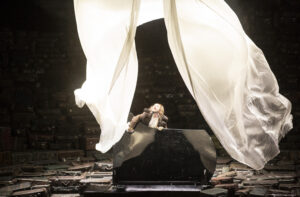
Herheim’s building blocks for this “Ring” consisted of juxtaposing the tetralogy’s gods and demigods with flocks of apparently East European refugees (possibly Bosnians, Kosovars or other Balkan Europeans, given the costumes they wore and the headscarves worn). The cluttered atmosphere continued with suitcases carried by the refugees as well as a mountain of other piled-up suitcases, a concert grand piano with its interior used as a passageway for characters to make their entrance and exit, and finally the score of the opera. The latter two devices were used as a humor-inducing instrument, which amused in “Das Rheingold,” then became tedious in “Die Walküre.” In this third installment, the Norwegian stage director’s attempts at base humor became unbearable, as they ran contrary to the opera’s very essence.
Mime the blacksmith is a musical instrument maker in this production; a collection of trombones, trumpets, French horns and tubas hang in his workshop. At least their bright golden color gave life to the drab, dark sets. The walls in this scene, as well as at the dragon’s lair and Brünnhilde’s rock were all made of dark suitcases. A simple rearrangement of the suitcases provided the change of scenery. This seems to suggest an IKEA or LEGO-inspired idea for a practical, economical and, most of all, gravely hideous visual. However, Herheim is neither Swede nor Dane, but Norwegian.
A novel idea that was somewhat interesting was to have the forest bird sung by a child (treble) soprano. Indeed, the child can serve as a symbol of innocence and hope. This may have worked had the proper choice been made, but alas, the boy in question had an unpleasant timbre and intonation issues.
Just before Siegfried confronts Fafner, two extras resembling Sieglinde and Siegmund, appear as angels with huge feathered white wings in the style of French painter William-Adolphe Bouguereau (1825-1905). Supposedly, the boy’s parents return as guardian angels, a novel type of incestuous and matricidal angels. Though Christian iconography does not mix well with Norse mythology, the idea is defendable, except that these two extras overstayed their welcome until the end of the act. Given their huge wings, they attracted more attention than either Siegfried or Fafner.
Often the most exciting scene of “Siegfried” is the confrontation between Siegfried and Fafner, now transformed into a dragon. This gives the director and his/her set designer the possibility of an imaginative portrayal of the dragon. Given Herheim’s propensity for humor, one expected a parody of the horror genre. Alas, the Norwegian director instead produced tedium in spades: two projections representing the creature’s eyes was the extent of his imagination. Yawning rather than fright was the predictable reaction. Herheim stayed faithful to his underwear fetish by having the dying Fafner fall off from inside a black costume in his white undergarments.
Further excruciating attempts at humor ensued: while Mime and Alberich squabbled, Fafner’s resuscitated cadaver and the child portraying the forest bird, now mysteriously in underwear, observe the bickering siblings with amusement.
The final act opens with Wotan awakening Erda to seek her advice. Annoyed with her answers, Herheim has Wotan strangle Erda to death, proving the director has at least read the libretto and has taken the text literally: “Hinab denn Erda! Urmütterfurcht! Ursorge! Hinab! Hinab! Zu ewigem Schlaf”(Return then, Erda! Mother of dread! World-sorrow! Return! Return to endless sleep!).
A favorite gimmick used by Herheim throughout this “Ring” is reducing the characters to their undergarments. In the case of the gods, it may be an indication of their humbling and/or a revelation of the truth or the uncovering of a subterfuge. However, the overuse of this disrobing became increasingly irritating. More the sign of a psychological ailment than a theatrical device, the undressing reached its pinnacle during the opera’s final scene: Brünnhilde’s awakening and the glorious Siegfried-Brünnhilde love duet. In this peculiar staging, the ubiquitous refugees gather to watch the pair. They are aroused into sexual frenzy by the love scene, with all concerned frantically disrobing and copulating in all variants of sexual flavor (man-woman, man-man, woman-woman, older man-young man and even boy, women cross dressing as male, and more). Siegfried and Brünnhilde’s love duet becomes an ode to sexual liberation–or more precisely, debauchery. While sex is a driving force and the culmination of love, to interpret this love duet in this fashion indicates a serious misunderstanding (and this is a generous euphemism).
On the surface, humor seems to be Herheim’s leitmotif, but in reality, it’s sex and violence. This is a bleak perspective, given that the monumental “Der Ring des Nibelungen” is already quite bleak. As in “Die Walküre,” the high quality of Donald Runnicles’ conducting as well as the singing of most of the singers is the public reward for enduring its length.
Cast Highlights
I first heard Clay Hilley as Florestan two seasons ago in Toronto. Despite the brevity of the role, Hilley made a huge impression with his stentorian dramatic tenor and his extensive tessitura. The American tenor’s voice is huge without being baritonal as is often the case with many Helden tenors. In the historic debut of Lise Davidsen as Isolde in Barcelona this past January, Hilley was her Tristan. Despite a flawed staging meant to make Isolde the only star of the show, Hilley gave the best performance of the evening. Like Tristan, the role of Siegfried demands stamina, and Hilley has it and then some. His bright timbre is most appropriate for the young hero.
Scottish bass-baritone Iain Paterson is one of today’s leading Wotans. As in Vienna’s Ring cycle last summer, he showed signs of vocal fatigue. However, he knows the role inside out and managed to give an impassioned and moving portrayal of the Wanderer. His compromised vocal was oddly appropriate for the diminished Wotan as Wanderer who has somewhat fallen from grace. He was especially effective in his third act scene with Siegfried.
An excellent Sieglinde in “Die Walküre,” Elisabeth Teige was less effective as Brünnhilde. While ideally suited for Sieglinde, Teige’s voice in the role of Brünnhilde had a metallic edge, indicating a voice pushed to its limits. Despite the catastrophic staging of the final scene, Teige acted her role with moving conviction. Surrounded by the fornicating hordes, she maintained her dignity and ignored them, though one felt Herheim’s intent was to create an interaction like Ariadne with the commedia dell’arte troupe in “Ariadne auf Naxos.” Other than a few looks of disbelief, she ignored the grotesque spectacle of debauchery. To wake up from years of deep sleep to this horror is indeed a harsh punishment.
Taiwanese tenor Ya-Chung Huang does not have the typical small voice of character tenors. His is a more hefty instrument that he adjusts to properly to portray the perfidious Mime, unctuous and sweet talking. His portrayal was even more on the spot than last summer in Bayreuth.
As in “Das Rheingold” a few days earlier, the American contralto Lauren Decker was an incandescent Erda. In this Berlin “Ring,” Decker’s warm contralto will be one of the voices that many will fondly remember.
American bass-baritone Michael Sumuel was a truly detestable Alberich, fidgety and anxious as he waited by Fafner’s cave. Sumuel’s voice was appropriately dry to convey his conniving malevolence.
After morphing into the role of Hunding in “Die Walküre” two days earlier, German bass Tobias Kehrer reverted to being Fafner, a role he portrayed at last summer’s Bayreuth Festival. Vocally impressive with his deep notes, his voice acquired a mellower hue than it had in “Das Rheingold.” Perhaps years of reflection in a cave would have that effect. One felt sorry for this Fafner as he took his final breath.
English conductor Donald Runnicles was the supreme star of this performance and Deutsche Oper’s Ring Cycle in general. This “Siegfried” was more high octane than either “Das Rheingold” or “Die Walküre.” He masterfully revealed the textures and colors of the score. Less brilliant was the first act’s sword-forging scene, where he was rather cautious (I suspect he looked at the action on stage and felt underwhelmed). Despite the unappealing visuals, he beautifully navigated a sensual love duet in the final act, where the Orchestra of the Deutsche Oper Berlin sounded truly glorious. The trick was to close one’s eyes and enjoy the sublime music making.