Deutsche Oper am Rhein 2025-26 Review: María de Buenos Aires
By Bernardo Gaitan(Photo: Andreas Etter)
In 1968, as Buenos Aires was going through a difficult political and social period, Astor Piazzolla and Horacio Ferrer brought to life a work destined to defy any clear definition: “María de Buenos Aires.” It is neither a lyric opera in the traditional sense nor a simple tango show; rather, as its own creators defined it, it is an operita tanguera, suspended between poetry, urban ritual, and metaphysical nightmare. Curiously, the work adopts the structure of a Baroque cantata, which is why it was originally conceived for its premiere, in May of that same year, as a “concert version,” that is, without any scenic staging. The plot is difficult to delimit, as it does not follow a linear narrative, but is instead articulated through singable poems and instrumental music, organized according to a dramatic thread. The unfortunate María is born “on a day when God was drunk” in a poor suburb of Buenos Aires and heads toward the city center, where, seduced by the music of tango, she becomes a prostitute. Sinful woman, specter, virgin, and harlot, María embodies Buenos Aires itself. From its origins, the work established itself as a singular artistic object of high intellectual ambition. Ferrer constructed a visionary libretto, imbued with raw and mystical imagery, while Piazzolla forged a score that fuses tango, jazz, and contemporary musical languages.
(Photo: Andreas Etter)
New Production Details
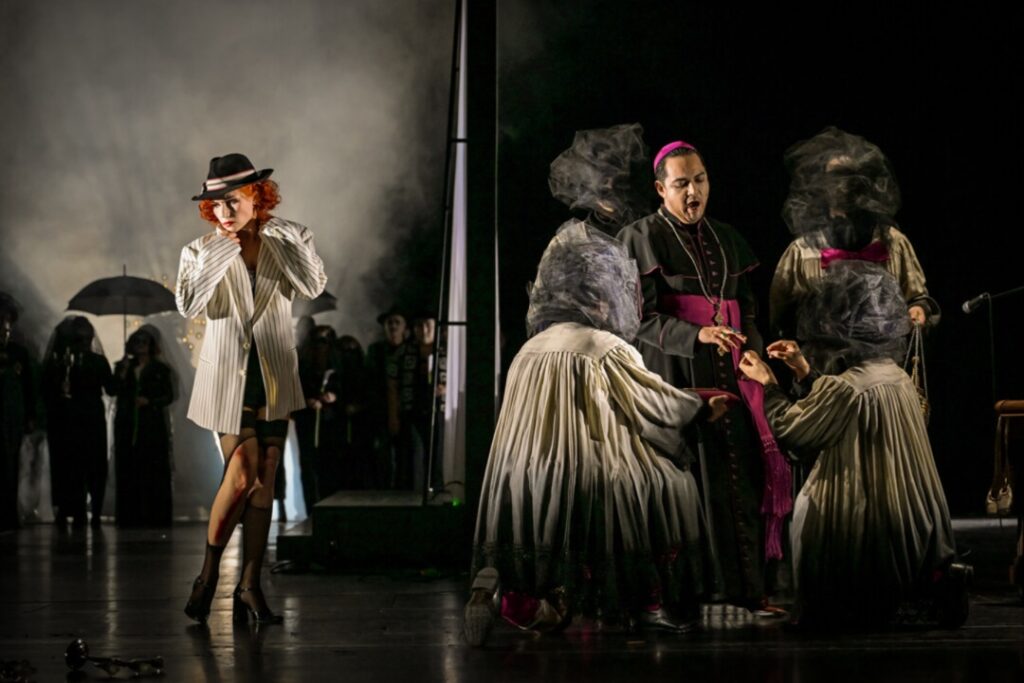
The ideal setting to appreciate a work of such conceptual density – where Regietheater is normalized, and even desired – is undoubtedly any major German city. For this reason, the decision by the Deutsche Oper am Rhein to create a new production of this singular title in Düsseldorf proves especially apt. At the helm of the creative concept was Johannes Erath, whose stage direction inhabits an oneiric territory in which life, death, and fantasy coexist without clearly defined borders. Erath understands María not merely as a character, but as a symbol, an idea, a martyred body that uses the Argentine capital as a mere pretext. He presents the protagonist as a fierce femme fatale, a strong-willed woman indifferent to others’ opinions, uninterested in approval, and locked in a conflicted relationship with authority. His concept – conceived in direct response to the physical, vocal, and artistic characteristics of the performers – functions effectively as a bespoke theatrical suit.
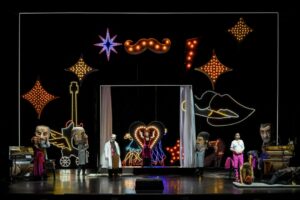
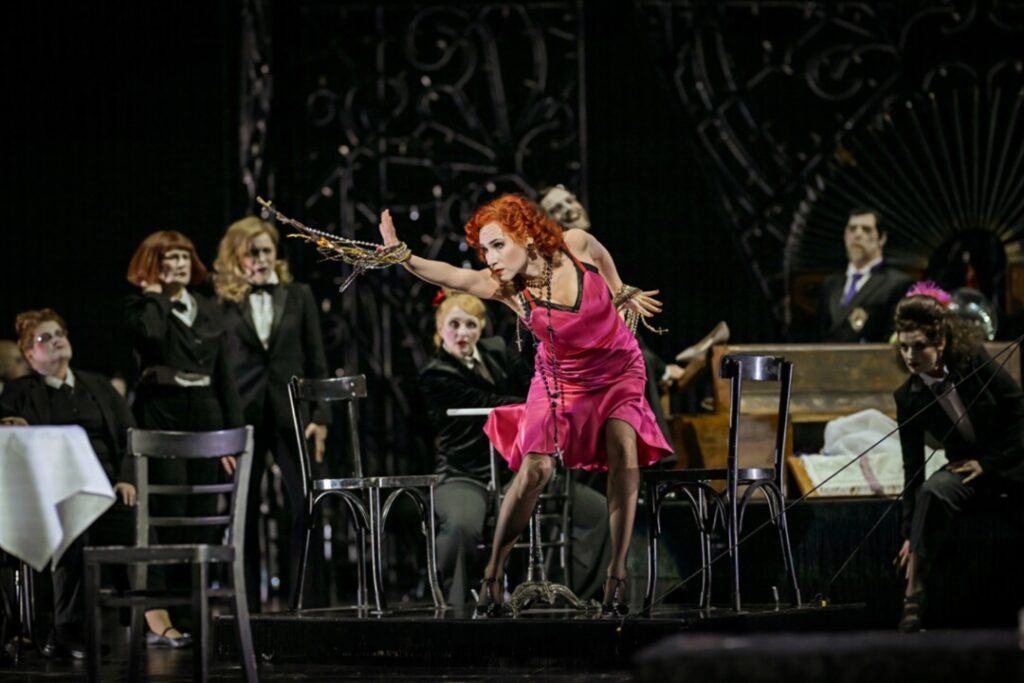
Katrin Connan’s set design proves functional thanks to a revolving stage that keeps the action in constant motion. Everything begins with a funeral inside a 1920s cabaret: tables laid for service, old upright pianos, and various props construct the ideal context for each scene. A large illuminated “M” made of drywall appears at center stage as the protagonist introduces herself with her famous song. In the antepenultimate scene, magically, nothing seems to correspond to anything else: everything is chaotic and incongruous, exactly like a dream. Neon LED lights shaped like mustaches, boots, dancers in motion, winged boots, and an endless array of elements flood the stage as the protagonists sing, dance, and recite: an authentic example of an oneiric theatrical proposal.
The costumes designed by Jorge Jara are inevitably linked to the collective imagery of the cabaret, with clear tango reminiscences. Worn and sensual garments, all in the same color, dress the three Marías (the protagonist, her shadow, and an alter ego). For the role of the Duende, however, Jara creates a playful blend of an extravagant gangster and a colorful dandy, featuring a Mexican-pink suit that contrasts sharply with the discreet costumes of the rest of the cast, dominated by dark tones that lend the elegance evoked by the music: tango. Bibi Abel’s video projections work in harmony with the physical sets, creating dynamic environments that, together with Nicol Hungsberg’s carefully crafted lighting, help materialize Erath’s concept, in which characters wander through a present shaped by surreal encounters.
Illuminating Music
Piazzolla’s concept of “nuevo tango” constitutes the true backbone of the work. From the pit, Mariano Chiacchiarini, leading the Düsseldorf Symphony Orchestra, proved an excellent choice for the musical direction of the piece. His performance stood out for well-measured tempi, an intelligent handling of tango cadences, and imaginative yet functional dynamic contrasts. Although all singers and actors were amplified, the Buenos Aires–born conductor constantly monitored the orchestral volume, accompanying the performers attentively and making them feel supported. Chiacchiarini amplified the fragmentary nature of the narrative with complete stylistic mastery, alternating moments of wrenching tango intensity with more animated passages and even Baroque music. An extraordinary idea that, far from feeling out of place, integrates naturally thanks to the stage director’s inclusion of choral excerpts from Bach’s St. Matthew Passion and Mass in B minor. The chorus of the Deutsche Oper am Rhein delivered these Baroque insertions with mastery, functioning as a unified voice under the direction of Albert Horne. The collective voices do not represent a neutral mass, but rather a judging and cruel community. Alongside María, as in all tango-based works, the other great protagonist of the operita is the bandoneon. Fortunately, in this production it was not replaced by accordion or concertina, as sometimes happens; instead, Argentine bandoneonist Carmela Delgado offered a restrained and discreet interpretation, at times almost reserved, yet always virtuosic.
(Photo: Andreas Etter)
Stellar Cast
The title role was performed by Maria Kataeva. The Russian singer offered a fully contemporary María: sensual, lascivious, and proud. Although she has not yet fully mastered Spanish prosody, particularly the Argentine accent she attempted to imitate, her pronunciation was nonetheless correct. She possessed a lively, fresh, fleshy, even earthy timbre, well projected throughout. Paradoxically, despite lending her name to the work, María is the character with the least vocal participation; however, these limited interventions are more than compensated by her intense stage presence. Her rendition of “Yo soy María de Buenos Aires” was powerful and overwhelming, and she further surprised the audience by sitting at a grand piano to perform, as a soloist, a transcription of the Adagio from Bach’s Oboe Concerto BWV 974, with an exquisitely refined attack and a commanding mastery of the instrument worthy of a concert pianist. The staging, clearly tailored to Kataeva, and particularly her pianistic intervention, recalls the bel canto tradition of the “trunk aria” as a moment of extravagant diva display; in this case, it works… and spectacularly so.
An enigmatic and fundamental figure is that of the Duende: a kind of goblin that acts as a narrator, poet, and demiurge who romanticizes María’s cruel life. Interpreted by Alejandro Guyot, a tango singer brought directly from Argentina for this production, it is difficult to imagine anyone more suitable for the role. His rough and deep voice possessed remarkable expressive quality; from his dark and unsettling timbre emerged pure poetry, marked by an unmistakable porteño accent that evoked the Pampas and mate. He is the one who pulled the narrative strings, dialogues with both the beyond and the present, and confronted the audience through prayer, recitation, and soliloquy.

(Photo: Andreas Etter)
The musical burden rests largely on the characters portrayed by Jorge Espino. He does not embody a single role; rather, his presence assumes multiple demands, comparable to that of the villains in “Les contes d’Hoffmann.” His various characters interact with María at every stage: they push her to extremes, seduce her, and play with her psyche; they pray with the Duende, becoming his accomplices, and even address the audience directly in the Analysts’ aria “Buenos Aires, saca tus sueños al sol.” The Mexican baritone boasts a solid instrument, a healthy and robust voice, an indisputably strong middle register, and assured histrionic skills. As payador, priest, criminal, psychoanalyst more psychopath than doctor, and many other figures, he transforms himself and gives each role a distinct identity.
María’s Shadow, sung by British soprano Morenike Fadayomi, delivered consistently musical singing, attentive to dynamic nuance and intentional phrasing. Visible onstage after María’s murder, the Shadow is not a mere double but a transfigured figure, an ethereal alter ego who, in addition to singing Piazzolla and Bach’s “Erbarme dich” with accuracy, also has spoken passages. Her porteño accent is not entirely polished, but dwelling on that would be nitpicking; overall, her performance is more than solid.
Choreography is a fundamental element in this project, as tango cannot be conceived statically. Argentine choreographer Agostina Tarchini designed the movements for herself as well as for Mariano Agustín Messad and Andrés Sautel; together, the three delivered a very strong performance. One of the most successful moments of the production occurs when they dance a Bach cantata using tango movements.
The Düsseldorf premiere of “María” was a resounding success. Ten minutes of ovations for the cast and creative team at the end of the premiere confirmed its impact. Thirteen performances are scheduled; the opening night referenced in this review was recorded and will be available for free online streaming for six months starting March 15 at www.operavision.eu.