Death of Classical & Prototype Festival 2026 Review: Tiergarten
By Jennifer E. Pyron(Photo: Kevin Condon)
Death of Classical (DOC), in partnership with PROTOTYPE Festival, presented “Tiergarten” on January 16, 2026, at Cullen Hall, behind St. Paul’s Church on Carroll Street in Brooklyn, New York. This one-night-only, very intimate, cabaret performance featured historical landscapes of music, movement, politics, ideologies, and, most importantly, unabashed entertainment.
Founder of DOC, Andrew Ousley, conceived, wrote, and directed the event. This dream-come-to-life was made possible with the support of his brilliant creative team and performers that left audience members stunned. “Tiergarten” plucked at listeners’ heartstrings and struck many controversial chords along the way – intentionally, intelligently, and as humanly as possible.
(Photo: Kevin Condon)
Weimar Berlin
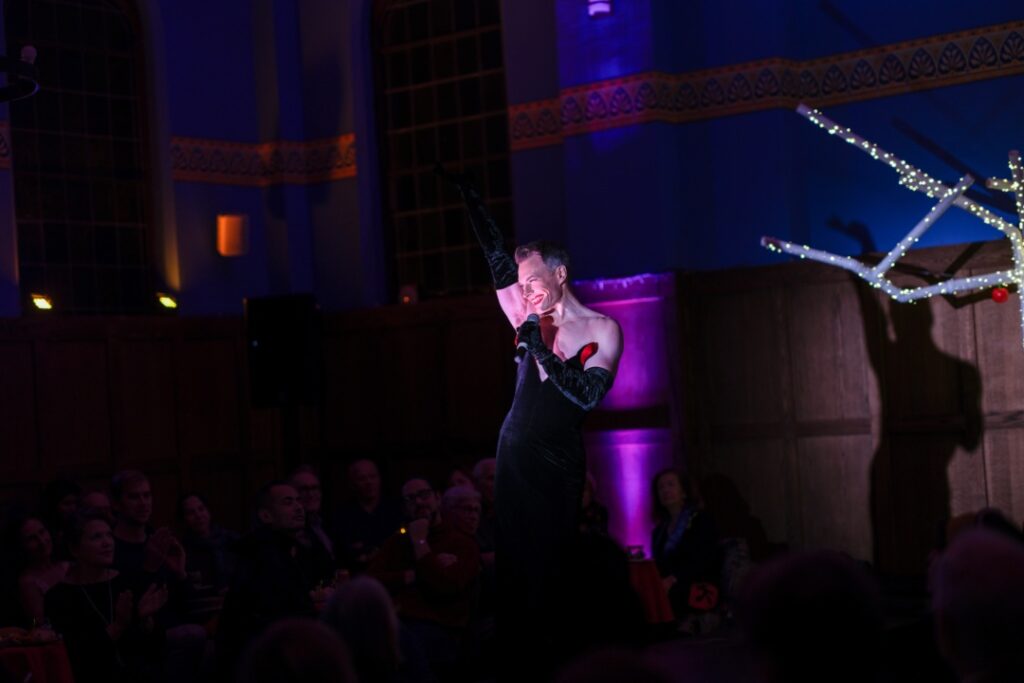
Master of Ceremonies Kim David Smith appeared from the back of the church hall’s gathering space with a radiant spotlight shining on his Weimar Republic-era black velvet gown with red scrolled details. He performed Richard Hartley’s “Time Warp” from “Rocky Horror Picture Show” with The Company, which included singers Amara Granderson, Ariadne Greif, and Miguel Ángel Vàsquez. The audience was enthralled with their presentation and Smith’s ability to simultaneously sing while interacting with the audience. He made this night immersive.
Smith addressed the purpose for this evening’s “Tiergarten,” especially during this particular moment in history, and artfully made light out of the very dark importance of revisiting previous moments in history when empires have fallen. He performed Mischa Spoliansky’s “I’m a Vamp” (“Ich bin ein Vamp”) and segued into Kurt Weill’s “Pirate Jenny” (“Seeräuber-Jenny“) with a live performance by the endlessly talented duo Rosalind Lilly and Gaby FeBland of Foreshadow Puppetry. According to their website’s description about this specific work, Foreshadow Puppetry said, “We were commissioned by Death of Classical to create a Kurt Weill-inspired shadow play for Carnegie Hall’s Weimar Festival. We adapted Weill and Brecht’s “Pirate Jenny” from Threepenny Opera, reimagining Jenny as a Rosa Luxemburg-esque revolutionary exacting revenge on the streets of Weimar-era Berlin.”
Their storytelling explored the layers of “Pirate Jenny” while capturing the imagination of everyone in the room. No one looked away – everyone was wide-eyed with wonder. Their precision and tempo while working together was unmatched and I highly recommend seeing this duo perform live.
Smith performed Friedrich Hollaender’s “Ruins of Berlin” shortly after, while the audience sat on the edge of their seats for “the aftermath, and what comes after that.”
American Revolution
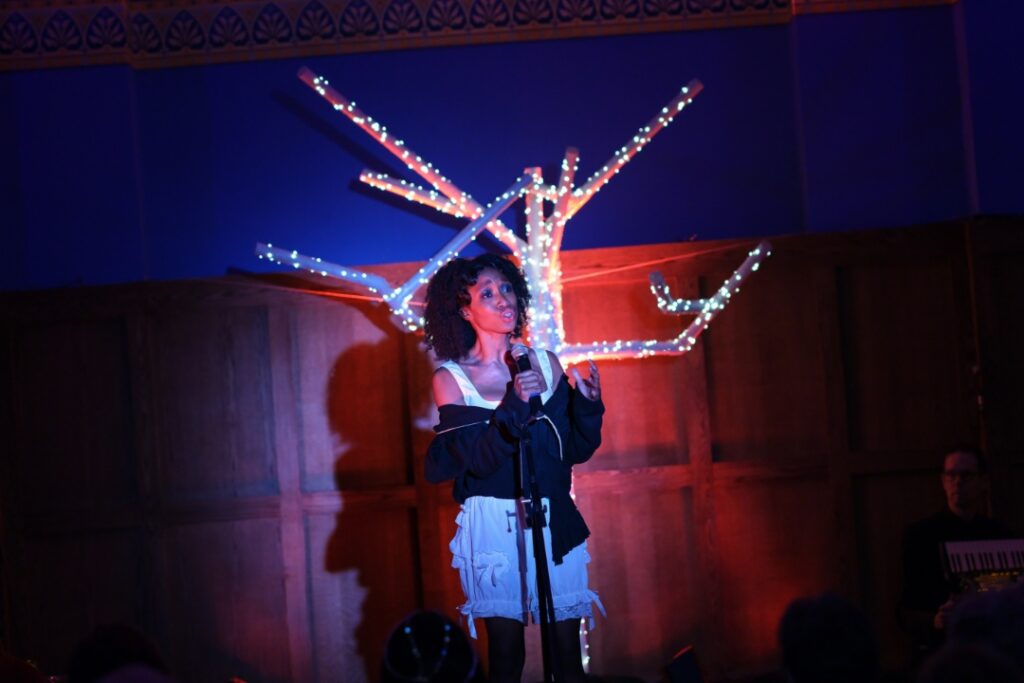
Weill’s “Alabama Song” kicked off the third portion of the evening with Smith and The Company in full swing celebrating “The Land of Opportunity and Whiskey.” Baritone Miguel Ángel Vásquez performed John Dickinson’s “The Liberty Song” with excellent vocal technique and a crowd roaring positive reaction. The momentum of the night continued to build, especially when Granderson sang Abel Meerpol’s “Strange Fruit.” Her voice resonated into the hall with warmth and exactness as she delivered one of the most monumental works in history, recording and exposing the reality of racism and lynching in America. Granderson’s performance was legendary.
(Photo: Kevin Condon)
Protestant Reformation
The instrumentalists of the night included Mila Henry (piano), Tracy Stark (piano), David Silliman (percussion), and Will Holshouser (accordion). William Byrd’s “Mass for Four Voices (piano/accordion arr.) Agnus Dei” was a beautiful respite. Audience members relaxed a bit more in their seats and enjoyed the piano solo that blanketed them in sound.
The Salem Witch Trials
Smith performed “Witchcraft” (1957) by songwriters Cy Coleman and Carolyn Leigh. Made popular by Sinatra, this was an entertaining pick-me-up moment where Smith really played up the cabaret aesthetic in full. His vocal range and ability to transition between singing and speaking was effortless and cool. “Who doesn’t love a good witch hunt?” he said in a coy voice.
Soprano Ariadne Greif and dancer Liana Zhen-ai performed Azucena’s song “Stride la vampa” from Verdi’s “Il Trovatore.” The duo portrayed the moment a woman recalled her mother being burned at the stake. Greif’s voice floated into the hall and Zhen-ai’s movements synthesized perfectly. I am always amazed at Zhen-ai’s adaptability in her performances when interpreting any style of music. Whether it be classical or contemporary, her keen sense of awareness for tone and delivery is spot on. Zhen-ai dropped her body to the floor at the base of the illuminated tree at the back of the stage for a dramatic ending.
Fall of the Roman Empire
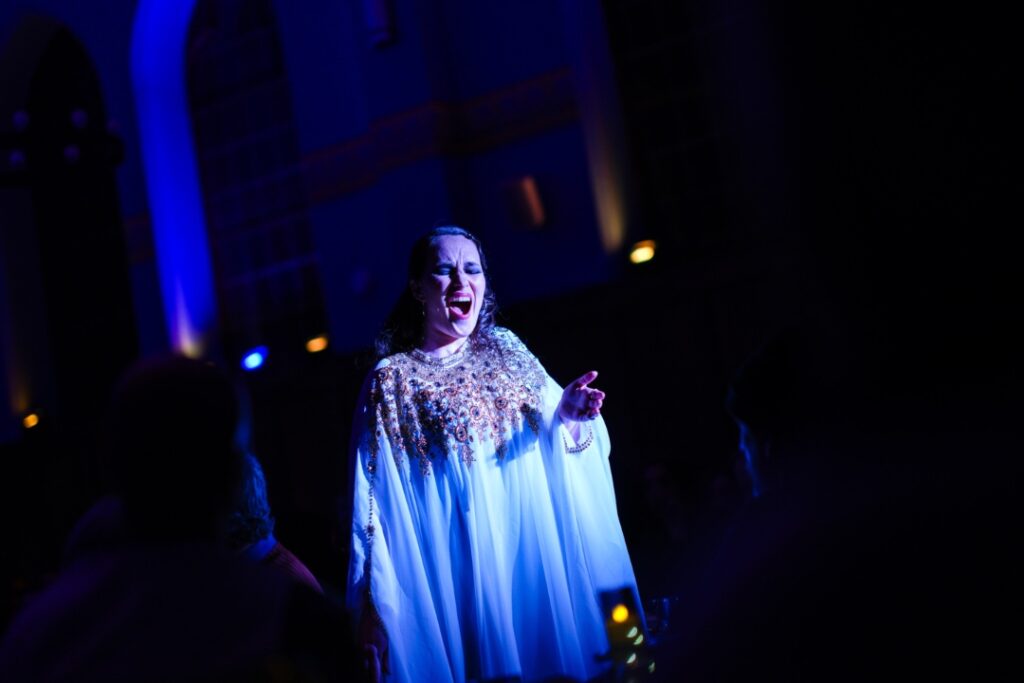
Weill’s “The Death of Caesar” (“Ballade von Cäsars Tod”) opened the sixth movement of this packed program. Smith pulled back the veil on the “lessons we learned from the Ides of March.” The gut-wrenching part of this moment came when Greif sang Handel’s “Piangerò la sorte mia.” Her voice fully opened up and blossomed in ways I had not yet experienced from her. She allowed her full range to be present and leaned into the musical dynamics and emotions of this work. There was an audience member nearby who was so emotionally moved that they openly wept. This moment embodied the vitality and purpose of Ousley’s vision. This is why “Tiergarten” was produced right now: for us to be as together, to feel as together, as is humanly possible in the midst of authoritarianism and its inevitable collapse.
(Photo: Kevin Condon)
33 AD and the Story of Adam and Eve
Granderson gave her second stunning performance of the night as she sang the spiritual “Were You There (When They Crucified My Lord).” This moment came to life as Pearls Daily, an iconic burlesque performer, dressed in a full-bodied sheer flowing white cape and brown beard, came onstage and twirled behind Granderson in “Jesus Christ Superstar” fashion. Daily concluded her whirling with a slow reveal of her red glittered tassels underneath the cape, exposing how the thrill of “True Faith can withstand any mockery.” She leaned up against the LED-lit tree with her arms outstretched before slowly making her way offstage, leaving the audience jaw-dropped along the way.

(Photo: Kevin Condon)
Dinah Washington and Max Richter’s “This Bitter Earth/On the Nature of Daylight” features American singer and pianist Washington’s iconic voice. She was known as the “Queen of the Blues” and is a vital part of the evolution of music, especially jazz. Dancers Zhen-ai and Dylan M. Contreras interpreted this song with breathtaking movements that, through art, showed the complexities of being human. Zhen-ai and Contreras’ performance, which resonated beyond space and time, was my favorite moment of the night.
Finale
Smith and The Company brought this monumental night to a close with Weill’s “Lost in the Stars” and George Gershwin’s “Love is Here to Stay.” This experience would not have been possible without the performers and those behind the scenes, including but not limited to Abigail Hoke-Brady (lighting designer), Everyday Fay (costume designer), Everyday Fay and Cherry Le (makeup designers), Jutta Weiss (coiffure), Yi-Ching Sung (program designer) and the production team, Carrie Boyd, Shelby Marquardt, Grace Griffin, and Roni Polsgrove. Special thanks also goes to Saint Paul’s Carroll Street, Father William Ogburn, The Greenwood Cemetery, Harry Weill and Derya Mergin, and Manhattan Beer Distributors, Peter Hagen, and Bouchaine Vineyards.