CD Review: Ottorino Respighi’s ‘Maria Egiziaca’
By Bob Dieschburg
Historiography operates through superlatives. All too easily, it compresses organic development into the quasi-religious advent of the monstre sacré. This antiquarianism of sorts keeps a particularly tight grip on the development of Italian opera: There’s Monteverdi at one end, Puccini at the other—no ante, no post. But what about Ottorino Respighi, born some twenty years after the composer of “La Bohème” and “Tosca?”
His symphonic idiom hardly fits the operatic mold, and the orchestration of Respighi’s “Fountains” (1916) and “Pines of Rome” (1924) remains discernible throughout his stage works. The continuous music in “Belfagor” (1923), for instance, represents a perfect example of symphonic eclecticism, akin perhaps to Straussian musical architecture.
This diversification peaks in “Maria Egiziaca” (1932), an opera-turned-oratorio conceived as a medieval-style triptych. Based on thirteenth-century hagiography, it recounts the transformation of the Alexandrian prostitute Mary into a penitent and a saint.
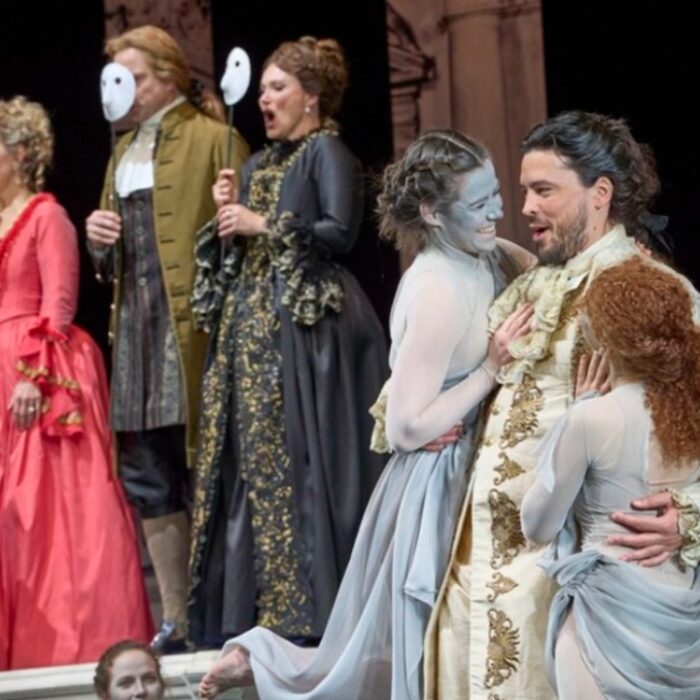
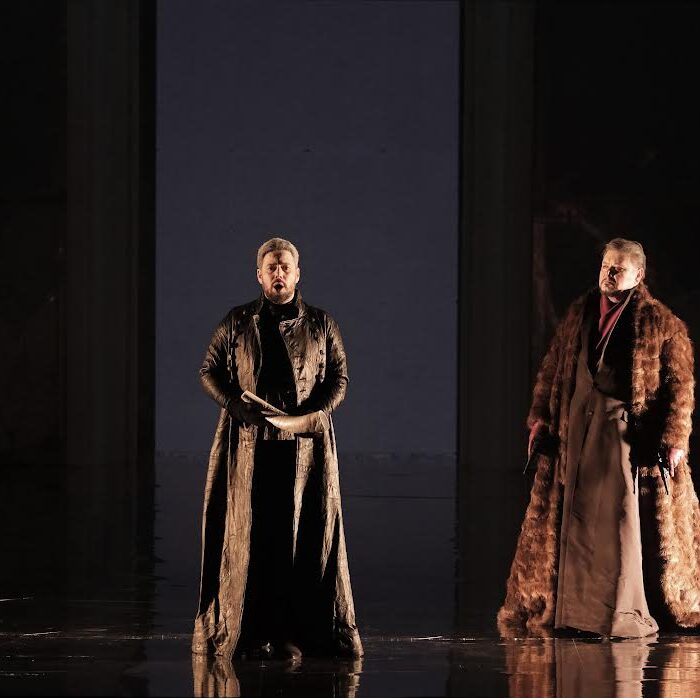
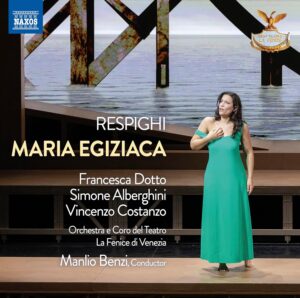
Discographic traces of the work are scarce. The benchmark remains a 1989 Hungaroton release, while Bongiovanni offers a somewhat mitigated live performance from 1980. It is high time, then, for a rediscovery, and Naxos attempts one with its publication of the 2024 run of “Maria Egiziaca” recorded at Venice’s Teatro Malibran (a DVD version is available as well).
Significantly, Olin Downes reviewed the U.S. premiere of “Maria Egiziaca” at Carnegie Hall, and much of his criticism from almost a century ago still holds: after multiple listens, for instance, I share his complaint about the “undue length of the score” (particularly when compared to Puccini’s “Suor Angelica”)—though Respighi’s revivalist style may no longer, in good conscience, be qualified “exterior, rather than atmospheric.” The finale, for one—with its quiet, suspended radiance—is highly dignified and appropriate to the work’s vocation as a mystery play.
Yet at its premiere, the NYT also noted that “Maria Egiziaca” was not “well adapted for a production in a concert hall;” to this I would add that it is even less suited for renditions on CD. For despite its orchestral sophistication, the work loses its visual, iconographic component, which Respighi and his librettist—Guastalla—relied on heavily.
What remains are archetypal characters who lack psychological agency beyond the didactic trajectory of Mary’s conversion from sinner to saint: The Pilgrim in the first episode acts like a mirror, forcing Mary to confront her own corruption. Abbot Zosimo is the spiritual elder, whereas the sailor, as temptor, represents the physical desires of the mundane world. The Blind Woman’s infirmity, by contrast, corresponds to inner sight.
The singers, then, do not exactly operate in a conventional operatic framework, even if the vocal requirements can be quite onerous. The title role, for instance, demands lyrical expanse and dramatic edge. As Saint Mary, Francesca Dotto delivers both, and her familiarity with the lirico-spinto parts of the Novecento certainly shows in her ability to sculpt the line. She crucially manages to capture the development of Maria from one tableau to the next, but receives little help from either Manlio Benzi–at the pulpit–or the rest of the cast.
Simone Alberghini (as the Pilgrim and Zosimo) puts his vibrato-heavy baritone to parsimonious effect. In the third act especially, his implied role as spiritual guide remains rather flat. Vincenzo Costanzo (as the Sailor and Leper), along with his tenor peers Michele Galbiati (as the First Companion) and Luigi Morassi (as the Second Companion and the Poor Man), boasts lavishly colored instruments in the vein of verismo-style performers.
Yet interpretively, their roles are constrained by relative unidimensionality, which–despite Respighi’s sophisticated orchestration–is not fully overcome musically. Benzi conducts the musicians from the Orchestra del Teatro La Fenice with great care, but the temperature remains a bit placid. Conversely, the finale is superb, though it requires the listener to navigate the thickets of an opaque–or, as the booklet has it, “enigmatic”–score that does not ultimately benefit from a somewhat tedious performance overall.