CD Review: EuroArts’ ‘Lucia di Lammermoor’
By Bob Dieschburg
“I want to fly with the music; we have to swim inside the music,” said Michele Mariotti in 2017, when Lisette Oropesa appeared in a rehearsal video for the Royal Opera House’s “Lucia di Lammermoor.”
Fast forward to 2026, and she still sings the “Mad Scene” with unequivocal ease; her voice soars to vertiginous heights before collapsing into the depths of an unusually resonant chest register. She is a Lucia for the ages, despite the slightly limp surroundings of the recent EuroArts release (produced by the San Francisco Classical Recording Company).
It is the hallmark of the “acting voice” to convey psychology through sound alone, without recourse to stage action. Walter Legge coined the phrase with singers such as Tito Gobbi and Maria Callas in mind. Yet the same could be said of Oropesa: the Bride of Lammermoor fits her vocal profile like a glove.
There is, for instance, a distinctive moribundity to her timbre, ideally suited to chart the necrotic progression of Lucia’s inwardness. In “Regnava nel silenzio,” the portrayal is suffused with chiaroscuro: phrases tend to emerge veiled at their onset, almost breath-inflected, while the coloratura (note the fleeting vibrato) carries an uncanny sense of fragility—if not outright premonition.
The integration of Lucia’s gradual dissociation—predictably—culminates in Oropesa’s performance of the “Mad Scene.” Her suspended tones in the first major cantabile (“Il dolce suono”) are superb, as is her timbral convergence with the obbligato flute.
In “Spargi d’amaro pianto,” she deploys a full arsenal of bel canto bravura, thinning the tone to an evanescent thread whenever the line demands it, particularly in the cadenzas. The result is a near-flawless musical arc, topped by a resonant—and unusually extended—high E-flat.
Admirers (myself included) of her Mozart recital will recognize the same degree of interpretive finesse here as in “Ombra compagna.” Shadow—to extend the metaphor—is her constant companion.
Ștefan Pop delivers a sympathetic Edgardo. While his singing is launched with evident verve, his Act three “Tombe degli avi miei” remains commendably free of vocal machismo. Pop shapes the line with delicate mezza voce, even if it never quite attains the suppleness of a true bel canto specialist.
Similarly, his expression throughout the opera remains somewhat achromatic, and his otherwise pleasant timbre turns slightly flat under pressure. This is still a solid and—by all means—serviceable interpretation, though one that inhabits the role a touch too monolithically for my taste.
Mattia Olivieri as Enrico brings a villainous snarl, particularly in the Wolf’s Crag scene. One might wish for greater emphasis on legato—which, by contrast, Riccardo Zanellato’s solemn, if slightly rugged, bass provides plenty of. Despite its relative economy of means, his “Ah! cedi! cedi!” strikes a fine balance between Raimondo’s ingenuity and his unspoken moral complicity in Lucia’s doom. Zanellato—so to speak—paints in broad brushstrokes.
At the helm of the Orchestra del Teatro Massimo Bellini, Fabrizio Maria Carminati conducts with restraint. He resists spectacle and favors an unpretentious, even candid approach which is occasionally undermined by the CD’s relatively shallow sound (at least on my vintage setup). The orchestra, for instance, lacks presence compared to the far greater immediacy with which the voices are captured.
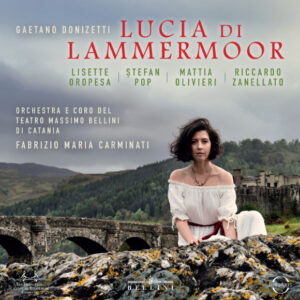
Finally, it is no secret that this production’s raison d’être centers on Oropesa. The cover art all but confirms it. She immortalizes her signature role in an ensemble that falls short of ideal, yet remains competitive in a crowded discography.
If nothing else, her “Mad Scene” may well prove anthological.