CD Review: Anthony Clark Evans’ ‘Signore! Signori! Scusatemi’
By Bob Dieschburg
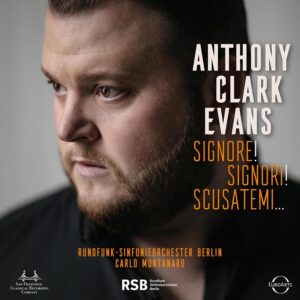
Leoncavallo’s “Signore! Signori! Scusatemi” may well be the most famous captatio benevolentiae in all of opera. A grand theatrical gesture, it also serves as the title of Anthony Clark Evans’ debut recital for EuroArts.
By all appearances, one might expect a veristic—or at least Italo-Romantic—show of force. “Pagliacci” is indeed followed by arias from Giordano and Puccini; yet it does not stop there. The album goes on to navigate an arguably oversized repertoire, offering a somewhat imperfect cross-section of the American baritone’s capabilities.
“Pagliacci” is certainly a long way from Wagner’s “Tannhäuser,” and so are Thomas’s “Hamlet” (“Ô vin, dissipe la tristesse”) and the diamond aria from “Les Contes d’Hoffmann.” Add some Donizetti (“Roberto Devereux”) and mid-period Verdi… and you have a cornucopia of 19th-century operas as cluttered—if I may—as Baron Ochs’ family tree.
Accordingly, not every rendition proves equally successful. In “Scintille, diamant,” for instance, Evans’ firmness sits uneasily with the lilting waltz idiom. It diminishes the quasi-languorous elasticity with which Dapertutto conjures both the brilliance and the latent danger of the jewel.
Similarly, the buoyancy of “Ô vin, dissipe la tristesse” does not entirely align with the forward placement of Evans’ tone. A brindisi-type number, it alternates percussive inflections with declarative passages and broader legato expansion. While—technically—Evans remains irreproachable, his interpretation is shaped a bit conservatively: uninclined, in short, toward theatrical poise.
Wagner, however, is a different story. “Wie Todesahnung… O du, mein holder Abendstern” is wonderfully grave; the diction is spot on, as Wolfram’s self-denial—and the premonition of Elisabeth’s death—are rendered in a gloriously spun mezzo piano.
The French arias feel rushed—even though conductor Carlo Montanaro’s tempi are comfortably average: perhaps a tad rigid, but broadly supportive of Evans’s voice. In Wagner, the latter demonstrates significantly greater aplomb.
His “Tannhäuser” is purposeful, and in “The Flying Dutchman” he drives the narrative of “Die Frist ist um” with full rhetorical command. The portrayal carries an appropriate degree of weariness, the cursed captain seeming almost literally to suffer through his signature monologue. The opening line sets the tone: it is neither heroic nor entirely resigned. Rather, Evans synthesizes the character’s tragic bitterness through a firmly chiseled declamatory style.
As for the Italian repertory, I was surprised not to find “La Traviata’s” Germont—praised in the booklet as central to Evans’ career. Instead, there is Luna’s “Il balen del suo sorriso,” sung with fine legato but little chromatic nuance. One misses the Italianate snarl in both “Il trovatore” and “Andrea Chénier,” though the top pitch—while not overly radiant—rings freely.
For the most part, however, the cantilena lines remain in a kind of grey area, lacking—perhaps—the definition that greater vocal malleability might provide. Compared with his interpretations of the Wagner arias, Evans’ Verdi remains strikingly monochromatic. And while one appreciates the inclusion of ariosi and orchestral preludes, I very much regretted the absence of “Il balen’s” cabaletta (“Non può nemmeno un Dio”).
In “Forse in quel cor sensibile,” Evans preserves all of Donizetti’s bel canto lyricism. His Duke of Nottingham projects firmly, and in this, vaguely recalls the vocal aesthetic of Albert Schagidullin (unforgettable alongside Edita Gruberová on DG).
Finally, “Nulla! Silenzio!” benefits from the half-declamatory grimness of the Wagner selections, allowing Anthony Clark Evans to draw on the solidity of his lower and middle registers. These convey authority and suffering with confidence—the hallmarks of Evans’ vocal profile when it shines at its most persuasive.