Buxton International Festival 2026 Review: La Liberazione di Ruggiero
Eloise Lally Turns Magic into a Tense Psycho-Drama
By Alan Neilson(Photo: Genevieve Girling)
Francesca Caccini holds a special place in the annals of the history of opera: she was the first woman ever to write a complete opera. It is thought that she may have written five in all, but like many operas of the period, they have all been lost, apart from her work “La Liberazione di Ruggiero dell’isola d’Alcina,” which is now considered to be the oldest surviving opera by a female composer.
The work, commissioned by the Archduchess Maria Maddalena of Austria to celebrate the visit of the Crown Prince Wladyslaw of Poland, premiered at the Villa Poggio in Florence in 1625, using indoor and outdoor spaces, after which it received a further staging in 1628 at the royal residence in Warsaw, which marked the first performance of an Italian opera outside Italy. It then fell into oblivion for over 350 years, only being revived in 1998 at the Teatro Metastasio in Prato, since which time it has received occasional performances, although usually at festivals dedicated to baroque music or rarely performed works, and thus remains on the margins of the repertoire. It has been defined as a “commedia in musica,” thanks to its magic, pastoral setting and happy ending, although one should not expect fun and laughter! Caccini and Ferdinando Saracinelli, the librettist, however, actually referred to the work as “balletto in musica” owing to the inclusion of courtly dances and its concluding horse ballet, which was actually a virtuoso equestrian display by skilled riders on horseback.
As was the norm at the time, “La Liberazione di Ruggiero” was commissioned for a private gathering to celebrate and show off their wealth and status to their invited guests. The lavish scenery, special effects, fabulous singing and dancing, and fantastical costumes were designed to entertain and, more importantly, to impress. Saracinelli’s libretto, based on an incident from Ariostos’s poem “Orlando Furioso,” was thus constructed to incorporate breathtaking spectacle. Singing and dancing alone would not have sufficed! He thus focused on a battle between good and evil, in which two sorceresses, the evil witch, Alcina, and the good witch, Melissa, confront each other. The Christian knight, Ruggiero, has been seduced by Alcina, who has used her magic to hold him captive on her island and to make him forget about his lover Bradamante. Melissa is sent to the island to free him, which she does. Alcina’s dark powers proved to be no match, and she is forced to flee on the back of her fire-breathing dragon. In a further final act of kindness, Melissa then liberates Alcina’s ex-lovers, whom she had turned into the plants, trees and animals that now inhabit the island.
Lally’s Imaginative Reinterpretation
It would have been a surprise indeed if the Buxton International Festival’s presentation, which was performed on the small stage of the Pavilion Theatre, managed to put on a similar show with flying dragons and magical transformations, let alone the concluding scene with its dancing horses.
Wisely, the director, Eloise Lally, along with the stage designer, Zahra Mansouri, made the decision to reinterpret the narrative so that the magical physical transformations, Alcina’s pet dragon, and the horse ballet were not part of the show, which they did by turning the drama into an emotionally strong and atmospherically tense piece of theatre, set sometime in the near future. The prologue opened with sea god Nettuno in full military uniform among other people in battle fatigues, which immediately set the tenor for the production. This was a militarized, dystopic world on the brink of environmental collapse. Alcina’s island became the arena in which the forces of change and “reinvention” fought against “those who wished to uphold the existing systems of power.” In her program notes, Lally outlined her vision for the piece, in which she sought to question “who has the right to shape the future.” Unfortunately, it was a reading and presentation that proved to be overly ambitious. Only occasionally was the question clearly addressed. For the most part, not enough physical symbols or pointers were used to flesh out possible answers. Lally’s program notes were essential in directing the attention of the audience. Nevertheless, it was far from a failure!
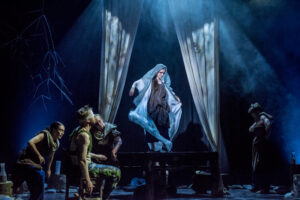
Mansouri, for the most part, relied on a single set consisting of a small wooden platform on which Ruggiero was tied to a chair, or used by Alcina to assert her dominance. The rest of the stage was a desolate space with a few dead branches and lifeless boulders strewn across its floor – which were the only direct reference to the environmental problems – and a couple of dirty, hanging curtains. It was a gloomy place, which Alex Musgrave’s expert lighting designs exacerbated. Bright, narrowly focused spots shone directly down through the darkness, highlighting the blindfolded Ruggiero, who clearly was not fully under Alcina’s spell. He was here under duress and would not have needed Melissa’s magic potion to make him resist Alcina’s charms. It was a joyless place, full of pain and despair. It was certainly no pleasuredome!
The piece became an intense psychological drama, in which Lally convincingly ramped up the tensions and emotional distress. The choreographed movements for Alcina’s three minions, Nunzia, Sirena and her Young Servant, were cleverly designed: acting in unison, they circled and taunted Ruggiero, closing in on his space, intensifying the pressure and further intensifying the heavy, threatening atmosphere that hung over the stage. Rarely was the tension allowed to subside.
The arrival of Melissa and her group did not come across as unambiguous welcome relief, although Ruggiero, no doubt, was delighted. Rather, it conjured up images of a rescue undertaken by a military junta in S. America in the 1970s of a prisoner held by a group of freedom fighters, which was illustrated by the their respective costumes. Alcina and her followers wore a mix of loose-fitting, informal, usually shabby clothes, while Melissa and her group were attired in military or severe formal clothing. The idea was pressed home in the final scene when Melissa took possession of the island at gun point following Alcina’s rapid escape. She was no savior. Ruggiero was no handsome dupe. They were enforcing their ownership and vision of the world.
Strong Musical Presentation Overseen by Darbourne
If directorial program notes proved an essential addition to accessing the dramatic interpretation of the work, the absence of such notes relating to the music meant that it was not possible to know the degree to which Jonathan Darbourne, its musical director, was involved in creating the edition for this performance. It would have been a pleasure to credit him with doing such a fine job if he were responsible.
Owing to the small size of the theater, the orchestra spilled out into both sides of the auditorium, which was no bad thing at all in that it created interesting and satisfying harmonic effects with the sackbuts on the left side, the strings and keyboard slightly to the right of the stage with the wind instruments placed at a slightly greater distance. The sprawl did not inhibit the balance between stage and pit, which was precisely regulated throughout the performance. The orchestral ensemble, consisting of 14 musicians, produced a sensitive, refined, well-paced reading that Darbourne used to bring out the melodic beauty that threads its way through the opera. For the most part, the music was neatly rendered to support the atmospheric staging, although on occasions, and especially during the musical interludes, there was a lively, vibrant, rhythmic radiance that distracted from the overall dramatic ambience.
Alcina & Ruggiero Dominate the Stage
The two dominant characters, Ruggiero and Alcina, were both given compelling performances, and their confrontation in scene three of the opera was certainly the work’s high point, both musically and dramatically. Yet, they were very different characters, not just as personalities, but also in the way the singers decided to approach the roles vocally.
The baritone Jon Stainsby was an emotionally strong Ruggiero, who used the expressive intensity and resonance of his voice to transform Ruggiero from a fairly passive prisoner, who appeared relatively content to remain blindfolded, tied up and taunted, to a focused soldier, committed to the cause. His voice was firm, confident and clear as he brushed aside Alcina’s protestations and rising fury, presenting himself as a man of conviction who has returned to a ‘just’ cause. It was a fine performance from Stainsby, which will be recalled for both the timbral beauty of his voice and the expressive force that he brought to his singing.
Mezzo-soprano Camilla Seale was certainly a feisty Alcina, but rather than allowing her emotions free range to gush forth in a frenzied vocal assault, she provided a sensitively controlled presentation, using an ambitious range of embellishments, vocal colorings and neatly placed inflections, underpinned by her admirable technique to create a contrasting perspective of the confrontation, one that showed Alcina in a less negative light and opened up the possibility that she was not necessarily the dark force in the conflict.
As the performance moved forward, it started to become clearer that Melissa, the supposedly good sorceress, was not necessarily a benign entity. Mezzo-soprano Phoebe Rayner, who was cast in the role, sang with subtlety and beauty, but something did not quite fit. She was fairly passive, emotionally cold and vocally tended toward understatement. It was not a particularly persuasive reading, at least until it became clear that she was a military figure, engaged in the job of releasing Ruggiero and conquering the island, whereupon it became a cleverly constructed interpretation!
Baritone Filippo Turkheimer produced a suitably authoritative reading in the role of Nettuno. His voice possesses a pleasing timbre, and his singing was expressive, although his ornamentations were a little rough around the edges. However, it worked to his favor by promoting Nettuno as a coarse military man.
The three women in secondary roles, Sirena, Nunzia and Alcina’s Young Servant, were all given convincing performances, especially in scenes in which they were required to operate as a group, for which they produced sensitive, beautiful and harmonically rich singing.
Soprano Betty Makharinsky imposed herself on the role of Sirena with a confident, clearly defined reading. Although only a relatively small part, it provides the singer with the chance to show off her voice in what is probably the opera’s most attractive piece, the “Siren’s Aria.” Makharinsky did not let the opportunity pass, and although Ruggiero might not have fallen for her charms, her refined, elegant rendition delighted the audience.
Soprano Harriet Burns is definitely a talent worth watching. She possesses a strong, colorful and well-balanced voice, which she showed off to fine effect in the role of Nunzia, in which her ability to bring variety and contrast to her vocal interpretation in order to elevate her characterization impressed.
Mezzo-soprano Aina Miyagi Magnell made a pleasing contribution in her role as Alcina’s maid servant, in which her tonal beauty and attractive phrasing caught the attention.
Tenor Tom Kelly was cast as the low-profile figures Astolfo and the Shepherd, for which he gave committed, pleasing and well-balanced interpretations.
Dramatically, this production by the Vache Baroque Ensemble for the Buxton International Festival was hugely enjoyable. For sure, it was not staged as a magical opera but reimagined as a psycho-drama, in which its dark and light forces were reversed. It was in many ways an ambitious interpretation, yet a very convincing one, despite needing explicit notes from the director to successfully access its meaning, which is never an ideal situation. On the musical side, Darbourne oversaw an engaging interpretation that sparkled, eliciting excellent performances from both the orchestra and singers.