Buxton International Festival 2026 Review: Amadigi
Olivia Fuchs & Erin Hyland Combine to Create an Amusing Yet Musically Strong Production
By Alan Neilson(Photo: Genevieve Girling)
Händel’s magic operas, with their complicated love plots, sorceresses, gods, monsters and magical transformations set in an era of chivalric sensitivities, alongside a rigid musical structure of recitatives separated by arias that hold up the narrative, can be a nightmare for directors. Yet in the right hands, they become visually exciting and dramatically engaging spectacles, and Olivia Fuchs‘ imaginative, fun production of “Amadigi” for the Buxton International Festival certainly hit the mark.
On the surface, it really does not sound like the most gripping of narratives. The sorceress, Melissa, has imprisoned Amadigi, Dardano and Oriana on her island. She is in love with Amadigi, but he has eyes only for Oriana, who reciprocates his feelings. However, Dardano also has designs on Oriana. The scene is now set for a love contest. In fact, it sounds very similar to the reality TV game show “Love Island.” And this is how Fuchs decided to present the opera, with ‘Love Island’ transformed into “Melissa’s Island,” with all the incidents repackaged and presented as competitive games. Everything became a performative exercise, at least in the first part of the evening, in which the characters deliberately played up their roles by exaggerating their emotions for the TV cameras. Yes, there were TV cameras; after all, this was a TV set!
Love Island Becomes Melissa’s Island
The curtain rose on a bright stage colored with pinks, reds and blues, designed by Eleanor Bull; even the palm tree was pink. In the center of the stage was a large heart through which each of the characters entered and descended down a few steps, where they were met by Melissa, microphone in hand, ready for a short interview. The two male contestants were dressed in bright, loose clothing, typical of holidaymakers ready for the beach, while Oriana decided on a pink evening dress. Camera men and lighting assistants were also present to make sure everything was captured on film. The scenery quickly morphed into a sugary beach setting with sunloungers, a paddling pool, and a giant pink flamingo. Once the contestants had drunk a few beers and had established their relationships, the games began. The participants joined enthusiastically in games such as “Cross the threshold.” In one contest, Amadigi and Dardano had to jump around the stage in an attempt to catch a red heart, which was significantly won by Amadigi. Another had Amadigi release Oriana from a ‘cage,’ which was actually an old-fashioned, white, hooped frame for a dress.
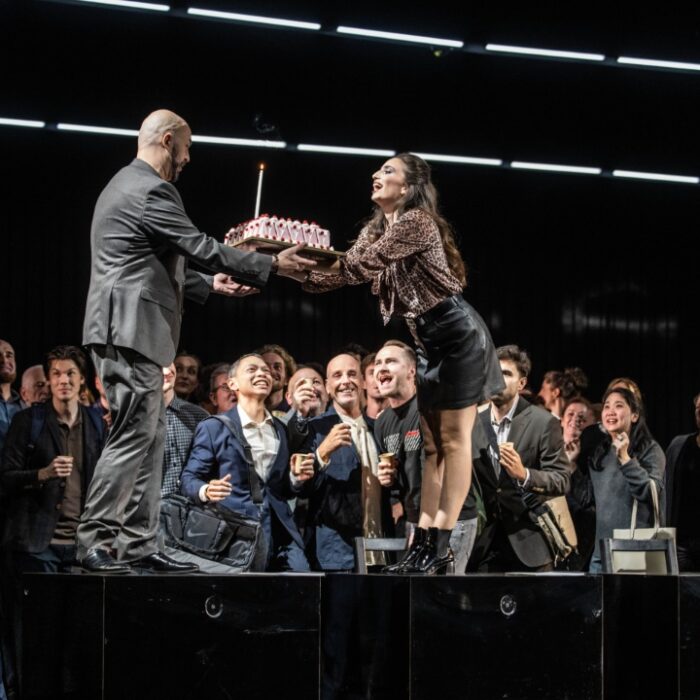
After the interval, the drama moved behind the scenes, and things took a murderous turn as the tensions between Amadigi and Dardano exploded into a fight, in which Dardano was killed. Initially, the set was a mix of the typical props that can be found backstage but this was subtly altered to resemble a torture chamber as Melissa tied Amadigi and Oriana to chairs and used the equipment on the makeup table, such as hair tongs and lipstick, to torture them. It was presented as a comic episode, despite Melissa’s raging. Amadigi and Oriana, however, were both prepared to die to save each other, causing an angry Melissa to admit defeat. She tears off her wig, high heels and smart suit and storms off the set. In one final twist, instead of Orgando descending from the skies in a chariot to bless the happy couple, he appears as the program producer, after which the cast join together to sing a final celebratory chorus.
Fuchs’ reading was certainly popular with the audience who were laughing out loud at the onstage shenanigans. However, she was also careful to develop four clearly defined characters.
Four Strong Performances
Countertenor Tim Morgan was a last-minute stand-in for Jake Ingbar in the role of Amadigi and, under the circumstances, made a fine impression. Morgan possessed a consistent, homogeneous, lyrically appealing voice with a beautiful timbre. His phrasing was graceful and subtle, and he was able to spin out long, smooth lines to delight the ear, all of which reflected the general good nature and decent character of Amadigi. Certainly, he stood in sharp contrast to his competitor, the vain, aggressive and plotting Dardano. His recitatives and each of his arias were presented beautifully and were particularly successful when he waxed lyrically on his love for Oriana. When a more aggressive approach was required, however, specifically in his conflicts with Dardano and Melissa, he was less successful. The arias were still delivered with an elegant beauty, but their strong negative emotions were rarely expressed with any conviction. He was too conservative in his approach; he never pushed the voice with aggression, indulged in complex embellishments, or coated the voice with sufficient feeling. Only occasionally did he leave his comfort zone. It was also notable in his duet, “Crudel, tu non farai” with Melissa, in which her passion and fiery temper easily overwhelmed Morgan’s tepid protestations of love for Oriana.
Soprano Rowan Pierce, with her big, blond hair, high heels and long eyelashes, looked the part as Oriana, the woman who had Amadigi and Dardano fighting over her. The role presented her with a series of arias of varying emotions, ranging from love and joy, to grief, to anger and defiance, of which she took full opportunity to show off her interpretative skills. Her opening aria, “Gioie, venite in sen,” beautifully captured her joy at meeting Amadigi again, which allowed her to illustrate her pleasing ornamentations, attractive lyricism and the flexibility of her voice, while the aria “S’estinto è l’idol mio” displayed very different emotions as she grieved for Amadigi, whom she believed to be dead. It was the aria “Ti pentirai, crudel,” however, in which she staggered around the stage drunk, raging at Amadigi’s accusations that she has been unfaithful, that caught the attention. Her passionate response brilliantly showed off her vocal flexibility with an expressive reading replete with dynamic contrasts, complex embellishments, leaps, carefully placed inflections and emotional colors. Her recitatives were well-considered; they were emotional, animated, clearly articulated, and centered on their meaning.
Soprano Hilary Cronin impressed with her excellent characterization of the sorceress-cum-TV show hostess Melissa, whose main motivation was to ensnare Amadigi as her new lover. She was obsessive, aggressive, ruthless and demanding and not averse to a little torture along the way. Cronin, however, never took the role too seriously and turned Melissa into quasi-comic character, in which even the torture scene was a bit of fun. Yet, her underlying emotions were real enough, and when she raged, she really was angry, and when she stormed off the stage towards the end of the opera, she really was hurting. It was a well-constructed, layered reading, which she supported with an equally strong vocal interpretation. Her recitatives were full of emotion and expertly delivered. There was the occasional hard edge to her singing that was revealed when she pushed her voice towards its limits, which actually reinforced the impression of Melissa as a hard and vicious character. The presentation of her arias was tightly focused to bring out their full meaning, and it also displayed her fine technique to good effect, no more so than in the rage aria “Desterò dall’empia Dite,” in which, following Amadigi’s rejection, she gave voice to her feelings in an explosive rendition full of rapid passages of coloratura, ornate embellishments and dynamic contrasts that conjured up an emotional whirlwind.
Countertenor James Hall produced a headstrong, impulsive and passionate interpretation as Amadigi’s friend, Dardano. He was no shrinking violet; he was on Melissa’s island for a good time and to win, no matter the consequences. His delivery of his recitatives was carefully aligned to the text; they were energetic, emotionally strong and focused on promoting the drama, while his arias proved to be some of the high points of the evening. In his opening aria, “Pugnerò contro del fato,” in which he decided to plot agianst Amadigi for Oriana’s attentions, one could hear the conflict and urgency in his voice as he attempted to reconcile his friendship and jealousy for Amadigi along with his determination to succeed, which he built upon in his aria “Agitato il cor mi sento” with an explosive rendition that further captured his jealousy and desperation. And his final aria, “Pena tiranna io sento al core,” with its long aching lines, which he sensitively adorned with subtle ornamentations and short, haunting passages of coloratura, was beautifully crafted to promote the deep suffering he felt on losing the battle with Amadigi for Oriana.
The musical director Erin Hyland elicited a clear, balanced and vibrant reading from The English Concert that successfully managed to capture the spirit of the onstage performance: it was emotionally strong when necessary but allowed a light expressiveness to infuse the music; one did not feel dictated to; rather, it encouraged listeners to engage on their own terms.
Together, Fuchs and Hyland combined to create the perfect festival production.