Buxton International Festival 2025 Review: The Impresario
Mozart’s ‘Comedy with Music’ Successfully Updated by Christopher Gillett
By Alan Neilson(Photo: Genevieve Girling)
In 1786, Mozart broke off from composing “La Nozze di Figaro” to pen a short ‘comedy with music,’ called “Der Schauspieldirektor,” for Emperor Joseph II at the Schönbrunn Palace in Vienna. Consisting of a mere five musical numbers connected by a copious amount of spoken text that pokes fun at the behavior of singers and the theatrical conventions of the time, it barely amounts to what many people would consider to be an opera. Performances can run anywhere between 30 minutes and an hour plus, depending on how much of the text is deleted. Usually, it is presented as part of a double bill, normally with Salieri’s one-act opera, “Prima la musica e poi le parole,” with which it was paired at its premiere.
Gilllett’s Imaginative Rewriting of the Text
This year’s Buxton International Festival decided to present four performances under the English translation of its title, “The Impresario.” This was not done simply to signify that the presentation was mostly in English but that it was, to a significant extent, a different work that ran for 90 minutes. Not only did the director, Christopher Gillett, rewrite the spoken text, rename some of the spoken roles, and add and delete others, but it was also decided to incorporate a number of musical numbers taken from Mozart’s other operas.
They were decisions that made complete sense, as they furnished the work with a larger musical component, while the spoken dialogue was successfully reconstructed to reflect today’s values, behavior, and theatrical practices from which the comedy sprang. And at 90 minutes, it could just about be justified as a freestanding work without the need for a companion piece. Moreover, and most importantly, it became a fast-moving, light-hearted romp containing some of Mozart’s best-known music, which kept the audience thoroughly entertained.
The narrative is centered on Frank, an impresario, and his assistant, the tenor Buff, who are preparing to put on an opera. They, therefore, audition two sopranos and end up employing both of them, who, of course, immediately start squabbling about who is the better singer, who should be classed as the prima donna, and how much each should be paid. Eventually, an agreement is reached as they put their differences behind them in order to serve the higher ideals of their art form.
It is a work that can easily be turned into a meta-theatrical production, and this is exactly what Gillett’s imaginative rewriting of the spoken text achieved by turning it into an opera within an opera. In fact, he took every opportunity to play with the idea of the concept. The role of the impresario, Leo (who is Frank in the original libretto), played by Robert McCabe, is deliberately confused by having him also play the role of the director for the opera within, the one the cast is preparing to stage and in which he takes part, although he is not the director for the production of “The Impresario;” that role was carried out by Gillett. This was further complicated by having Associate Director Joyce Henderson cast as Lisa, the associate director within the opera. Unsurprisingly, this led to absurd exchanges between the director, Leo, and associate director, Lisa, in which he is costumed in 18th century dress and discussing aspects of the rehearsal with Lisa, dressed in contemporary clothes, who sat in a chair watching and commenting. If that were not enough, the cast also stepped out of character to join in conversations unrelated to the original narrative. At one point, during a break in rehearsal while the characters playing Mademoiselle Silberklang and Monsieur Vogelsang were engaged in a little flirting, another director appeared and commented on how they were meant to be playing the scene. He was supposed to be the director for the overall performance, which included Lisa, the associate director, as nothing more than a cast member, thereby creating a further level of theatre. If it all sounds very complicated, in practice, it was actually easy to follow and was wonderfully entertaining.
Nor was the comedy restricted to this one theme. There were plenty of other ridiculous hijinks and silliness at which to laugh, such as one of the sopranos turning up at her audition with her leg in a brace and hobbling around the stage, and jokes about Dutch pancakes, called poffertjes – a result of the production originally being created for Opera Zuid.
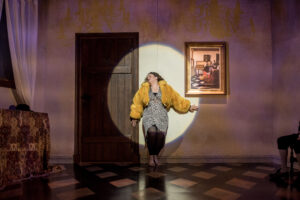
The production’s Dutch origins were also represented in the scenery, designed by Bretta Gerecke, which consisted, for the most part, of a room straight out of a Vermeer painting, including the black and white floor and a Vermeer painting on the wall. Just before the interval, the scenery rotated to display a backstage view, in which the cast could relax and where Vogelsang and Silberklang engaged in their flirting. Having already been interrupted by a director, the scene was again interrupted, this time by a stagehand with headphones and a clipboard, who told the audience that it was time for the interval.
The costumes, designed by Leo van den Boorn, were colorful, typical, traditional 18th century designs, with the occasional oddity thrown in, like a modern leg brace. Characters not associated with the meta-theatrical conceit, such as the associate director and stagehand, were dressed in expected everyday wear.
Dame Jane Glover, conducting the Buxton International Festival Orchestra, produced an elegant, bright and lively reading of “Der Schauspieldirektor” and the introduced pieces, such as the trio from “Cosi Fan Tutte,” “Soave sia il vento,” and the aria “Non piú andrai” from “Le Nozze di Figaro.”
A Committed Cast Captures the Comedy
The dominant role of the Impresario, which was essentially a spoken role, was expertly essayed by McCabe, whose comic timing, clear and articulate speech, and ability to move in and out of character as he related to the other characters within the actual drama, vented frustrations to the audience, and chatted to the associate director about his concerns, were first-rate.
His assistant, Buff, was given an energetic and sympathetic reading by the baritone Dan D’Souza, whose warm, honeyed timbre and lyrically strong voice impressed. He rolled comfortably with the comic goings-on and successfully showed off his own comedic skills.
Soprano Nazan Fikret played Madam Herz as a Romanian with a limited English vocabulary, opening up further opportunities for fun. There was, however, nothing light-hearted or frivolous about her singing; she possesses a beautiful, versatile and expressive voice that is well-balanced and secure, with a strong upper register, which allowed her to show off her attractive and confident coloratura.
The young and relatively inexperienced soprano Jane Burnell made an excellent impression at last year’s Wexford Festival playing the comedic role of Molly Allgood in its production of “Lady Gregory in America.” As Mademoiselle Silberklang, she once again showed off her skill in creating a comedic character that often had the audience laughing along. Her singing oozed energy and positivity, which she harnessed to create a beautiful, lively yet sensitive vocal interpretation, underpinned by her attractive tone and lyrically engaging phrasing.
Tenor Conor Prendiville has a convincing stage presence that allows him to bring even minor characters to the fore. His clearly defined, easy-going, amiable characterization of Monsieur Vogelsang was neatly crafted, which he combined with an expressive, confident and attractive vocal interpretation.
Baritone Owain Rowlands and soprano Jessica Hopkins played the roles of two singers who turn up for an audition with Leo. They were deliberately presented as wholesome, young Germans, dressed in traditional costumes, and gave a fresh, playful rendition of the duet “Pa, pa, pa” from “Die Zauberflöte” that charmed the audience.
Tenor Jamie MacDougall, playing the role of a wunderkind director, entertained the audience with his ideas for a new production of “Die Zauberflöte,” in which he wishes to explore the ideas of empire that underpin the story. To the disgust of Leo, the empire he refers to is the Galactic Empire from “Star Wars.”
Lisa, played by Joyce Henderson, joined in the fun with a serious interpretation of the associate director.
Overall, there was nothing at all to dislike about the production; you could simply sit back and enjoy the fun and beautiful music.