Buxton International Festival 2025 Review: ‘Hamlet’
Gregory Feldmann Stars In The Title Role
By Alan Neilson(Photo: Genevieve Girling)
The main opera presentation at this summer’s Buxton International Festival was Ambroise Thomas’ 1868 composition, “Hamlet,” to a libretto by Michel Carré and Jules Barbier. Although initially successful, it eventually faded from the international stage as the popularity of French grand opera declined; its last Parisian performance took place in 1938. In 1978, however, a staging in San Diego revived its fortunes, and it has since reappeared on the stages of the world’s major companies. However, to say it has become a staple or even a popular work of the repertoire would be an overstatement: performances are still a fairly rare event. The Festival’s production was thus a welcome opportunity for audiences to assess the work for themselves.
What came across very strongly was the inconsistency of the work. Certainly, there are a number of dramatically strong scenes – the Act Three confrontation between Hamlet and his mother, Gertrude, was particularly powerful – and the music, in parts, is emotionally and atmospherically compelling – notably Ophélie’s mad scene, Hamlet’s famous soliloquy ‘To be or not to be,’ and the appearances of the King’s ghost. Yet all too often one’s attention drifted. The libretto was not sufficiently taut. Often the dramatic momentum dragged as the scenes played out against music that did little to capture the audience’s attention. Some scenes felt stretched, at times to the point of tedium, with climaxes needlessly delayed. As the performance lasted over three hours, it had the space for a few surgical cuts that would have undoubtedly sharpened the drama. Certainly, there is a work of high quality contained within and waiting to be liberated.
Furness’ Staging is a Partial Success
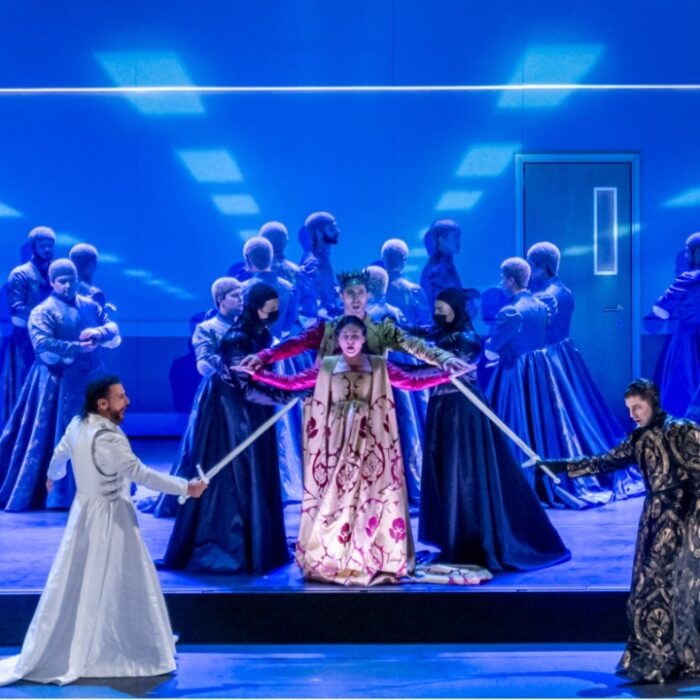
The staging, directed by Jack Furness, with sets and costumes designed by Sami Fendall and lighting designs by Jake Wiltshire, was equally inconsistent, often highlighting the weaknesses of the work. On the positive side, Furness’ handling of the interactions between the characters was finely attuned to the dramatic thrust and nuances of the narrative, and his development of the characters was clearly and sensitively managed. However, he was unable to deal successfully with the languors that pervaded certain parts of the drama. Too often, he opted for a fairly static presentation, in which those characters not directly involved in a scene stood fairly motionless and thus magnified the flaws of the libretto. In one particularly irritating scene, in which Hamlet and Ophélie declared their love for each other, he decided to have them making love so that Ophélie’s embellishments simulated the joyful groans of their coupling. It became rather silly and acted completely against the drama.
As is all too common in staging a tragic opera these days, the sets were overwhelmingly black with a white light highlighting the pertinent characters. There were few props, which of course were black; after all, black equals negativity and tragedy! It also happens to be very unimaginative, and when the drama is traipsing through one of its more inactive scenes, it does nothing to invigorate the mood. Of course, this is not to say that overall the sets were unsuccessful. They certainly generated the necessary gloomy and conspiratorial atmosphere that hung over the drama, and they were neatly constructed to define the context of each scene while giving sufficient space for the characters to operate. It was just the lack of contrast that dulled the effect at times when the drama needed a little help. In fact, the one instance in which a little color was injected into the staging felt like a breath of fresh air blowing through the theater. It occurred just before Ophélie’s suicide, in which the stage was set up to resemble a well-ordered cornfield with the women’s chorus singing, and acted as a strong contrast to her mad scene that was about to unfold.
With the exception of Ophélie, the costumes were contemporary designs in which Hamlet wore casual clothes, while most of the other characters wore formal attire, which was particularly apparent in the case of the chorus, as it gave them a regimented look, underlining Claudius’ authoritarian system of government. During the overture, the populace was rebelling against his rule, even as he was being crowned king.
A Standout Performance from Feldmann as Hamlet
The role of Hamlet was played by baritone Gregory Feldmann. Earlier this summer, he produced a fine performance in the role of Demetrius in Britten’s “A Midsummer Night’s Dream” at the Blackwater Valley Opera Festival. In it he showed off his lyrically appealing and expressively convincing voice. The role of Hamlet, however, is on an altogether larger scale, requiring a different level of emotional depth, stamina, and vocal expressivity. Feldmann rose to the occasion with a powerful yet nuanced interpretation that caught Hamlet’s swirling and deeply troubled emotional state, in which his vocal clarity and sensitivity to characterization impressed. Each aria was beautifully and convincingly fashioned, while his Act Two scene with the actors showed off his splendid acting skills to good effect as he played the fool, seethed with anger, and feigned madness. And in his opening monologue to Act Three, he produced a compelling, sensitive rendition of the famous introspective passage ‘To be or not to be,’ in which he revealed a calm, philosophical side to his nature.
Surprisingly, the bass, Alastair Miles, got off to an uncertain start in his role as Claudius. His voice appeared insecure as he struggled to hold the line, and his vibrato was far too wide for many tastes. However, he quickly rectified the situation, putting in an expressively compelling performance in which he successfully crafted a portrait of the usurper as an unscrupulous and emotionally unstable character, often in need of reassurance.
Mezzo-soprano Allison Cook expertly presented Gertrude as a deeply conflicted character, struggling to balance the love for her son and his need for vengeance with her complicity in the murder of her husband. Cook possesses a colorful, flexible voice, which she used intelligently to express the intensity of her feelings. That she actually managed to create a character that drew both disgust and sympathy from the audience was a testament to her ability in creating complex, meaningful characters.
Soprano Yewon Han appeared to be ideal for the part of Ophélie. Her light, bright, and versatile voice with its scintillating upper register, underpinned by an excellent technique, was perfectly suited to the requirements of the role, including the demanding mad scene that leads up to her suicide, while her petite physique gave the impression of fragility and vulnerability that added to her presentation as emotionally delicate. The first section of her aria ‘Sa main depuis hier n’a pas touché ma main!,’ in which she voices her fears that Hamlet’s love for her is fading, was sensitively rendered. Her singing was gentle, detailed, and emotionally strong, and she spun out delicate, beautiful lines that highlighted her fears. It was her Act Four mad scene that stood out. In what was a vocal tour de force, Han showed off her fabulous technique as she danced nimbly across the line, taking in audacious leaps and brilliant, complex passages of coloratura, moving easily into the upper register and punching out the top notes without any signs of stress. However, it came across as emotionally distant; she appeared to be seeking big effects rather than focusing on Ophélie’s emotional breakdown. Certainly, it was a vocal display of the highest order, which in itself was pleasing to witness, but it did not convince dramatically.
Ophélie’s brother, Laërte, was played by tenor Joshua Baxter. He characterized the part well, transitioning convincingly from loyal friend to enemy of Hamlet. He sang with an air of confidence, in which his pleasing timbre, neat phrasing, and secure technique appealed.
Bass Per Bach Nissen’s appearances as the ghost of King Hamlet were always brilliantly executed. His shadowy figure emerged from out of the mist, high up at the rear of the stage, with a bright light shining from behind, dispersed by the mist, which meant his face could not be seen, while his deep voice coated with a hollow, eerie sound carried across the stage, before he disappeared back from whence he came.
Baritone John Ieuan Jones and tenor James Liu produced appropriately amusing portraits of the First Gravedigger and Second Gravedigger, respectively.
The two small roles of Marcellus and Horatio, who are the first to see King Hamlet’s ghost, were given lively, convincing performances by tenor Tamsanqa Tylor Lamani and baritone Dan D’Souza.
The Buxton Festival Chorus produced a vibrant and dramatically engaging performance.
Conductor Adrian Kelly elicited a clearly defined performance from the Buxton International Festival Orchestra, which successfully captured the atmospheric textures of the score and made the most of the melodies, even when, on occasions, they were not particularly strong. He was particularly attentive to the musical balance, both within the pit and between the stage and pit.
Overall, it was a production that brought the strengths and weaknesses of the work to the fore. The best scenes are truly excellent, and some of Thomas’ music is dramatically, emotionally, and atmospherically strong, but ultimately one left the theater slightly frustrated by the inconsistency of the piece.