Boston Lyric Opera 2025-26 Review: The Song of Earth
By João Marcos Copertino(Photo: Nile Hawver/Nile Scott Studios)
On the surface, this production of “Das Lied von der Erde” as a drama is an interesting idea. Mahler wrote no operas, but “The Song of the Earth” is the closest one gets. Schoenberg’s arrangement is also a hidden gem that fits the inauguration of Boston Lyric Opera’s new music hall perfectly (a small but promising auditorium in the cool and desolate area of the Seaport in Boston). Yet the show felt like a spectacle of missed opportunities and a display of a certain kind of philistinism that is characteristically Bostonian.
First things first: people will correct me if I am mistaken, but I always thought that Schoenberg shared the credit for his arrangement with Rainer Riehn. Riehn’s name, however, is nowhere to be found in the program notes. If there is a version of the arrangement that is “pure Schoenberg,” I will try to correct this here.
Let’s begin with the good things: Boston Lyric Opera (BLO) is the only opera company surviving in the city. Their work is crucial, and they seem in many ways to understand that. They promote real community engagement, they seek to understand their place in the city, and they are aware of their position outside of Boston’s Brahmin institutions (that is, the Boston Symphony, the Museum of Fine Arts, and more recently, the Boston Ballet).
My problem is that when it comes to artistic excellence, the company simply does not deliver. And that is a pity because, in many ways, in a country where opera companies often tend toward more traditional stagings, BLO does take risks. They brought Calixto Bieito’s “Carmen” before the Met even dared to mention the Spanish enfant terrible’s name. They staged a “Butterfly” focused on the internment camps of the Second World War. And, in one of their more successful ventures, they produced a Vivaldi pastiche (“The Seasons”) with an interesting text by Sarah Ruhl.
Yet, most of the time, the conceptualization is interesting, the casting heterodox, and the performance is poor. This “Song of the Earth” did not escape that rule.
BLO, of course, is not the first company that has aimed to dramatize Mahler’s works. Recall Maurice Béjart’s excellent choreography for “Songs of a Wayfarer.” Or even Romeo Castellucci’s version of the “Resurrection” symphony.
Boston Lyric Opera invited Anne Bogart, a former Columbia professor and experienced stage director, for the task. Whatever her qualifications, I have yet to see a lyrical staging of hers that is actually good. BLO’s insistence on continuing to invite her to stage productions is, to me, astonishing (she will direct “Le Nozze di Figaro” next season).
It is not that the staging’s idea is bad; it is just that it tries too much and achieves little. Bogart designates the tenor part as “The Poet” and the mezzo as “The Lover;” then she introduces a third wheel: a spoken character called “the Mother.” They inhabit the same stage but technically do not see each other. The plot, if there is one, might be this: a drunk poet, a woman who finds his poetry, and a mother who has just lost her son and tries to deal with grief (an evident reference to Mahler’s deceased infant daughter).
Bogart’s textual interventions were, to me, either redundant to the proposed dramaturgy or disruptive to the acoustic delight that the evening could have provided. The Mother, for example, often speaks over the orchestral introductions, eliminating any possibility of musical sublimity. Do you remember that amazing oboe solo at the beginning of “Der Einsame im Herbst?” Now it becomes a soundtrack for the Mother’s words: “The house is steeped in moonlight and sleep. No sound from beyond the wall. I am safe.” The very worst moment of the night, however, was when I had to hear “The Lover” giggling between the final (and here almost staccato) iterations of “ewig” at the end of the symphony. Bogart seems to have so much contempt for music on its own that I simply do not understand her approach.
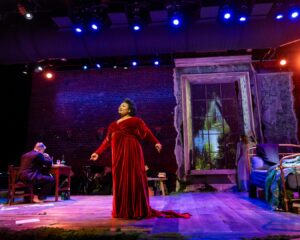
It is exciting to enter a new performance space in Boston. The new room is small, and the AC is louder than it should be. But it has great potential for chamber works. The set design by Sara Brown ranks among the best that BLO has ever produced.
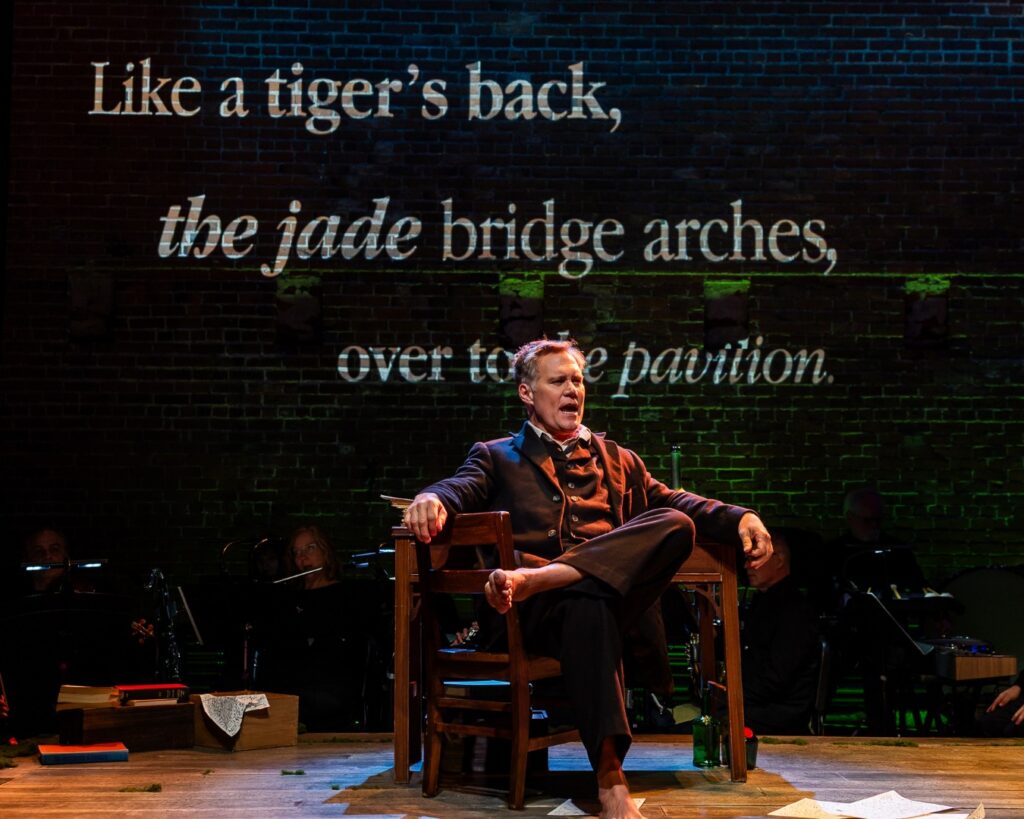
Credit: Nile Scott Studios
The performances were somewhat off. David Angus seems to be a genuinely nice person, but he is certainly subpar when it comes to conducting Mahler. It strikes me that he is able, impressively, to create coherence with a group of musicians who evidently do not rehearse together as much as they should. His musical readings, however, are never emotionally compelling. Otherwise sublime moments were imprecisely rushed (especially in “Der Abschied”), while the drinking song sometimes seemed too slow for its own good. There were some fairly energetic moments in “Der Trunkene im Frühling,” and that was about it. The ensemble was particularly unappealing: there was no coherence and too many clumsy notes (especially in the horn and oboe) to tolerate, particularly in a show already mid-run.
Brandon Jovanovich’s performance as “The Poet” was, in a nutshell, typical of how he often performs: there are some dramatic qualities and a certain charm, but the vibrato was a bit too much (and sometimes screamy), and his voice became rather opaque in the high notes. Closed vowels, for example the “u” in Dunkel, were never sufficiently focused. I also fear that BLO’s new concert venue was too small for the kind of vocal approach he was aiming for in these songs. Truth be told, while opera audiences may tolerate (and even appreciate) less beautiful voices for the sake of size and expression, chamber music requires a certain beauty of tone and the capacity for pianissimi that Jovanovich simply did not demonstrate.
Raehann Bryce-Davis was the star of the night—and rightly so. She has a magnificent stage presence and a beautiful tone. Nevertheless, I would not say I was fully satisfied with her performance. Her voice was very warm and appealing, but again, there was little space to explore the acoustic dynamics of such a small room. Moreover, her voice often carried a certain Italianate quality that does not easily translate to Mahler. It is not that mezzos who sing Verdi cannot sing Mahler (quite the contrary), but it requires a tonal shift—a certain positional adjustment that each singer must find for themselves. Bryce-Davis has the voice, but her approach to “The Lover” bordered on camp. Her giggling at the end of the song revealed a certain self-indulgence and pleasure in a style of performance that I, personally and professionally, find alien to Mahler’s musical language.
Ellen Lauren, the actress who played “The Mother,” did what she could with the text she was given. It was a very theatrical performance, but devoid of any trace of sentimentalism (which may be a virtue). To a certain degree, one can sense that those involved in this production have a genuine love for the lyrical arts—or, in Bogart’s case, for the idea of a lyrical production—but as Bogart herself puts it: “If love alone could have saved you, / you never would have died.”