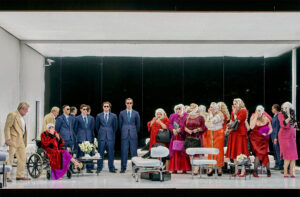
Bayreuth Festival 2025 Review: Der Ring Des Nibelungen
By Christina Waters(Photo Credit: Enrico Nawrath)
The power of the music transcends any single interpreter. From the primal opening chord the rising and falling of Richard Wagner’s Gesamtkunstwerk will lead audiences through 17 hours of an ecstatic vision. Amidst such orchestral glory, however, the second cycle of the Bayreuth Festival’s 2025 “Ring” provided plenty of conceptual confusion as Wagner-lovers bid a grateful adieu (perhaps a sigh of relief) to the directorial innovations of Valentin Schwarz.
The apocalyptic thunder of Wagner’s denouement might have felt compromised, but the impeccable acoustics and brilliant orchestra of this final outing of Schwarz’ resolutely 21st century interpretation worked the magic the visuals lacked. In the expert hands of conductor Simone Young — the first woman to conduct the “Ring” in Bayreuth — the orchestra spun pure gold, conjuring Wagner’s interlacing motifs with rare clarity. Young guided her players through the majestic text as if reading an epic poem. We heard the dangers, thrills, dreams, regrets, and desires of this four-opera journey, clearly articulated and elegantly phrased. Taking her time through the most highly wrought passages, Young invited us inside the music. There was no hyperbolic storming of the emotional gates, no over-the-top reinforcement of what Wagner had already given us in the musical text. Young’s players might have been performing string quartets at certain points, so exquisite was the detail she favored. At times her languid tempi argued with the singers’s needs, and the last act of “Die Walküre” was noticeably adagio. However, in the last moments of “Götterdämmerung,” Young’s pacing shifted gears and the music quickened its ardor. Young and her orchestra gave us the true text and the most potent images of the four operas. Where Schwarz’ visuals became incoherent, we had only to listen to the music to know where we were.
The Schwarz “Ring,” based upon an idea by Richard Wagner
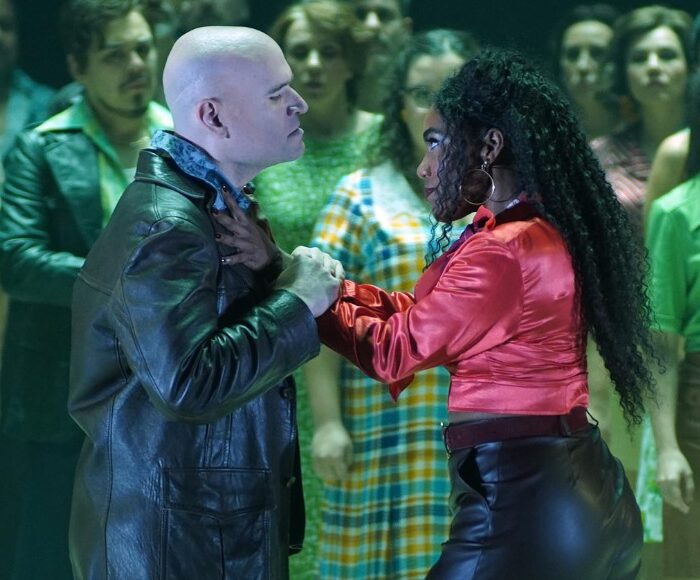
Since the four operas of the cycle can easily be read as a made-for-TV series about a self-destructive family dynasty, each opera can be considered as stand-alone or a moment in an unraveling puzzle. Rife with non sequiturs, burdened with a glut of symbols, and lacking the supertitles that might have aided an audience hungry for clues as to what they were watching, the “Ring’s” magic largely remained in the ingeniously covered orchestra pit. Much of Schwarz’ original brashness still worked in his production’s final Bayreuth run. As “Das Rheingold” opened last week, the Rhinemaidens — now attendants for pampered children at a swimming party — frolic in the water, taunting the lust-struck Alberich (a magnificent Olafur Sigurdarson) with as much mockery as the angry Nibelung can handle. In his black leather jacket, blue jeans, and perennial handgun, Alberich seeks revenge on those who’ve rejected him — namely his richer, sexier, more powerful twin brother Wotan. He abducts a young boy who serves as a surrogate for the power of the ring, a bargaining chip for the the upcoming drama of Freia’s abduction, and as a reminder of the anger ghosting the louche life enjoyed by Wotan and his family of dissolute gods.
The opening foretells the final scene of “Götterdämmerung,” where we will again meet the Rhinemaidens as aging hags, who once again taunt the fading gods from the bottom of an empty swimming pool. Individually distinctive, these Rhinemaidens created a vocal trio of iridescent luster. Gorgeous ensemble colors and shadings from Katharina Konradi (Woglinde), Natalia Skrycka (Wellgunde) and Marie Henriette Reinhold (Floßhilde).
This “Ring” plays as a Netflix series, or a spin-off of “The White Lotus” in which almost every member of a large and entitled family is sleazier than the next. By the end of the first evening, the audience realized that there was going to be precious little fairy-tale magic in Schwarz’ final version. No ring, no tarnhelm (which, silly as it was in the literal portrayal, was a rather charming remnant of Teutonic folktales), no visible Nibelungen hammering away at
their gold, no Freia’s apples of eternal youth. Even the giants Fafner (Tobias Kehrer) and Fasolt (Patrick Zielke) appear as gun-toting gangsters who enter the stage in a vintage automobile. Chaotic it is, yet the first opera, the Vorabend loaded with backstory, is also distinguished by bits of brilliant performance. Loge, here a sort of family advisor, was sung and acted with wit and lithe physicality by Daniel Behle. Fricka, as the long-suffering wife of the long-philandering Wotan, was sung with sculptural phrasing and a rich spinto soprano by the capable Christa Mayer. In a role that fits him with the same perfectly disheveled elegance as the Naples yellow suit he wears throughout, Tomasz Konieczny is the world-weary patriarch Wotan, with a perennial drink in one hand and a cellphone in the other. “Succession” meets “The White Lotus” in a cocktail lounge of family feuds. Loge advises Wotan to grab the abducted boy from Alberich, and so armed with a gun but without the benefit of the tarnhelm, Wotan takes possession of the boy — and a mysterious young girl, who shows up throughout the operas as another visual placeholder for exploitation and loss. The bickering thickens when Wotan balks at trading the boy to the giants for the freedom of Fricka’s sister Freia. The melodrama leaves the audience free to insert their own theories as to which one of the symbols stands in for Wagner’s ring.
In “Das Rheingold’s” most breathtaking coup de theatre, a servant in the family lounge steps into a spotlight and becomes Erda, Wotan’s former lover and confidante. The astonishing contralto of Anna Kissjudit, had the entire house spellbound from her first note. You could practically hear the earth purring. Her voice is nothing short of a force of nature, a profundo wrapped within an opulent tessitura. She added a sudden and highly welcome moment of gravitas amongst the dissolute assemblage.
By the end of the first opera we have an abducted boy, wearing his signature blue and yellow baseball cap, and an angry Alberich whose gun has now been taken by Wotan (Schwarz conceives of Alberich and Wotan as twins, separated at birth). That Alberich and Wotan are the opposing sides of a single coin is a thematically solid idea that Schwarz further underscores in “Siegfried,” where the two fraternal adversaries sit down together and have a drink. And to the strains of the Valhalla bolero, drink in hand, Wotan dances on a balcony high above the rest of the gods, who may or may not be interested in the mighty new abode for which he has made some questionable deals.
In “Die Walküre,” Schwarz again takes us by surprise. When Siegmund (Michael Spyres) and Sieglinde (Jennifer Holloway) meet in Hunding’s forest hut, she is already pregnant! Perhaps time can be played backward in this mythic setting? Or perhaps the child who will become Siegfried is Wotan’s? Tenor Spyres made a compelling Siegmund with a voice of gorgeous timbre. His remarkable legato spun a continuous ribbon of satin. Spyres is perched at the edge of a very big career and the audience loved him. However beautiful the music, however, the staging proved banal: so much standing around and just singing at each other, and irritatingly busy. The two long-lost twins, now lovers, revisit their childhood bedchambers while surrogate children act out youthful games behind them. So constantly are we reminded of who they are to each other that it is clear Schwarz just does not trust his audience to understand what is going on.
And without supertitles, many do not! For example, Siegmund sings of having won possession of Nothung, the Neidliches Schwert (coveted sword), even though there is no sword in sight. Alas, it gets worse when Spyres begins to romance his sister with the aching love song, ‘Winterstürme wichen dem Wonnemond.’ Our ears hear ethereal beauty, while our eyes watch two lovers awkwardly straddling a narrow stairway while Wotan gropes around under Sieglinde’s tight blue skirt. Enter Catherine Foster, one of the few reigning singers who can approach the daunting role of Wotan’s favorite daughter. In her wide-brimmed black fedora, fringed leather jacket and leather leggings Foster was a swaggering and exuberant vision of Brünhilde. She and her father, clearly articulating a disturbing relationship full of desire and shared rebellion, have some fine moments together until she defies him.
People throw things in this opera. Toys, guns, hats, balls, as though flinging objects is a substitute for motivated stage direction. Schwarz has unleashed a Pandora’s box of physical analogs for the power of the ring. We have handguns, the youth with the baseball cap, an illuminated pyramid, more guns, a crutch, and even an actual sword suddenly turns up when Hunding is allowed to kill Siegmund in a fit of revenge.
The third act of “Die Walküre” bids us bask in the high-key colors of a recovery room at a plastic surgery clinic where Brünhilde’s Valkyrie sisters prance around comparing breast enhancement and face lift surgeries. A visually arresting concept during the first years of Schwarz’ production, the scene somehow felt tired this last go around. Again, my sense was that because there were now so many symbols standing in for the ring, the impact each made had been neutralized. Two years ago, when it was clear that what everyone wanted was youth, the plastic surgery clinic and the obsessive quest to stay young became a potent metaphor. Now it was just a harshly lit scene in which bright pink, orange, and red costuming did the heavy lifting. “Real Housewives of Valhalla” trapped in a candy-colored bubble.
Brünhilde Loses Her Spark, Wotan’s Lament
Knowing that even his most trusted and beloved offspring, Brünhilde, has disobeyed him and kept the child Siegfried safe, Wotan must bid her farewell. Naturally there is no a ring of fire, but there is breathtaking music and the chance to watch the final despair of the once mighty ruler, a man who has run out of dreams. The gods must give way to the era of humanity, or in this case the messy and violent needs of whoever is left standing — including the now grownup Hagan, passing on the baseball cap to yet another child.
Tomasz Konieczny’s fierce vocal power and performative swagger took full hold of the stage in this last hour of the opera. With his low biting consonants and growling interrogation, he has fashioned a way of being Wotan that honors some sorcerer’s pact with both Schwarz and Wagner. Crouching, crooning, arms flung out as if to ask the universe just why everything he dreamed of has now turned to dust, this broken, despairing Wotan fits the times in which we now experience Wagner’s myth. Konieczny, a gifted actor, is a captivating lens through which to feel the thrall of Wagner’s vision.
Curled up in his beloved daughter’s lap, Konieczny’s Wotan is a terrified child and a spoiled king of the gods who sees it all going up in flames. While his often melodramatic embodiment of this fabulous character is not for every taste, the great bass-baritone delivered the goods in this last performance of this production. His farewell to Brünhilde, the despairing harrowing Leb’wohl, was filled with the spent passion and failed dreams of the potentate who, once upon a time, had it all. As he finally sank to his knees, he was every inch the broken immortal. With a giant metal curtain lowered behind him, shutting him out of Valhalla forever, Konieczny crumpled into a remnant of former glory. There was not a sound in the house as he whispered his last notes.
A New Siegfried
The next installment of Schwarz’ melodrama opened with the interminable chattering of Mime, a superb Ya-Chung Huang in the truncated role of the Nibelung who has raised the foundling hero Siegfried, hoping that he will kill the dragon Fafner and bring home the treasure. In place of the durable Andreas Schager, superstar Klaus Florian Vogt debuted his deepening vocal powers as Siegfried. Looking every inch the Wagnerian Heldentenor, the golden-haired Vogt gamely sang his way through the antics of Wagner’s adolescent hero, mocking his foster father while longing to break out into the larger world. The beautiful bell-tone voice sounded a bit light for the muscular dimensions that this role requires, but Vogt’s diction is like etched crystal. On the other hand, Vogt’s recital hall stance made me wistful for Schager’s playful abandon (though not his vibrato).
The first act, set in Mime’s cluttered hut, offered more examples of disconnect between what we saw and what we heard. In the mighty Schmiedelieder — the blacksmith forge song — Vogt hammered away downstage, attempting to craft the hero’s weapon, the Zauber Schwert. But there was no sword, only a crutch. As he flailed away at the front of the stage, singing ‘hoi ho, hoi ho,’ a shower of sparks far backstage sent a large cloud of smoke up into the wings.
The second act was stunning, and successful in terms of concept and in delivery. Fafner’s lair is now a swanky assisted living suite, and Fafner himself an old man on life support tended by a young nurse and Hagan, the abducted prize for whom he murdered his brother Fasolt. Alberich arrives, growling his intent to reclaim his ‘child,’ Hagan. Wotan too enters, and the two rivals sip cocktails in front of the fireplace as Mime, Siegfried, and Hagan arrive. We know that Mime is planning to kill Siegfried but Siegfried only finds out when, thanks to another clever bit of role doubling, the nurse begins to sing as the Waldvogel, telling Siegfried of the plot against his life.
Everybody tries on the blue and yellow baseball cap. The staging was brilliant. In a single space Schwarz has, to paraphrase “Parsifal,” collapsed time into space and brought together almost all the “Ring’s” antagonists and protagonists in a single scene. Their presence in this compelling tableaux reminds us of their entangled destinies, and that the surrogate ring (children, baseball cap, quest for youth, glowing pyramid) has stained each of them. Schwarz has said in recent remarks that he wanted to make a “Ring” that was accessible to today’s audience. Does a baseball cap make Wagner’s “Ring” accessible to a Gen Z viewer? When Wotan confronts Siegfried, bitterly passing him the torch, he also leaves him with a full slate of symbols: gun, crutch, sword, illuminated pyramid, and the baseball cap that is ultimately worn by every principal in the opera.
This act provided a breakout moment as Victoria Randem’s Waldvogel produced not only a vivacious bit of acting, but unleashed a dazzling instrument. Not as delicate a coloratura as many who perform this role, Randem’s voice handled the arpeggios and tessitura top easily, deftly, and without an iota of wobble. Having cluttered the symbolic stage with so many possible surrogates for the ring, plus a wonderful Fafner death sung with angst and malice by Tobias Kehrer, Schwarz threw in a charming visual amuse bouche.
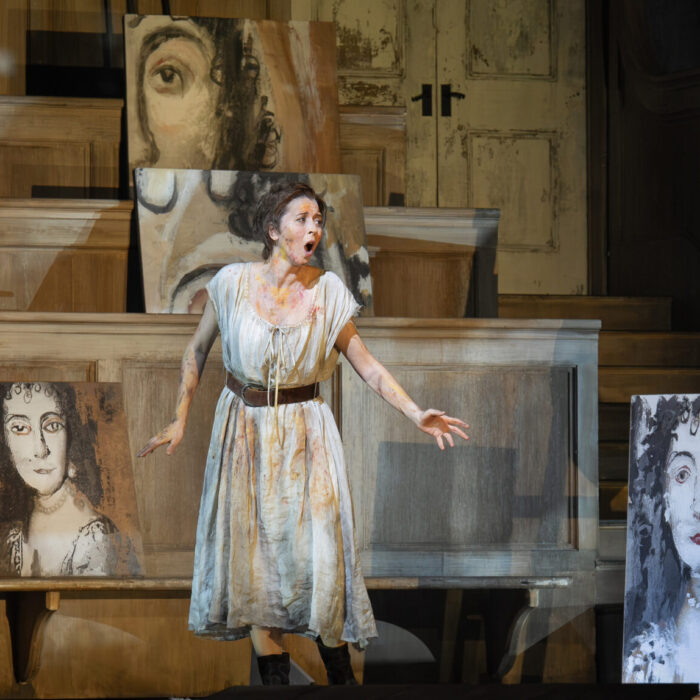
Hanging on the wall above the fireplace, Schwarz’ scenic team hung a portrait of father and son by American-born Impressionist painter Mary Cassatt. Climbing up a ladder, Siegfried slashes the father and son image before he and Hagan climb through the painting and disappear into the final act.
Rising to the occasion in Act Three, Klaus Florian Vogt caught fire in his stunned discovery of the newly reborn Brünhilde. In this scene Catherine Foster arrived in long robes and face bound in bandages, and as Siegfried unwrapped this strange new creature, she emerges into life as a fully human woman. It was a good night for Foster, a stalwart veteran of the role, and she made the most of this central moment. Gone, or at least controlled, were the militant stomping habits that had marred past portrayals, and Foster managed to control her vibrato while retaining all the power and emotional surge these moments of rapture required. A softer version of Brünhilde than I had seen in the past gave depth to her movements and singing. Curiously stiff as an actor, Vogt seemed to warm to Foster’s performance and by the end of their love duet the two had created the vocal excitement the score demands. The scene belonged to Foster, the high C still within her reach, or at least a high B and a half. But it takes two to tango. In the final moment the two singers and the orchestra unleashed the throes of surrender: ‘Erb’ und Eigen, ein’ und all’: leuchtende Liebe, lachender Tod!’ The opera ended a resounding success as Foster threw herself into Vogt’s waiting arms.
Orchestral Götterdämmerung
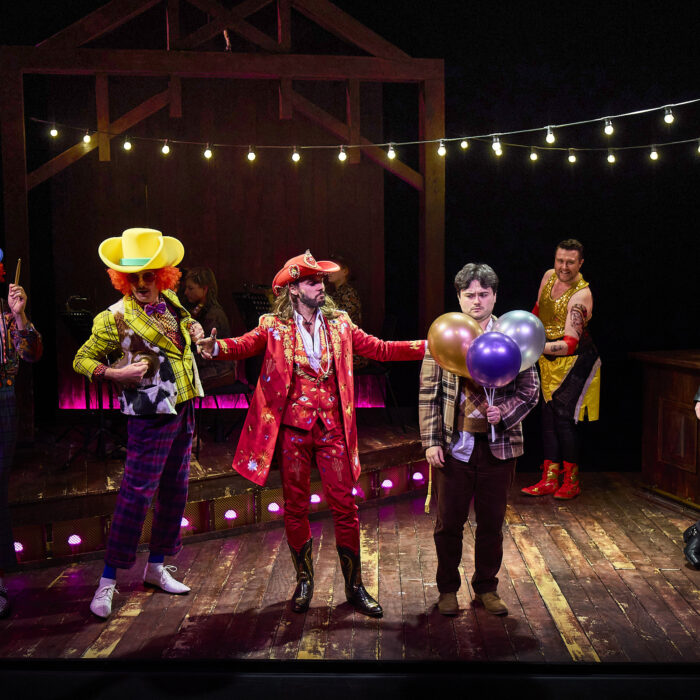
The prophetic Norn sisters began Götterdämmerung as three eerie visitors to the home of Siegfried and Brünhilde, whose long marriage has produced stagnation and a son (plus the additional girl child). Waving their arms continuously, the besequinned visitors enter the dreams of the children, telling of the past, present, and future as if performing a Halloween vaudeville act. Arms flailing about and throwing a ball back and forth, their actions obliterated any legibility of the music and/or words. Later, when her sister Waltraute visits to plead with Brünhilde to return home, this plea is reduced to a ‘tradwife’s lament,’ thanks to the twitching and running around of the children behind the gorgeous music . Only if Schwarz had clarified the youth motif of his original concert would it make any sense for Brünhilde to keep hugging her child instead of considering her sister’s poignant tale of Wotan’s decline.
I urge Katharina Wagner and her Bayreuther Festspiele team to put aside rigid tradition and adopt supertitles in the Festspielhaus. The further directors venture from Wagner’s libretto and prescribed symbolism (gold, a ring, a sword, a dragon), the closer they come to obscurantism. There was arguably a time when opera-loving Europhiles might have understood the sung German text. But given the cultural diversity of today’s Bayreuth audiences, it is time to adopt supertitles. Bayreuth would please its faithful and welcome newcomers with such an easily-installed innovation, one that is already standard practice at almost every other opera house.
In the final act of “Götterdämmerung,” Simone Young again chose to slow the various passages in ways that seemed to frustrate vocal work. Nevertheless, her orchestra was exceptional in capturing the colors of the surging, sonic tapestry. The key changes, chromatic resolutions, and the repeated, evolving themes, make this not only the denouement of the myth, but the wellspring of the opera’s most sublime music
What begins as a mess of unmotivated gestures accelerates as the opera moves into the upscale abode of the Gibichung clan where we meet the dim-witted Gunther and his bimbo sister Gutrune, who along with their new best friend Hagan begin to plan the overthrow of Siegfried’s heroic destiny.
The various circuitous plots involving Siegfried’s agreement to wed Gutrune, and betray Brünhilde by giving her over to Gunther, contain so little dramatic energy — save for the baseball cap and drinking glasses being continuously tossed into the air — that the thrilling towering musical phrases become actually boring. Additionally, there was no chemistry between Gabriela Scherer’s Gutrune and Vogt. The glorious Bayreuth Festhalle Chorus and the wedding feast tributes provided musical relief.
In the final act, returning to the now-empty swimming pool, Siegfried and his son encounter the saucy Rhinemaidens, now elderly winos whose grotesque attempts to seduce the handsome hero provide some terrific moments of camp humor. But the end is near. And here Catherine Foster adopted a new way of handling Siegfried’s majestic funeral music and Brünhilde’s final Leb’wohl farewell to Wotan. Foster sat on an ice cooler at the bottom of the empty pool and sang of all that was now lost in unexpectedly soft, almost conversational phrasings. Possibly to preserve her voice, her quiet lyrical singing was an interesting approach but one that denied us the longed-for climax. With the exception of the sassy Rhinemaidens, the entire last act played out in soft focus, without bite or edge. Siegfried is of course killed by Hagan (Mika Kares never rose to the vocal occasion), Hagan escapes with the young boy, Brünhilde commits suicide by pouring gasoline over her head, and the once-mysterious glowing pyramid sprouted a few flames. The confusing proliferation of visual cues proved fatal to the thrilling sorcery, the matchless grandeur of Wagner’s music.
The music during the final minutes, as it always is, was exceptional, with refreshed leitmotives, spine-tingling chordal progressions, dissonance, and resolution. At the end, Simone Young summoned her orchestra to full power. When she gathered the orchestra members onto the stage for a final curtain call, the thunderous applause said it all. In the end, the “Ring of the Nibelungen,” even in the absence of either ring or Niebelungen, always belongs to Richard Wagner.