Bayerische Staatsoper 2026-27 Review: La Bohème
By Andréas Rey(Photo: Geoffroy Schied)
The Bayerischer Staatsoper is presenting Puccini’s “La Bohème” throughout November. An opera containing two love stories that deals with poverty and mortality, it asks questions like: what can one do in the face of poverty? What can one do in the face of death?
Poverty is an omnipresent evil, with all that it entails.
In the first Act, taking place in Rodolfo and Marcello’s cramped attic room, Rodolfo sacrifices his drama for warmth. They also trick their landlord, Benoit, by avoiding telling him they don’t have a penny for rent. It is in the second Act, during Musetta’s ruse to get her wealthy suitor to pay for Café Momus and even in Rodolfo’s relationship with Mimì in the third Act, followed by her death in the final Act, during which everyone sacrifices a little of what they have.
As Edmond Rostand put it through the words of his dying Cyrano: “It is far more beautiful when it is futile.” What can one do in the face of death and misery? Not much. Stick together, laugh at it before weeping over it, as Beaumarchais said. As the four friends do: “We work as hard as we can. But it is all only temporary.”
Director Otto Schenk’s choice is, in the classical sense, one of realism, and indeed of hyperrealism. Not a single advertising mural, not a single gaiter button, not a single paving stone is missing – except, perhaps, those elements that would suggest this era, with its locomotive soot, the dust kicked up by horse-drawn carriages and the grime of wear and tear, is precisely that: dirty, yet lived-in and vibrant. This staging presents Paris under a glass dome – clean, almost ideal – in which a ‘glossy realism’ replaces reality. It is no doubt this abstract conception that appeals to some, amuses others, and perhaps even offends because it is so far removed from the misery, poverty and soot of that era, as depicted in Puccini’s opera.
This dissonance is also evident in Rodolfo, who is elegant in his cochineal-red waistcoat and grey silk trousers, contrasting with the modest worker’s outfit worn by Marcello, his counterpart.
The choice of tenor Saimir Pirgu for the role of Rodolfo was spot on, as his clear, bright and resonant lyric timbre, combined with his precise articulation, made for a brilliant Rodolfo. However, a slight tendency towards an outward-facing performance, directed at the audience was evident, particularly in his first-act aria “Che gelida manina!.” This was in contrast to baritone Davide Luciano’s Marcello, who maintained an inward-looking, deeply felt performance as if performing without an audience.
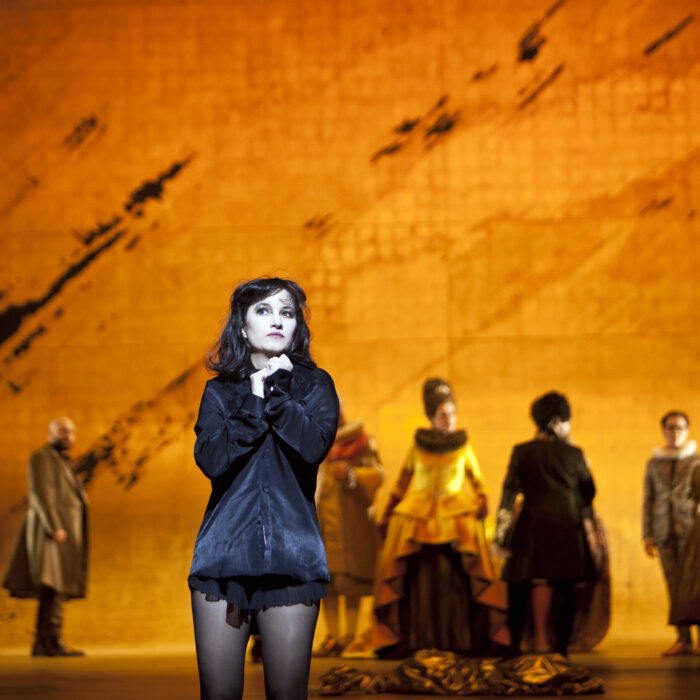
This distinction was also evident in the opera’s two female characters, though this time with far greater intentionality. Soprano Nicole Car in the role of Mimì was particularly apt. Beneath her vocal technique, a thoroughly fitting fragility came through, making her “Sì. Mi chiamano Mimì” particularly moving. Soprano Juliana Grigoryan as Musetta, who toyed with Marcello in the second Act, did not go too far in her exaggeration of the prima donna.
The duets between Mimì and Rodolfo in the first and second Acts were gripping in their tragedy, pathos and humanity. Similarly, those between Marcello and Musetta, whose performances throughout the second Act and during the quarrel in the third were remarkable based on their naturalness, charm and character.
Bass Giorgi Manoshvili as Colline, especially during his farewell to his coat, “Vecchia zimarra, senti,” was quite memorable. He brought out a tragic dimension in that moment. Vitor Bispo as Schaunard was also a standout as his singing was close to comic speech in the first Act, when he recounted the episode with the parrot, and tragic in the final Act.
The Bayerische Staatsoper Orchestra, conducted by Francesco Ivan Ciampa, played very loudly, risking losing Puccini’s silken texture, particularly in the duets between Rodolfo and Mimì. This affected the breathlessness of Mimì’s theme; yet it brought forward the melodic line that unites Marcello and Musetta amidst the turmoil of the second Act with great success.