Bard’s Summerscape Festival 2025 Review: Dalibor
A Smetana Rarity is Given a Powerful Performance by Stellar Cast & Creatives
By Matt CostelloMany who visit OperaWire regularly have their various interests in what one might call, operatic “rarities”–works that have achieved, to an extent, legendary status despite being seldom staged.
As an avid lover of Hector Berlioz’s archetypal romantic career, I devoured both the Barzun and Cairns biographies of the composer more than once. And such a rarity mentioned was Spontini’s “La vestale.” Berlioz, as demonstrated in both bios, loved that opera and was inspired by it…to such an extent, I really wanted to hear it for myself.
Which, back in the heyday of vinyl and no streaming, wasn’t that easy. But eventually–somehow, somewhere–I acquired a recording on some unknown-to-me label and…at last listened.
Suffice it to say, I didn’t love it, though I did listen more than once. Whatever hold it had on Hector, whatever magic, didn’t quite come across to me. Though there is a great recording of Callas singing in the opera, which, upon a recent listen, does make a strong case for it. But then–that’s Callas.
There were other seldom performed works to be explored. For example, Peter Cornelius’s “Der Barbier von Baghdad,” turned out to be a tuneful and comic Wagner-era opera. Again, seldom preformed.
Or Boito’s unfinished “Nerone.” Loving the composer’s “Mefistofele.” I did have to really hunt for a recording of that follow-up. And while there are certainly moments that recall the best of his earlier masterpiece based on Goethe’s “Faust,” “Nerone” perhaps showed that the composer’s decision to focus on his work as librettist–and muse–with the quite aged but still amazing master Verdi…was perhaps the correct one.
Production & Musical Details
Which brings us to Bedřich Smetana’s “Dalibor.” The Bard Summerscape Music Festival is of course known for presenting such rarities. And not just mounting them, but consistently casting great singers matched with often remarkable staging and sets.
And I always marvel at the conducting of Leon Botstein–Bard President but also among other titles, conductor of the American Symphony Orchestra.
This particular production hit a speedbump though close to the premiere date that must have had the team scrambling. Namely, two of the lead artists due to perform in key roles faced ‘challenging visa issues,’ and had to bow out. A sign of our times? Who knows…
And then two people had to step into those significant lead roles. Happily, both performers were remarkable in Smetana’s challenging and dramatic music.
They included the Dalibor of the piece, sung by John Matthew Myers. The role requires a heroic tenor which–if not quite as demanding as those tenor roles created by Wagner–demands a very powerful voice. And Myers delivered, especially when one remembers that he had a mere two weeks or so to prepare–rather incredible.
Ditto for the other last-minute substitute, playing Milada–whose brother Dalibor killed. Soprano Cadie J. Bryan exulted in the dramatic range of the role. She seemed, as in her duets with Erica Petrocelli, to be completely enjoying the performance in which a major vocal range is required.
(And as the world of opera would have it, she ends up falling in love with the imprisoned Dalibor. Guess love does triumph all…)
Both of these roles are remarkably demanding, with the opera providing exciting moments, and the leads arriving late to the production more than rose to those challenges. Their singing was visceral and thrilling.
Matching these two was a strong cast in all the other roles, who also desire special mention. First, the role of Jitka, a villager who Dalibor helped, sung by the second powerhouse soprano, Erica Petrocelli. When she and Bryan sang together, with those two perfectly shaded and powerful soprano voices…genuine sparks flew. That they both seemed to revel in such moments made it all the more enjoyable.
Strong supporting roles were performed by Alfred Walker as the King, Eric Greene as Commander of the castle guard, Terrence Chin-Loy, as one of Dalibor’s mercenaries, and rounded out by Aaron Theno’s stern and powerful Judge.
But one supporting character made an oversized impression, both in vocal range and acting. And that was the jailer, Benes, performed by the bass Wei Wu. It was an acting performance that–forgetting the sublime singing–made the stage come to life.
The vocal power was extraordinary; the singer was a true pleasure (and crowd-pleaser) to hear in that role.
More Highlights
As usual, the Bard Festival Chorale, under chorus master James Bagwell, was wonderful. Their careful, confident and passionate singing of the unfamiliar score was met with acting that made their scenes compelling.
Again, quite to be expected at this jewel of a summer festival, Leon Botstein conducted with precision and nuance, making every telling moment in the score fill the theater with rich detail.
The production was under the direction of Jean-Romain Vesperini who, with the opera text often slipping into ‘telling’ versus ‘showing,’ shaped the piece into a good number of moving moments…especially with the capable leads and fabulous chorus.
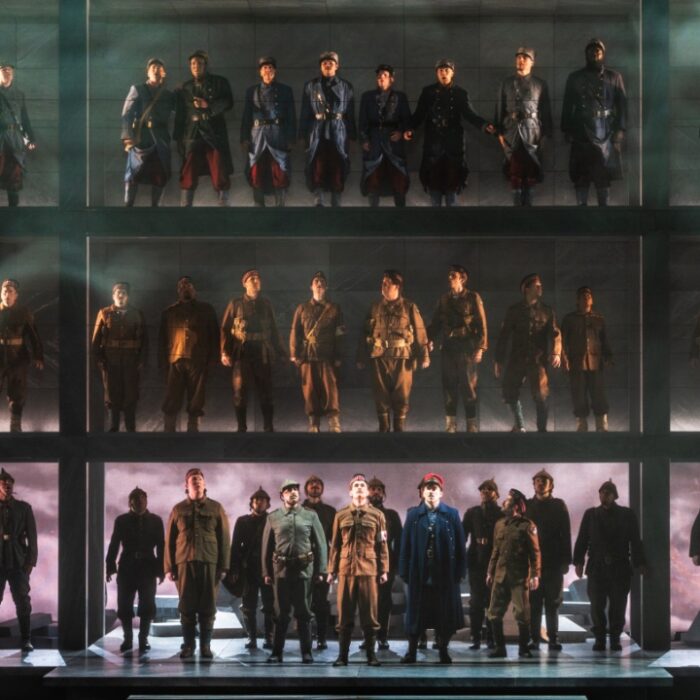
The set design by Bruno de Lavanère–a spiral staircase that became the setting for the dramatic castle scenes, worked generally well, especially when aided by the dramatic scrims showing different views, from the top turrets of the castle itself to the very depths of the dungeon.
All aspects of the production were at the highest level.
But the remaining key question is: well, how was the opera itself?
One can certainly fault the libretto, often stodgy and missing many opportunities for action. But then perhaps that is not too uncommon for the art form of the period in general–with of course some remarkable exceptions.
Smetana’s musical score certainly had its strong points, from the singing and heroic moments for Dalibor, to the remarkable and exciting interplay of both sopranos, and always–the choral sections.
None of which deterred from the overall success of this Bard exploration of the seldom-performed opera. It also provided much post-show discussion as I headed back home from Annandale-on-Hudson and the Fisher Center, Sosnoff Theater on the Bard campus.
While I certainly enjoy seeing the crowd-pleasing masterpieces–witness my recent review of Tanglewood’s remarkable “Tosca“—there is a different excitement in seeing a rarity, with all its great moments and its lesser ones. And with the talent assembled by the Summerscape festival–beyond compare.
I always leave this summer festival wondering what they will do next summer? It is always a special operatic experience to be treasured.
Categories
Reviews