American Symphony Orchestra 2025-26 Review: Requiem & Revelation
By Jennifer E. Pyron(Photo: Matt Dine)
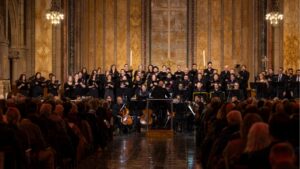
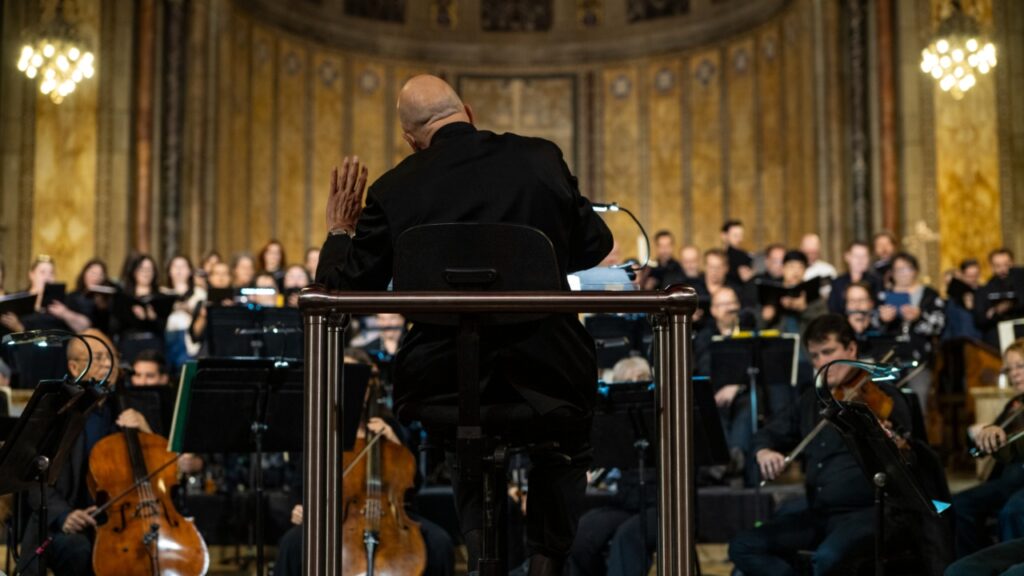
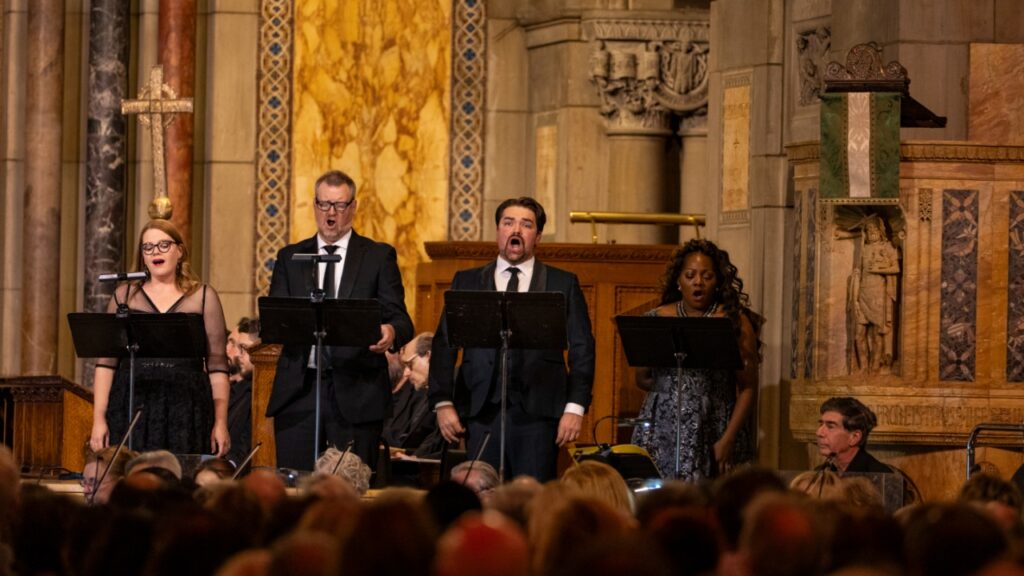
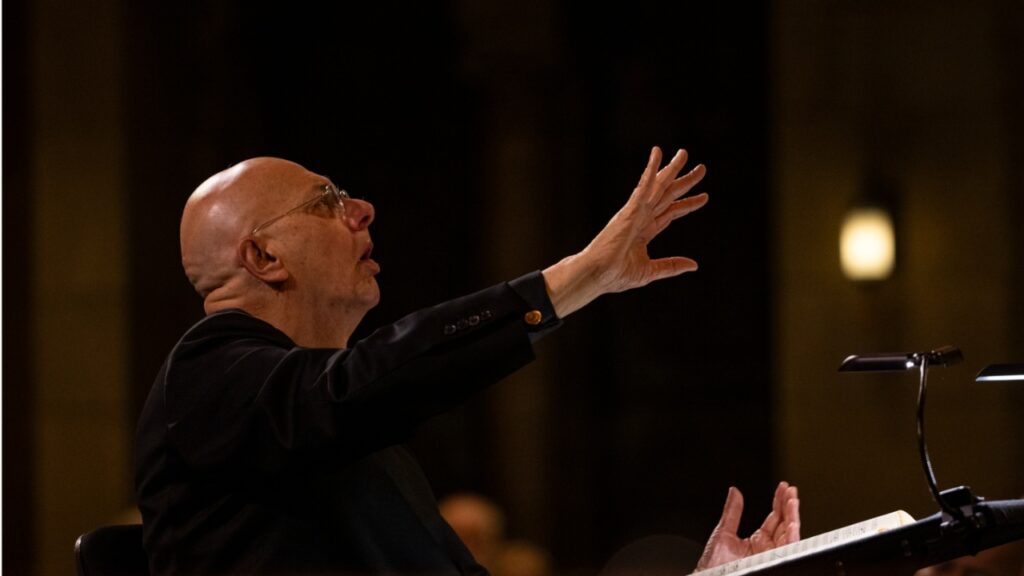
American Symphony Orchestra (ASO) performed “Requiem & Revelation” at St. Bartholomew’s Church led by conductor Leon Botstein, featuring the Bard Festival Chorale and soloists soprano Wendy Bryn Harmer, mezzo-soprano Krysty Swann, tenor Eric Taylor, and bass Harold Wilson. The evening showcased the US premiere of Peter Cornelius’ “Stabat Mater” (1849) and Luigi Cherubini’s “Requiem in C minor” (1816).
Cornelius’ “Stabat Mater” (1849)
“Stabat Mater” illuminates the dramatic complexities of Cornelius’ score. The laborious tempo, laden with cascading vocals at the opening, created a timeless perpetuation of grief void of reason. This heaviness remained at the forefront for the entire performance, grasping the infinite instead of rushing into idealized enlightenment. The text, “Stabat Mater dolorosa, juxta crucem lacrymosa, dum pendebat Filius. Cujus animam gementen, contristatam et dolentem, pertansivit gladius…” (The grieving Mother stood, weeping beside the cross, where her Son was hanging. Through whose weeping soul, saddened and grieving, a sword has passed…) transfixed listeners, forcing them to concentrate on the imagery of a mother mourning the murder of her son. Cornelius’ score evoked a sense of brutal starkness suspended in the balance.
“O quam tristis et afflicta,” (O how sad and afflicted) began with soprano Wendy Bryn Harmer’s bright voice. The ebb and flow of the soprano’s voice mixing with the string section was breathtaking. The heavy veil of emotions remained, but a softness was fast approaching. Cornelius’ composition for the soprano voice highlights his deep understanding of tonal colors. The text’s imagery came to life at this moment, especially when tenor Eric Taylor and bass Harold Wilson joined in during “Nati poenas incliti” (of her glorious child). The ending of this movement was especially dramatic with its slowed tempo and reflective pauses.
(Photo: Matt Dine)
“Qui est homo, qui non fleret” (Who is it that would not weep) highlighted Wilson’s bass as he sang in ardent fervor. His vocal lines were expressive and his technique supported his legato’s finesse. There was a special timbre in his voice that resonated warmly in St. Bartholomew’s Church hall and for a moment I saw audience members looking up into the rafters at the inlaid details.
“Pro peccatis suae gentis” (For the sake of His people’s sins) began with the Bard Festival Chorale male voices resonating in matched ardency with Wilson’s voice from the previous movement. This felt like a turning point in the “Stabat Mater” and Cornelius’ determinacy to remain vigilant to the seriousness of his work rang loud and true. The tempo quickened and all voices of the choir rose up in a fury of illuminating sound.
“Eja Mater, fons amoris” (O Mother, fountain of love) featured Bryn Harmer’s voice at the opening. The dynamics of her voice mixing with the swelling of the string section was magnificent. This was a tender moment cherished by all.
“Sancta Mater” (Holy Mother) slows in tempo and the choir’s voices resumed the laborious legato from this work’s first movement. Grief’s return took hold and, like fresh fallen snow, it seemed to paint over the previous movements’ momentum. The voices sang a cappella and were magical in their own way, ushering in a softer veil of sadness made perfect in music’s harmonious bliss. The quietest moments in this movement were my favorite of the whole piece, allowing listeners to lean back and digest the multitude of emotions at play.
“Fac me vere tecum flere” (Let me truly weep with you) rested in the laurels of “Stabat Mater’s” infinite sadness: “Juxta crucem tecum stare, te libenter sociare in planctu desidero” (I wish to stand with you next to the Cross, and willingly be your companion in tearful lamentation). This movement was much shorter than the rest. It combined voices with the orchestra in what felt like a blanket of ubiquitous lamentation.
“Virgo virginum praeclara” (Most illustrious Virgin of virgins) opened with all soloists and maximized their voices as an illustration of luminosity. Cornelius dives head first into the abyss of suffering as he prioritizes penance in the form of passion.
“Fac me plagis vulnerari” (Let me be wounded by His wounds) was the most dramatic in its dynamics and composition. The string section rapidly pulsed upwards and the voices resounded as a soothing balm: “Inflammatus et accensus, per te, Virgo, sim defensus, in die judicii” (Burning and on fire, by Thee, Virgin, may I be defended, on the Day of Judgment). The choir sang with dedicated delight.
“Fac me cruce custodiri” (May I be guarded by the Cross) resumed the slow tempo that Cornelius clung to so tightly for this entire work. Its pace quickened when the male voices entered, followed by the rest of the voices, aiming to climax before its end: “Quando corpus morietur, fac, ut animae donetur, Paradisi gloria” (When my body dies, let my soul be given, to the glorious Paradise).
(Photo: Matt Dine)
Cherubini’s “Requiem in C Minor” (1816)
“Introitus” began with a solemn cello section and voices of the choir that grew in anticipation of its development. Already there was a sense of lightness and levity in the hall following Cornelius’ “Stabat Mater.” A Revelation was looming. The lyrical quality of this first movement determined the listener’s path for the remainder of the evening. The Bard Festival Chorale sounded absolutely beautiful and well-balanced. Conductor Leon Botstein’s overall vision for this evening’s theme came to fruition. His dedication to performing rare scores continues to inspire beyond all measure, and his ability to successfully realize them is unmatched. Botstein’s curiosity drives him into the depths of study, but most importantly into the hands of composers that would trust him, if anyone, to carry on their legacies.
“Dies Irae” exploded in sound and filled St. Bartholomew’s hall. While it is not Verdi’s “Dies Irae,” it does have a hellfire message sure to make any audience member wake up. The cascading string section of this composition is so incredibly moving, I could listen to their part alone for hours.
“Offertorium” was the perfect lead up to “Sanctus,” the Requiem’s crowning moment when all voices celebrate in unison, “Holy, Holy, Holy, Lord God of Hosts!”
“Pie Jesu” offered a melancholy tone of remembrance. The moments when the higher registers peaked created a landscape of passing clouds where the light shone through only intermittently. “Agnus Die” was reminiscent of “Dies Irae” in its opening phrases of dramatic vocals and dynamics. The horn section was also a highlight, breaking through the thickness of sound. This final section brought to a close this wondrous evening of “Requiem & Revelation” presented by Leon Botstein’s ASO, Bard Festival Chorale, and soloists. Pairing Peter Cornelius’ “Stabat Mater” and Luigi Cherubini’s “Requiem in C minor” brought to the surface the many similarities and differences that make music universal no matter the subject or idealization.
(Photo: Matt Dine)