Polish National Opera 2026-27 Review: Salome
Claus Guth Explores the Dark Underpinnings of Bourgeois Respectability in Strauss’s Music Drama
By Zenaida des AubrisThere is something particularly unsettling about evil when it is impeccably dressed. In Claus Guth’s production of Richard Strauss’s “Salome,” which premiered at the Polish National Opera in Warsaw on November 22, 2026, the moral depravity of Herod’s court is concealed beneath the veneer of late 19th-century bourgeois respectability. One is reminded of the films of Claude Chabrol, in which elegant interiors and seemingly impeccable manners serve as the camouflage for psychological and moral abysses.
A co-production with Madrid’s Teatro Real, Guth’s “Salome” revisits his concept of presenting the protagonist at successive stages of her emotional and physical development – here with the use of five additional girls to show her growing up. The biblical narrative becomes a psychological study of a young woman struggling to liberate herself from the pernicious influences that have shaped her existence.
Beneath the Surface
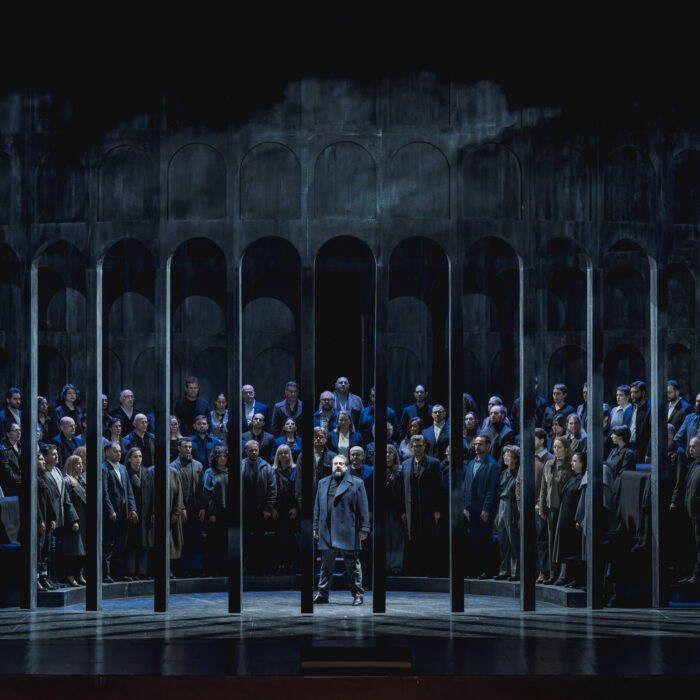
Set designer Étienne Pluss creates an oppressive architectural environment whose monumental proportions evoke the grand palaces, often resembling bastions, of the late 19th century. There is no sunlight in this world, no suggestion that laughter, affection or spontaneous expressions of emotion have ever been permitted within its walls. Olaf Freese’s dramatic lighting reinforces the sense of psychological imprisonment.
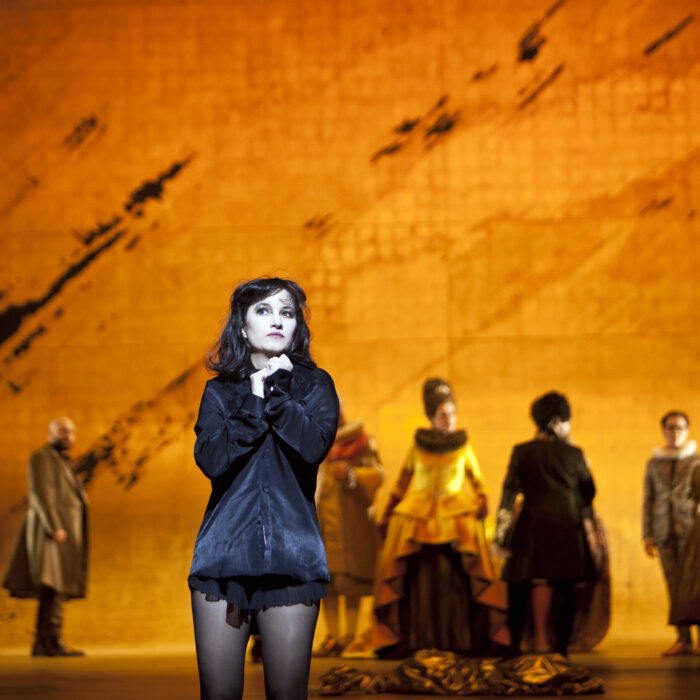
Ursula Kudrna’s costumes are particularly eloquent. High collars, long sleeves and elegantly tailored garments suggest a society intent on keeping both the body and its natural impulses under wraps. Herodias provides the sole conspicuous exception in an orange-red gown reminiscent of Otto Dix’s celebrated portrait of the Berlin dancer Anita Berber. Its sensuality derives, paradoxically, from what it conceals.
Salome first appears as a little girl in a dark blue velvet dress with a white collar, the very embodiment of well-bred innocence. But innocence, in Guth’s universe, is a precarious commodity.
Rather than having Jochanaan brought before her, Salome ventures into his place of confinement, accompanied by Narraboth. The whitewashed enclosure, populated by dolls and a hobbyhorse, suggests that it might once have been her playroom. Childhood memorabilia and the physical presence of the prophet, clad only in a loincloth, make for a disturbing juxtaposition.
She removes her formal attire, revealing a cream-colored undergarment. It is the first of several symbolic acts of shedding a skin. Her response to Jochanaan oscillates among fascination, attraction and repulsion. What she seeks from him is not exclusively sexual gratification but something approaching spiritual guidance, perhaps even an alternative moral universe.
The famous Dance of the Seven Veils becomes the psychological centerpiece of the production. Six incarnations of Salome, ranging from a little girl to an adolescent on the threshold of womanhood, enact episodes in her development, frequently with Herod’s active participation. The implications of childhood sexual abuse are unmistakable.
Guth is less concerned with the revelation of physical nakedness than with the exposure of moral nakedness. What is being stripped away is the protective covering of a society that has perfected the art of concealing its own transgressions.
An Alternative Destiny
Guth’s most radical intervention comes in the final moments. Salome’s encounter with Jochanaan culminates not only in the kissing of his severed head but also in an embrace of his headless torso. Yet this act of extreme transgression constitutes, in Guth’s reading, the final stage of her emancipation.
Herod, having issued his command to kill Salome, suffers a heart attack and himself becomes the final casualty. Salome walks into the distance, presumably liberated from the constraints of her past.
It is an intellectually provocative conclusion, although not an entirely unproblematic one. Can an act of such horrifying violence constitute a credible passage toward psychological liberation? And can the annihilating force of Strauss’s final orchestral gestures be reconciled with the prospect of a new beginning? The tension between Guth’s decidedly contemporary therapeutic reading and Strauss’s musical dramaturgy remains unresolved.
The Orchestra as Protagonist
The evening marked Yoel Gamzou’s first new production as music director of the Polish National Opera. Gamzou has spoken of the orchestra as the principal protagonist of “Salome,” emphasizing Strauss’s extraordinary ability to assign musical identities not merely to individual characters but to their constantly shifting emotional states.
The excellent orchestra responded to his direction with considerable sensitivity. Unfortunately, the acoustics of Warsaw’s cavernous auditorium presented a formidable obstacle. The sumptuous architectural grandeur of the opera house, with its magnificent staircases, foyers and chandeliers, finds a less felicitous counterpart in the acoustic properties of its performance space.
Increasing orchestral volume is hardly the solution, particularly when it comes at the expense of musical and vocal intelligibility.
Vocal and Dramatic Intensity
Monika Radecka proved an intensely committed Salome, both vocally and dramatically. Her soaring upper register possessed considerable impact, although much of her middle register was barely audible, possibly owing in part to the acoustics. The intensity of her acting, however, went a long way toward compensating for these shortcomings.
Nadine Lehner’s Herodias cut a striking figure, dispensing her sarcastic commentary with an appropriately corrosive edge. Gerhard Siegel embodied Herod with ample lechery, while Granit Musliu brought sensitivity and devotion to Narraboth, whose desperate attempts to protect Salome ultimately proved fatal.
The outstanding vocal achievement of the evening belonged to Tomasz Konieczny, arguably the best current interpreter of the role of Jochanaan. His richly endowed bass-baritone conveyed not only the prophet’s authority but also the emotional intensity of a man utterly convinced of his beliefs.
Guth’s production is at its most persuasive when it exposes the disturbing proximity of outward respectability to moral monstrosity. Whether Salome can ultimately escape the world that has produced her is another question. Strauss, one suspects, would have been considerably less optimistic.
Zenaida des Aubris