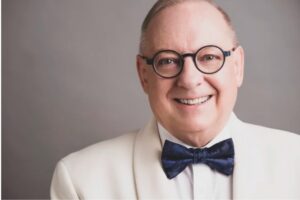
Q & A: Nicholas McGegan on Conducting ‘L’Allegro, il Penseroso ed il Moderato’
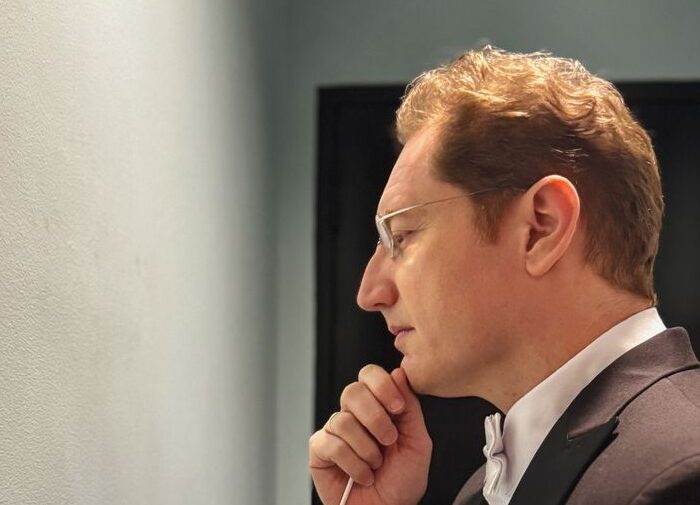
By Mengguang Huang(Photo: Dario Acosta)
In his sixth decade on the podium, Nicholas McGegan has become one of the world’s most trusted interpreters of Baroque and Classical music — an artist whose gift is making history feel vibrantly present. Long hailed as “one of the finest baroque conductors of his generation” (The Independent) and “an expert in 18th-century style” (The New Yorker), he is prized as much for the wit, warmth, and insight he brings to the podium as for the scholarship beneath it. Following a 34-year tenure as Music Director of Philharmonia Baroque Orchestra & Chorale, he now holds the title of Music Director Emeritus, and he serves as Principal Guest Conductor of Hungary’s Capella Savaria. At home in the opera house, he shed new light on close to 20 Handel operas as Artistic Director of Germany’s International Handel Festival Göttingen for two decades (1991–2011), illuminated the Mozart canon as Principal Guest Conductor at Scottish Opera in the 1990s, and served as Principal Conductor of Sweden’s Drottningholm Court Theatre from 1993 to 1996.
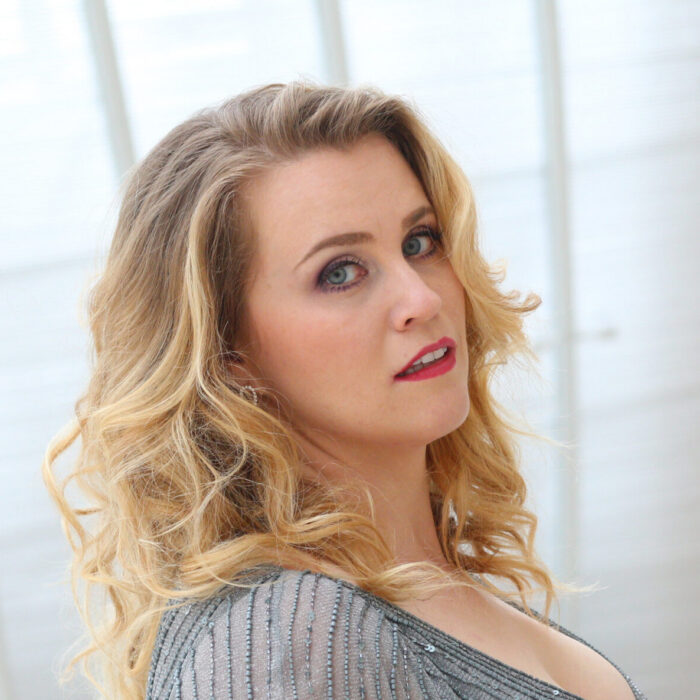
In November 2026, Nicholas McGegan leads Handel’s “L’Allegro, il Penseroso ed il Moderato” at the Filharmonia Narodowa with the Warsaw Philharmonic Orchestra and Choir, joined by soloists Robin Johannsen, Fflur Wyn, Robin Tritschler, and Matthew Brook. Before the event, OperaWire had the opportunity to talk with him on this project.
OperaWire: As a longtime champion of Handel who collaborated with the Mark Morris Dance Group on this piece, how was your first encounter with this score?
Nicholas McGegan: It is one of Handel’s most imaginative works. Unlike his usual librettos, which are sometimes merely “serviceable,” this score pairs great music with great poetry, specifically the very academic English of John Milton. I have grown up in England, Milton was part of our school education, so I knew the words even before the music. The poems are nearly as old as Shakespeare and sometimes harder to understand. Even now I sometimes have to look up words!
My history with this piece goes back first in 1987, and then I directed the American premiere of Mark Morris’s iconic choreography in 1991. I have done it many times since.
OW: When Handel composed for this libretto, did he make any changes to make it more accessible to 18th-century audiences?
NM: Well, Handel didn’t really change Milton. The person who did the shaping was Charles Jennens, the same person who put together the libretto for “Messiah.” And Jennens was brilliant at handling other people’s words.
Here he wove two separate poems together. Otherwise, you’ve just got Allegro—the ultimate party boy, looking for comedy and sunshine—and then Penseroso, sitting quietly in the corner reading by candlelight. Jennens interleaved them. Even at the very beginning, you get miserable music telling misery to get lost because it’s time to party, and then happy music gets kicked out because it’s time to be philosophical!
And that third part? That’s all Jennens’ own poetry, which is… well, let’s say a bit weaker! But the idea is brilliant: you need balance. It’s almost Buddhist, really—finding the middle way. Don’t party all day long, don’t spend your whole life reading by candlelight either. It’s not a religious piece; it’s a moral oratorio.
OW: Will you perform a complete “L’Allegro” in Warsaw?
NM: We aren’t doing the full thing. We’re trimming parts of Part three. Ironically, cutting Part three is actually something Handel himself did. It gets underplays of the whole moral lesson, sure, but it makes for a much nicer concert evening and ends with a happy chorus.
OW: Both “The Creation” and “The Seasons” by Haydn heavily rely on descriptive word-painting, much like “L’Allegro.” How do you view this musical pictorialism?
NM: Sound-painting was just a massive part of the period. You see the exact same thing in Haydn’s work—bird songs, people falling asleep, even a dog. Haydn called some of that as ‘French trash’ because there was too much of it!
But the funny thing is, these two Haydn oratorios are actually based on British librettos. “The Seasons” used James Thomson, who was Scottish, and “The Creation” heavily relies on Milton’s “Paradise Lost.”
Composers just loved imitating birds, hunting horns, and festive trumpets. It’s a great excuse to unleash their imagination. But Look at “Messiah”—Handel carefully avoided all of that. He wanted a plain orchestration so the words came first, only pulling out a trumpet when it literally says “the trumpet shall sound.”
But “Messiah” and “L’Allegro” were written just a year apart in the early 1740s. At that moment, Handel had practically abandoned opera and was going full-throttle into oratorios. With those compositions, he was showing off. Bigger orchestras, color, choirs on stage—he was just proving to everyone, “Look at what a brilliant composer I am.”
OW: What was Handel’s working relationship with his librettists? Did Charles Jennens take the lead in bringing him texts?
NM: For the oratorios the librettists often came to him. Take Charles Jennens—he was super wealthy, adored Handel, but kind of treated him like a servant! Jennens called Messiah “my Messiah,” and he even complained that Handel was too lazy to rewrite the overture.
Jennens hated London, lived alone in this massive country palace, and suffered from depression. Handel could be a nightmare too—Charles Burney thought Handel was probably manic-depressive. He’d write at a white-hot pace, and he could be wonderfully witty, but also pretty cruel if he didn’t like something.
And oh, the language barriers! When Handel first saw Milton’s line “Hence, loathed mélancholy,” he had no clue where the stress went. He sang it as “meláncholily!” A singer had to fix it for him. When working on Jephtha late at night, he hit a word he didn’t recognize—”Billows.” So what did he do? He gets into a horse carriage in the middle of the night, drives over to the librettist’s house, starts throwing stones at his window, and yells: “What on earth does billows mean?,” gets the answer, and goes right back to composing!
OW: Do you think these three different temperaments in the libretto somehow reflect the dual nature of Handel and Jennens themselves?
NM: Could be. Handel was a man of extreme energies. Charles Burney described how he usually looked sullen, but when he smiled, it was like the sun suddenly coming out! He could sink into deep melancholy, yet when he was up, he was pure joy.
So in a way, this whole piece was a gentle reminder—for Handel, for Jennens, and for all of us: don’t overdo the misery, and for heaven’s sake, don’t overdo the partying. Find a nice middle way.
OW: Without a plot or liturgy, it feels quite similar to Handel’s earlier “Il Trionfo”—both deal with making moral choices.
NM: Oh, absolutely. An oratorio doesn’t have to be sacred. It just means it’s not staged. Handel wrote other secular and mythological ones like “Hercules.” Do you choose pleasure, or do you choose prudence? It’s a very real moral lesson, especially for the aristocrats in the audience. Let’s be honest, many of them were rich, yet they spent way more than they had and were drowning in debt!
OW: Looking at the premiere cast, Handel used five singers—including a boy soprano. How are you handling the vocal cast for this Warsaw performance?
NM: Well, we’re not using a boy! An orchestra footing the bill prefers a tight cast, so we have four: two sopranos, a tenor, and a bass. The lighter soprano covers the boy’s parts, while the darker soprano takes the rest.
In Handel’s day, it was an international crew. Italians for the sopranos, Germans for the basses, English tenors. The choirs would usually be made up of members of the choirs of Westminster Abbey and Saint Paul’s Cathedral. And back then, soloists actually sang in the choruses! Mrs. Billington got roasted later in the century because she refused to sing chorus parts—she thought she was too grand!
OW: Did he recruit these singers from his opera company, or was it a fresh team?
NM: A bit of both. Some stuck around, like John Beard—he started as a boy soprano in “Alcina,” his voice broke, and he came back as Handel’s star tenor! But during Lent, when theaters couldn’t stage operas, Handel recruited theatrical stars.
He used famous actresses. For example, Kitty Clive played the naughty Dalila in “Samson”—she was a comic actress with the tightest waist in London! And Susanna Arne, who sang in “Messiah,” couldn’t even read music! But she was a tragic actress who could make an entire hall weep.
Handel even raided Dresden for talent, with the power of British money. Plus, he could visit his sister in Halle on the way. You know, Bach actually heard Handel was in town and hopped on a horse to meet him—but missed him by a day! They never met. The only thing they ever shared was the same awful eye doctor, Chevalier Taylor, who managed to blind them both!
OW: When collaborating with modern ensembles like the Warsaw Philharmonic, how do you guide them?
NM: I do my homework. I always bring my own prepared orchestral parts—all computerized, clear, with exact bowings and written-out cadenzas. If they played Tchaikovsky last week, they obviously need a massive gear change. A period ensemble transitions smoothly because they just played Bach last week.
And I know two of the four soloists extremely well, which helps immensely. I’ve sent them a recording of a previous performance so they get a feel for my tempos and style. They can always change things like cadenza, but it gives us a clear starting point. Plus, we have proper rehearsals scheduled, and they all have my email if any questions pop up before we meet.
OW: Is this your first time conducting in Warsaw, and what are your expectations for the venue?
NM: Never with the Warsaw Philharmonic. I was in Warsaw just once about 2005 when the Irish Chamber Orchestra made a grand tour through the 10 countries who just joined the EU! I did not see that much and I’m looking forward to going back. As for the venue, it’s a concert hall and not a cavernous church. Handel premiered the work at Covent Garden, so a drier acoustic helps with clarity. I’m really eager to see the Polish chorus get their teeth around Milton’s tricky English text. It’s going to be brilliant fun.
OW: We’ve seen period-instrument ensembles tackling 19th-century works like Mahler, while modern orchestras play Baroque. How do you view this?
NM: I think everybody should play everything! What’s fascinating is how historical practice applies to later music. With Elgar’s First Symphony, which he recorded himself, we have all these unwritten ritardandos and accelerandos he actually executed in performance. For the 18th century, we lack audio record, but for the late 19th century, we have direct evidence.
Look at orchestra layouts: Iván Fischer just caused a stir with the Berlin Philharmonic because he insisted on Mahler’s original seating with the double basses lined up across the back wall. I did the same when recording Brahms’ Serenades—placing basses raised at the back, based on a diagram Brahms himself sent to the Boston Symphony.
However, seating isn’t one-size-fits-all. Many modern orchestras like splitting First and Second Violins left and right. For Mozart and Haydn, that’s great. But for Handel? It’s a terrible idea! Handel often writes violins in unison—if they’re split across the stage, the players literally can’t hear each other. They must sit side-by-side.
OW: What historical evidence guides your tempi for “L’Allegro?”
NM: Shortly after Handel died, his amanuensis, John Christopher Smith, was commissioned to transfer works onto barrel organs. The barrels burned, but the exact duration index survived.
“L’Allegro” has 19 pieces documented this way—more than any other Handel work. Created in 1762 by Handel’s amanuensis John Christopher Smith, it gives us a direct window into his tempos. It turns out some pieces I thought were fast were indeed intended that fast! It’s similar to Hummel and Czerny arranging Mozart and Haydn symphonies for piano with metronome marks. Hummel actually lived in Mozart’s house. These historical sources aren’t rigid rules, but invaluable guides.
OW: How accurate are these historical sources?
NM: Before Maelzel’s metronome, Louis Spohr used a weighted pendulum, and Quantz famously used the human pulse—around 60 beats per minute. Or simply a clock second-hand. People knew how to measure time.
For our Warsaw performance, of course I still have to negotiate with human singers who need to breathe. As for the cuts, modern audiences expect a concert lasting two to two-and-a-half hours with one interval. Complete with all three parts and Handel’s improvised organ concertos, a premiere in his day easily ran close to four hours with two intervals. By trimming parts of Part three and skipping the organ concertos, we create a much more compact musical evening.
OW: Looking ahead to next year, you’ll be conducting the opening concert at the Halle Handel Festival with the Coronation Anthem.
NM: It’s lovely to go back to Halle—I’ve been going there since the early nineties. But our artistic director Florian Amort has put together a programming twist that will probably shock the audience: we’re pairing Handel’s Coronation Anthems with Sir Peter Maxwell Davies’s Eight Songs for a Mad King. It is literally Francis Bacon in sound! The work depicts the madness of King George III, requiring the singer to push the human voice to its absolute limits. I knew the composer well and admire him greatly.
George III’s coronation actually used the very Coronation Anthems Handel wrote for his grandfather, George II. Plus, Davies’s piece literally quotes “Comfort Ye” from Messiah, but punctuated by hysterical shrieks! Some people will hate it, some will be deeply moved.
Categories
Interviews