Birgit Nilsson Festival 2026 Review: Matilda Sterby in Recital
Swedish Soprano Gives Voice to Longing, Vulnerability, and the Sea
By Zenaida des Aubris(Photo: Gunilla Hovenäs)
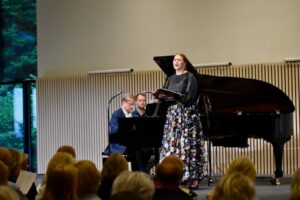
Tall and statuesque, Swedish soprano Matilda Sterby stepped onto the stage of Ravinen Kulturhus on August 6, 2026, in Båstad and immediately captivated the audience with a winning smile. The recipient of the 2024 Birgit Nilsson Stipendium appeared during the Birgit Nilsson Festival with her pianist Matti Hirvonen.
Their program reflected this year’s festival theme, “The Sea,” beginning with eleven songs by Franz Schubert before turning to Nordic works by Edvard Grieg, Gösta Nystroem, and Jean Sibelius.
Schubert by the Sea
In Ravinen’s recently built hall, the sea was visible through floor-to-ceiling windows, lending an almost theatrical immediacy to Franz Schubert’s “Auf dem See” and “Auf dem Wasser zu singen.”
Although Sterby’s German diction had room for greater clarity, her evident appreciation of the texts and the melodic warmth of her soprano proved winning. She was particularly compelling in “Der Zwerg,” D. 771, Schubert’s setting of Matthäus von Collin’s enigmatic Gothic ballad. Sterby captured the work’s unsettling psychological mixture of jealousy, tenderness, violence, and remorse, allowing its fatal events to unfold with finely judged dramatic intensity.
In “Mignons Gesang,” D. 321, she approached Goethe’s familiar opening, “Kennst Du das Land, wo die Zitronen blühn?” with a sense of wistfulness. Italy emerged not simply as a classical ideal, but as the lost homeland of a displaced child. Sterby shaped the longing without allowing it to become overly sentimental.
Nordic Affinities
Sterby appeared more at ease linguistically during the recital’s Nordic second half. From Grieg’s “Haugtussa,” Op. 67 cycle, she selected “Blåbærli” (“Blueberry Slope”), “Møte” (“The Meeting”), and “Ved Gjætle-bekken” (“At the Shepherd’s Brook”). Together, the songs traced the emotional journey of a young shepherdess from awakening desire to romantic fulfillment and, finally, consolation beside a murmuring brook. Sterby embodied this progression with a sincere mixture of innocence, sensuality, and melancholy. Hirvonen’s sensitive playing allowed berries, hillside, and flowing water to become active elements in the drama rather than just picturesque background.
Two songs from Nystroem’s “Sånger vid havet” followed: “Ute i skären” (“Out in the Skerries”) and “Jag har ett hem vid havet” (“I Have a Home by the Sea”). Sterby emphasized their longing for the coast as both refuge and summons. Her warm, mellow soprano gave substance to the music’s central ambiguity: the sea offered a sense of belonging while calling the solitary individual toward something distant and adventurous.
The recital ended with three Sibelius songs: “Säv, säv, susa” (“Reeds, Reeds, Rustle”), “Våren flyktar hastigt” (“Spring Passes Quickly”), and “Törnet” (“The Briar Rose”). In each, nature became an emblem of human fragility–mourning a young woman who drowns herself, measuring the brevity of youth, or promising that the neglected might yet flower through love.
The program ultimately revealed Sterby’s finest quality: her ability to give voice to vulnerability without diminishing its strength. Throughout the evening, sea and landscape became mirrors of longing, loss, memory, and renewal.