Arena di Verona 2026 Review: Aida
Zeffirelli’s Golden Egypt Still Cast Its Spell at Verona
By Ossama el Naggar(Credit: Arena di Verona)
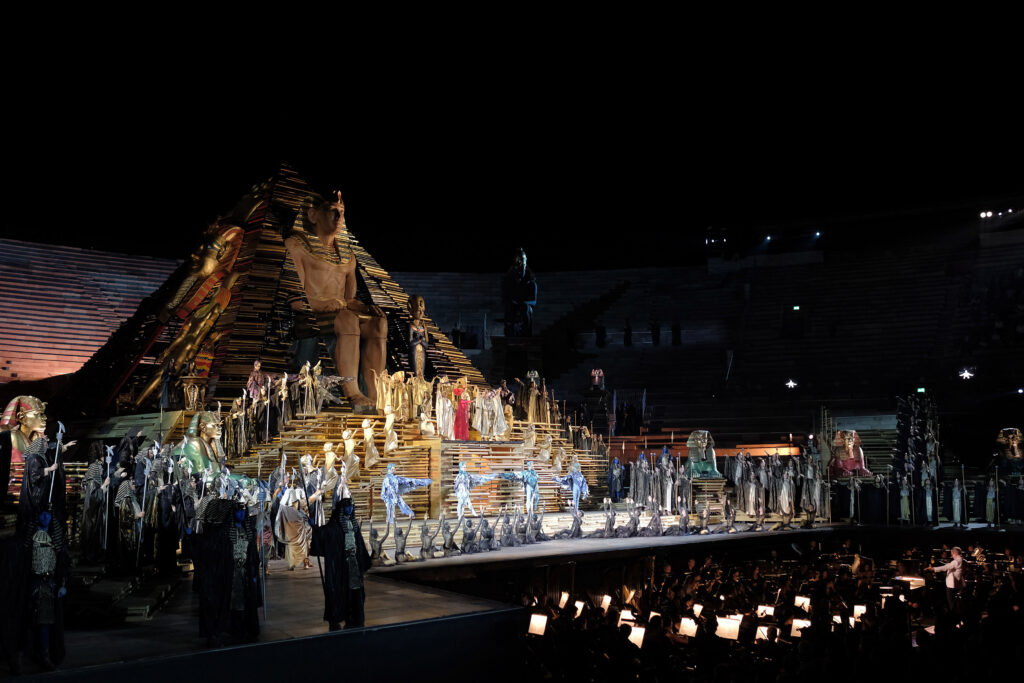
Oddly enough, the Arena di Verona was offering two different productions of “Aida” this summer: Franco Zeffirelli’s and Stefano Poda’s. Judging from Poda’s staging of “Nabucco” the previous evening, I was glad to have found myself at Zeffirelli’s classic production, which I had first seen in 2018. True, Zeffirelli had positively buried Verdi’s opera beneath gold. Yet, for all its vulgarities, excesses and theatrical gigantism, his conception proved brilliant and perfectly at home in Verona.
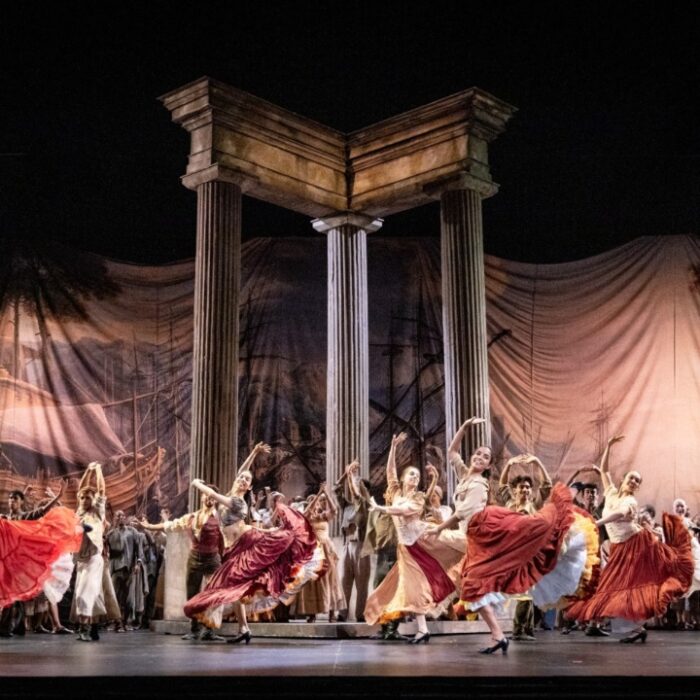
The production, inaugurated in 2002, had long since ceased to be merely a revival. It had become part of the Arena’s mythology. Its colossal pyramid dominated the stage, flanked by fourteen sphinxes and four idols, while armies, priests, slaves, dancers and courtiers transformed the amphitheater into an imaginary ancient Egypt of almost delirious opulence. Anna Anni’s elaborate costumes contributed further layers of colour and splendour, while Vladimir Vasiliev’s choreography supplied the ceremonial movement expected of a grand-opera “Aida.” There was nothing remotely minimalist about it.
Indeed, Zeffirelli’s production, seen on August 9, could be exasperatingly excessive. The pyramid was so enormous that it occasionally seemed to crush the opera beneath its weight; the profusion of bodies and objects could verge on visual congestion; and the incessant magnificence sometimes approached self-parody. Yet these were ultimately the excesses of a theatrical imagination rather than the symptoms of an absence of imagination. Zeffirelli had understood something fundamental about the Arena: an outdoor amphitheater accommodating tens of thousands of spectators required images that could be apprehended instantaneously and at enormous scale.
The choreography, too, belonged to this conception. Vasiliev’s contribution was unapologetically traditional, its large formations and ceremonial gestures conceived for an immense open-air stage rather than for the intimate theatricality of a modern studio production. The additional choreographic figure of Akmen, originally created for Carla Fracci, remained an eccentric interpolation into Verdi’s dramaturgy, but it was another reminder that this “Aida” had acquired a mythology of its own. It was no longer simply Zeffirelli staging Verdi; it was the Arena staging “Aida” as preserved in the collective memory of its public.
Arena di Verona
Aleksandra Kurzak as Aida
Unfortunately, the musical performance did not consistently match the production’s stature. Aleksandra Kurzak’s Aida was the evening’s principal disappointment. Much admired in such roles as Adina in “L’elisir d’amore, and Liù in “Turandot,” Cio-Cio San in “Madama Butterfly,” Kurzak is a lyric soprano unsuited to a role ideally entrusted to a lirico-spinto or even dramatic soprano. Nonetheless, her musicianship enabled her to confront the role’s formidable challenges, although it was clear that she was under considerable duress in the more dramatic passages.
The timbre was not naturally alluring in the heavier writing, while the emission in “Ritorna vincitor!” sounded effortful and artificial. “Numi, pietà” fared somewhat better, but “O cieli azzurri” was conspicuously undernourished. “O patria mia” required an almost suspended lyricism, an outpouring of homesickness and impossible longing; what emerged instead was relatively pallid and opaque. In a role in which vocal beauty was not an ornament but one of the principal means of characterization, the deficiency was difficult to overlook.
This was particularly unfortunate because Kurzak had been the finest Adina I had heard in years, as well as a moving and utterly uncontrived Cio-Cio San and Liù only a couple of years earlier. Hopefully, this misguided excursion into inappropriate repertoire and Fach would prove an exception rather than a new direction.
Kurzak’s characterization lacked the qualities that made Aida one of Verdi’s most affecting heroines: delicacy, inwardness, natural nobility, vulnerability and that almost mystical radiance suggested by the opera’s poetry. Her stage deportment was too blunt for a woman caught between her love for Radamès and her loyalty to her fatherland. Rather than a proud yet emotionally fractured princess, she appeared curiously mature and dramatically undifferentiated. Alas, the stress of vocal inadequacy can easily disconcert an artist and lead to dramatic approximation.
Illuminating Cast
Clémentine Margaine’s Amneris possessed greater dramatic authority, but the voice was less sensual than one had come to expect from the French mezzo-soprano. Admired as Dulcinée in “Don Quichotte” and Eboli in “Don Carlos” in Chicago, and as Léonore in “La Favorite” in Barcelona, Margaine was especially appreciated in the French repertoire, where her diction and feel for the language were beyond comparison. As Amneris, she communicated jealousy and aggression more successfully than vulnerability, although the princess’s emotional volatility never quite developed into a fully rounded characterization.
Roberto Alagna fared better as Radamès, chiefly because of the fervour with which he approached the role. The French tenor demonstrated commendable commitment and sufficient vocal amplitude for the Arena. Heard a month earlier as Samson in “Samson et Dalila” in Berlin, Alagna remains one of the most sought-after tenors, and for good reason. Time had, inevitably, left its imprint on the voice, and there were moments when the upper register betrayed signs of fatigue and the tone occasionally turned unpleasant. These, however, were minor blemishes in an otherwise excellent and convincing performance. His Act one aria, “Celeste Aida,” was beautifully sung and elicited an enormous ovation.
Korean baritone Youngjun Park’s Amonasro was less successful. Much as in his “Nabucco” the previous evening, Park’s account remained generic, lacking the authority, menace and paternal nobility required to make Amonasro’s confrontation with Aida one of the opera’s great psychological ruptures. Russian bass Alexander Vinogradov, by contrast, supplied the evening’s most immediately impressive bass presence as Ramfis: dark, sonorous and authoritative, despite the impediment of a pronounced Russian accent. Simon Lim was a reliable and musical King, while Riccardo Rados, in the tiny role of the Messenger, once again demonstrated how experienced comprimario artists could make even the briefest appearances count. Francesca Maionchi lent the Priestess’s music a welcome measure of beauty and poetry.
Musical Highlights
Francesco Ommassini’s conducting was competent and well controlled, if somewhat restrained in interpretative personality. He accompanied the stage efficiently and kept the sizable Arena forces in good order, though Verdi’s striking contrasts between intimacy, ritual grandeur and sensual lyricism could have been more sharply differentiated. The performance was solid rather than especially distinctive, although the five remaining performances might yet allow Ommassini to bring a more personal imprint to the score.
The Arena Orchestra played with professionalism, while the choral and massed stage forces supplied the spectacle for which the evening had largely been conceived. Here, Zeffirelli’s understanding of the amphitheater remained difficult to dispute. The triumphal procession, with its multitude of performers and overwhelming visual apparatus, achieved precisely the sort of theatrical impact for which the Arena had been built.
And therein lay the paradox of this “Aida.” Zeffirelli’s production remained unapologetically extravagant—lavish, crowded and monumental—but its very excess had acquired the patina of history. What might once have seemed merely grandiose now possessed the reassuring authority of a theatrical tradition.
The musical results may have been uneven, but the production once again demonstrated why it had endured. Zeffirelli had understood that “Aida” could thrive on scale, spectacle and unabashed theatricality. At Verona, where opera was itself an act of collective spectacle, his vision remained remarkably persuasive.