Kissinger Sommer 2026 Review: Baroque Queen
By Mengguang Huang(Photo: Julia Milberger)
The 2026 Kissinger Sommer festival reached its final weekend with a highly anticipated event: the return of Cecilia Bartoli after a ten-year absence. To welcome back the popular Italian mezzo-soprano, the festival organizers took the unusual step of extending its schedule by an entire week. This extension created a special festival-within-a-festival, giving audiences three concerts over three consecutive nights. The opening night was designed as a “Baroque Queen” gala concert, centered around Bartoli’s unique artistry.
Production Details
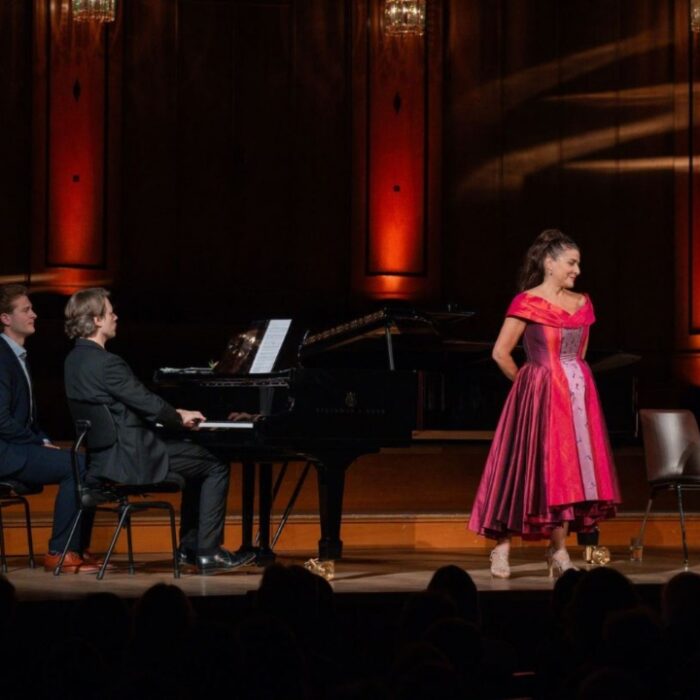
The setting for this performance was the historic Max-Littmann-Saal. With its elegant 1910s interior design, the hall offered an impressive acoustic experience. The sound was rich, warm, and clear, with just the right amount of natural reverberation. Public demand for Bartoli’s return clearly pushed the organizers to accommodate the massive crowd, the adjacent Grüner Saal had to be opened up and joined directly with the main auditorium.
On stage, Les Musiciens du Prince – Monaco provided the orchestral framework under the direction of Gianluca Capuano. Unlike their usual work in fully staged operas, the ensemble took a more supportive approach here. Instead of adding dazzling embellishments during the A’-sections of the da capo arias, they focused on providing a sensitive, warm backdrop for their star soloist. The evening began with the Sinfonia from Händel’s “Rinaldo,” taken at a slightly faster tempo than usual. The inclusion of a rare drum part added an energetic pulse to the opening.
Illuminating Performance
Bartoli made her entrance with her trademark long-sustained note capability. After two brief pieces by Nicola Porpora, she quickly moved into Vivaldi’s famous aria “Sovvente il sole” from “Andromeda liberata.” Backed by a silk-like cushion of timbre from the solo violin, Bartoli demonstrated her remarkable breath control. In the aria’s A’-section, she chose an extreme pianissimo strategy. While this created a breath-holding effect that drew the audience in, however, it occasionally felt slightly weak in terms of vocal projection into the large hall.
Following an instrumental dance from Ariodante, Bartoli performed one of Händel’s most famous melodies: “Lascia la spina” from “Il Trionfo del Tempo e del Disinganno.” Here, her interpretation choice stripped of any unnecessary distraction. She delivered Piacere’s final plea with genuine sincerity. Backed by the wavy textures of the continuo harpsichord, she again turned to a radical pianissimo for the da capo section. Her phrasing remained excellent, though the sound dropped so low it nearly verged on a mere whisper. Although one should not be overly demanding of a ‘great hit’ detached from its complete dramatic context, it was clear that considerations of sheer sonic beauty were prioritized above all else. Here the surtitle team in the royal box flashed the wrong lyrics or scrambled to catch up with the singer—that distraction unfortunately occurred repeatedly throughout the evening.
The instrumental portion that followed provided a real highlight. Les Musiciens du Prince – Monaco performed the Sinfonia from Johann Adolf Hasse’s “Marc’Antonio e Cleopatra” with exceptional clarity, bringing out the bright qualities of the score. The Grazioso movement featured a beautiful and elegant violin solo. This piece transitioned smoothly into the heavenly orchestral textures of Händel’s “Il Parnasso” from “Giulio Cesare.”
This instrumental interlude granted Bartoli necessary time for a costume change. She returned to the stage as Cleopatra to sing “V’adoro, pupille,” accompanied by dancer Giovanni Imbroglia, who framed her performance with large feather fans. Against this flamboyant backdrop, Bartoli drew the audience in with undeniable conviction, transforming the pure beauty of the music into the highest form of seduction.
This musical lure was elevated even further in Telemann’s Trumpet Concerto in D Major, which prepared the audience for the trio from Händel’s “Amadigi da Gaula,” “Mi deride… Desterò dall’empia Dite.” The piece featured a competitive dialogue between oboe, trumpet, and voice. While the trumpet’s articulation felt a bit muddy at times, the oboe delivered a highly convincing performance. The three-way musical battle was fiery and full of life, capturing the sumptuous atmosphere of the Baroque era. Although the performance here felt somewhat overly theatrical, it was entirely expected given the entertaining nature of such a summer evening concert.
Bartoli then returned to her commanding territory with Vivaldi’s “Sol da te mio dolce amore” from “Orlando furioso.” Supported by the flowing lines of a Baroque transverse flute and a texture dominated by plucked strings, her singing was captivating. After a set of dances from “Ariodante” that carried Scottish folk hints, she reappeared for “Augelletti, che cantate” from “Rinaldo.” In a playful moment of audience interaction, she walked out holding a fishing rod with birds attached to the end, deliberately maneuvering it in a clumsy and humorous way. Her highly flexible vocal lines paired beautifully with the woodwinds to recreate this classic pastoral scene.
What Passion Cannot Music Raise & Quell
The official program concluded with “What passion cannot Music raise and quell” from Händel’s Ode for St Cecilia’s Day. It was a fitting choice for an artist celebrating her 60th birthday this year. Introduced by a thoughtful cello solo, Bartoli used her characteristic elastic timbre and seasoned tone to deliver a deeply affecting performance.
The evening ended with an exceptionally generous offering of five encore pieces: Agostino Steffani’s spirited “Mie fide schiere, all’armi” from “Il trionfo del fato,” followed by a string of popular Italian melodies including “Non ti scordar di me.” Throughout these extras, Bartoli looked entirely at home, clearly relishing the spotlight and the radiant energy of the crowd. In a spa resort like Bad Kissingen, the entertaining spirit of a summer evening concert naturally takes precedence, and holding such a star-studded gala to the critical standards of Historically Informed Performance practice would be missing the point. Yet, for a festival celebrating its 40th anniversary, and for an influential singer who has contributed to shaping our modern understanding of Baroque vocal music, this highly accessible program dated from their previous “Farinelli” touring project and comfortable interpretive approach felt a bit too safe. While local holiday-makers were thrilled, dedicated music lovers who traveled from further afield were left wishing Bartoli could have offered more out of her comfort zone.
Categories
Stage Reviews