Blackwater Valley Opera Festival 2026 Review: Acis and Galatea
Lismore Cathedral Hosts A Dramatically Strong Reading of Handel Work
By Alan Neilson(Photo: Frances Marshall)
As well as its headline opera that takes place in the grounds of Lismore Castle, the Blackwater Valley Opera Festival offers a range of other events that take place at venues around the area. This year’s program included a production of Händel’s one-act masque, “Acis and Galatea” (HWV 49), from 1718, in its 1732 adaptation, in which he divided the piece into two acts with an expanded formal chorus. The performance took place inside Lismore Cathedral, which is in truth no larger than a typical parish church but which is nevertheless a beautiful building and proved an ideal space for a small scale work of this nature.
The libretto written by John Gay and others is based on the well-known tale from Ovid’s “Metamorphoses” in which the shepherd Acis and the nymph Galatea are happily living out their romance in an idyllic pastoral setting. All is peace, pleasure and harmony, when into their world bursts the cyclops Polyphemus! Lusting after Galatea, who is not at all interested in him, he immediately turns his attention to the unfortunate Acis and kills him. Distraught by her loss, Galatea responds by turning his body into a stream so that he will remain by her side in the natural world. It is a simple story that breaks down into two discrete acts; the first conjures up the beauty of pastoral bliss, while the second act plays out the tragic events following Polyphemus’ arrival on the scene.
The audience was seated in the main body of the church with the orchestra positioned on a small raised platform in the transept. Although it was essentially a concert performance with the soloists positioned in front of the orchestra, they made use of most of the available space, which gave it a more theatrical appearance. The chorus moved in from the sides as required.
There was no added scenery; the layout of the church itself proved an ideal backdrop. The lighting was beautifully managed to create a variety of emotionally strong colors that lit the chancel, situated behind the performers, to create a changing evocative setting that successfully supported the drama. Unfortunately, the lighting designer was not named in the program.
Ruthven Guides the Cast in a Convincing Reading
The musical director Oliver-John Ruthven oversaw a beautiful, well-paced, elegant interpretation from the Irish Baroque Orchestra, with each number carefully fashioned to promote the affect and knitted together to form a compelling musical drama. The balance between the musical forces was sensitively measured throughout, allowing the singers’ voices to shine.
Soprano Jade Phoenix wore her heart on her sleeve with an emotionally strong portrayal of Galatea. Recitatives were neatly crafted and delivered with meaning while her singing was expressively aligned to the text. Her first aria, “Hush, ye pretty warbling quire!” was robustly embellished to mimic bird song, replete with short coloraturas, which perfectly reflected her strong desire for Acis, while in her lament “Must I still my Acis still bemoan,” accompanied by the chorus, she gave voice to her pain following the death of Acis with a moving interpretation that showed off the quality of the melody and her delicate phrasing.
Tenor Dean Power presented Acis as an earnest, deeply committed lover. In the first act, he sings two arias, in which he used his clear, articulate diction, sensitive phrasing and the subtle colors of his palette to convincingly express his deeply felt love. However, in Act two everything is thrown into chaos. Recitatives became anxious and fraught, and in his aria “Love sounds th’ alarm,” he ramped up the passions with a stirring, energetic and determined rendition, although with the loss of a little beauty in the process.
Together, Phoenix and Power developed a compelling interpretation, one that brought out their mutual feelings of love, upon which the drama ultimately rests, and which was wonderfully illustrated in their duet “Happy we,” which brought the first act to its joyful conclusion, in which their voices combined to deliver a series of pleasing embellishments and which set the scene for the arrival of Polyphemus at the start of Act two.
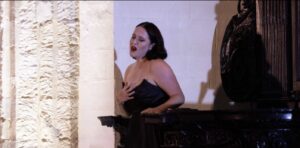
Bass-baritone Yannis Francois made a powerful entrance as Polyphemus, walking down the aisle from the church doors to the staging area to the sound of the chorus singing “Wretched lovers.” After which, he immediately launched into an angry passage of recitative followed by his introductory aria “O ruddier than the cherry,” which quickly established Polyphemus’ character. However rather than the raging wildness of a beast, Francois presented him as confident, determined and proud with a cold, well-focused intent. His distinctive, dark tones echoed around the stage, immediately suggesting imminent and real danger. His voice contrasted starkly with the more emotional, brighter tones of the two lovers and helped create the necessary musical tension. Rather than engaging in the physical act of murder, Polyphemus ended Acis’ life by leading him off the stage and into the afterlife. There was no violence, no rage, only a cold inevitability while Galatea was left crying in the church pulpit.
Tenor Patrick Hyland made a strong impression in the relatively small role as Damon, a wise shepherd, who offers a reasoned philosophical perspective. He possesses a light voice with a pleasing tone, which he used expressively in rendering his two arias, although his diction was somewhat untidy, which made his words difficult to understand.
The chorus of twelve singers was in fine form, delivering a series of beautifully balanced and harmonically captivating pieces, in which the final chorus, “Galatea, dry thine eyes,” was a delight.
The cast and orchestra received a well-deserved standing ovation from an appreciative audience. It was an excellent performance, beautifully presented in a perfect venue!