Teatro alla Scala 2025-26 Review: Carmen
Maestro Myung-Whun Chung Leads Damiano Michieletto’s New Production Alongside Illuminating Cast
By Bernardo Gaitan(Photo: Brescia e Amisano © Teatro alla Scala)
There are works that endure through time because they contain questions that no era has ever been able to answer completely. “Carmen” is one of them. Since its controversial Paris premiere in 1875, when the Opéra-Comique witnessed an audience bewildered by a story centered on a woman who rejected the social and emotional conventions of her time, Georges Bizet’s final opera has continued to challenge successive generations of spectators.
Born amid initial incomprehension and the moral outrage of a society unprepared to accept a woman who claims her sentimental and sexual freedom, “Carmen” eventually achieved extraordinary popularity. Yet that very success conceals a trap: the weight of a stage tradition built upon folkloric clichés, exoticism, and a superficial understanding of its characters. Every new production must inevitably confront that legacy, deciding whether to reproduce it or to question it.
Damiano Michieletto’s Production Details
The new production presented at Teatro alla Scala, a co-production with the Royal Opera House in London and Madrid’s Teatro Real, brings together Italian Director Damiano Michieletto and Maestro Myung-Whun Chung on the Milanese stage for the first time. It is a particularly anticipated collaboration, considering that the Korean maestro will soon succeed Riccardo Chailly as the theatre’s Music Director. As is often the case with productions signed by Michieletto, the performance provoked a clear division between supporters and detractors.
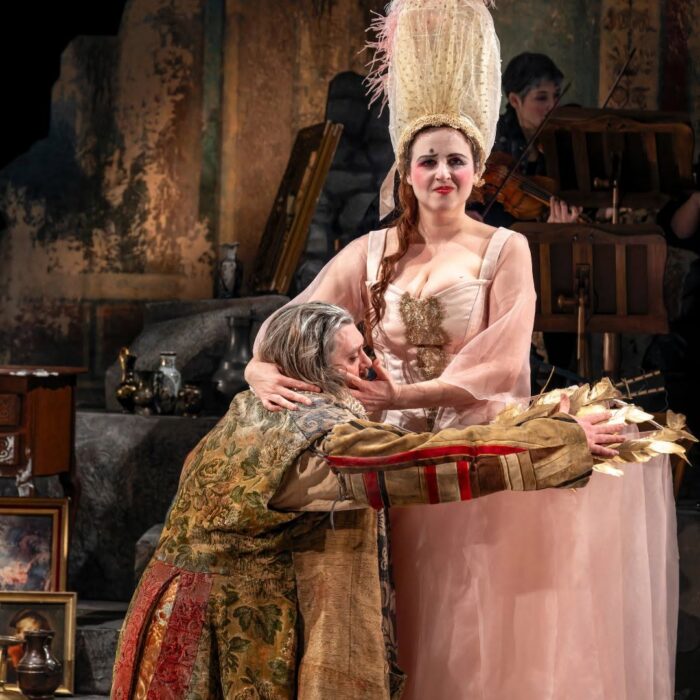
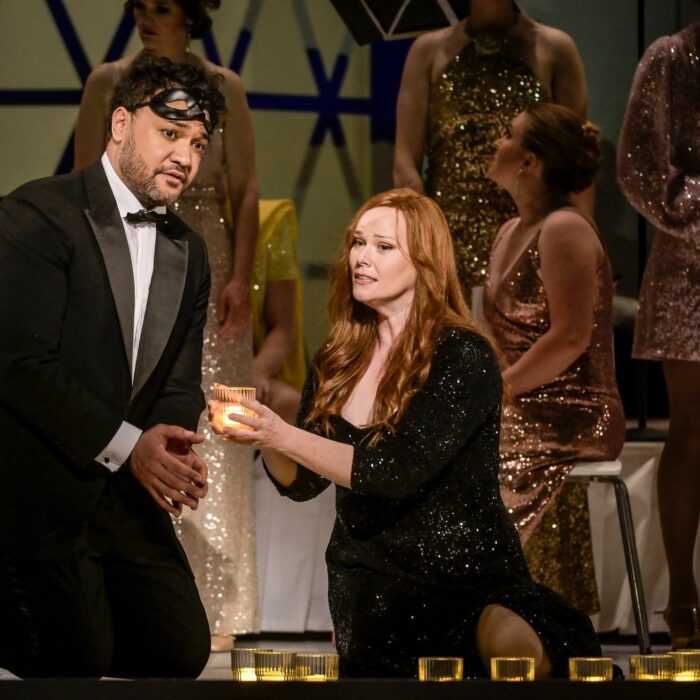
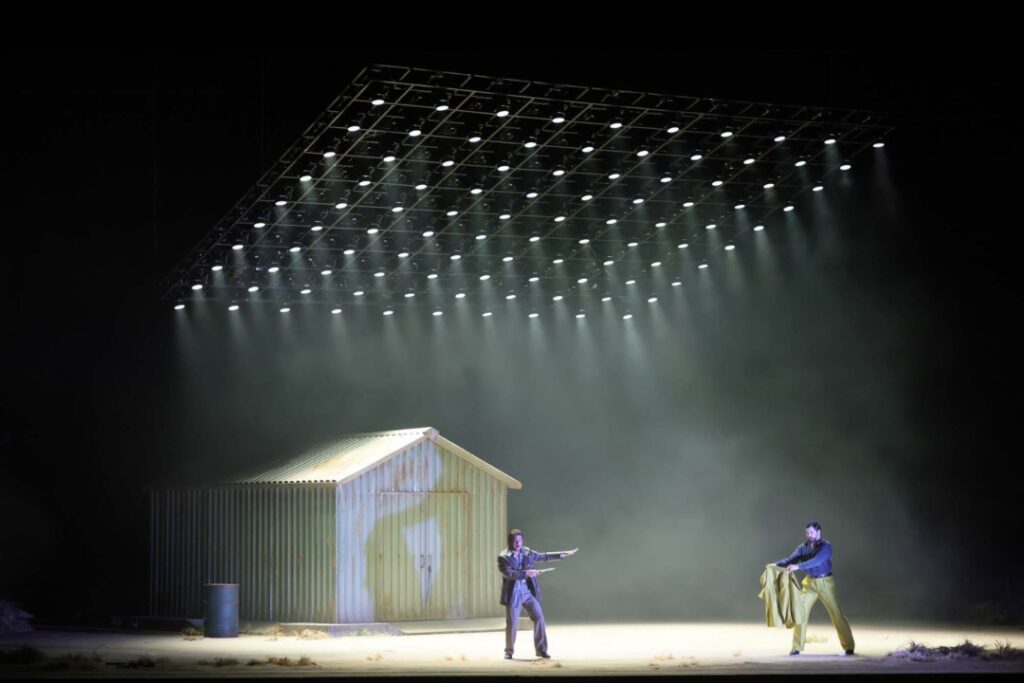
Far removed from the provocations that have characterized some of his previous work, Michieletto opted for a restrained reading. There is no desire to shock or radically rewrite the plot; it is certainly not the Venetian director’s finest achievement, but it fulfills its purpose and works effectively. The central concept of the production revolves around fate. The most significant addition to the staging is the woman dressed in black who appears throughout all four acts. She may be interpreted either as the embodiment of destiny or as Don José’s mother transformed into a ghostly presence; the symbol is evocative, although at times somewhat repetitive. Romantic, colorful Seville, together with the familiar Iberian clichés, almost entirely disappears, giving way instead to a rural Spain of the 1970s.
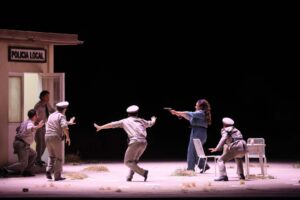
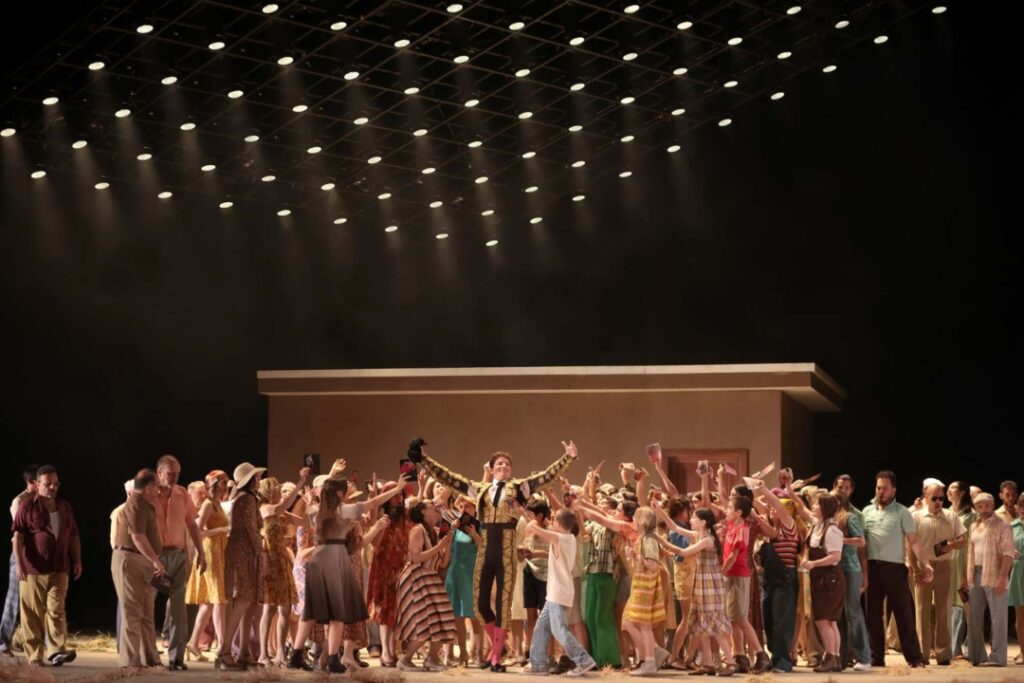
Set Designer Paolo Fantin conceives the stage space as a succession of stark environments dominated by a single structure that continually transforms itself, from the police barracks to Lilas Pastia’s clandestine tavern, where the characters seem trapped from the outset in a destiny from which there is no escape. The dramaturgy developed together with Elisa Zaninotto, in addition to the numerous cuts to the spoken dialogue, focuses attention on the opera’s central conflict between possession and individual freedom.
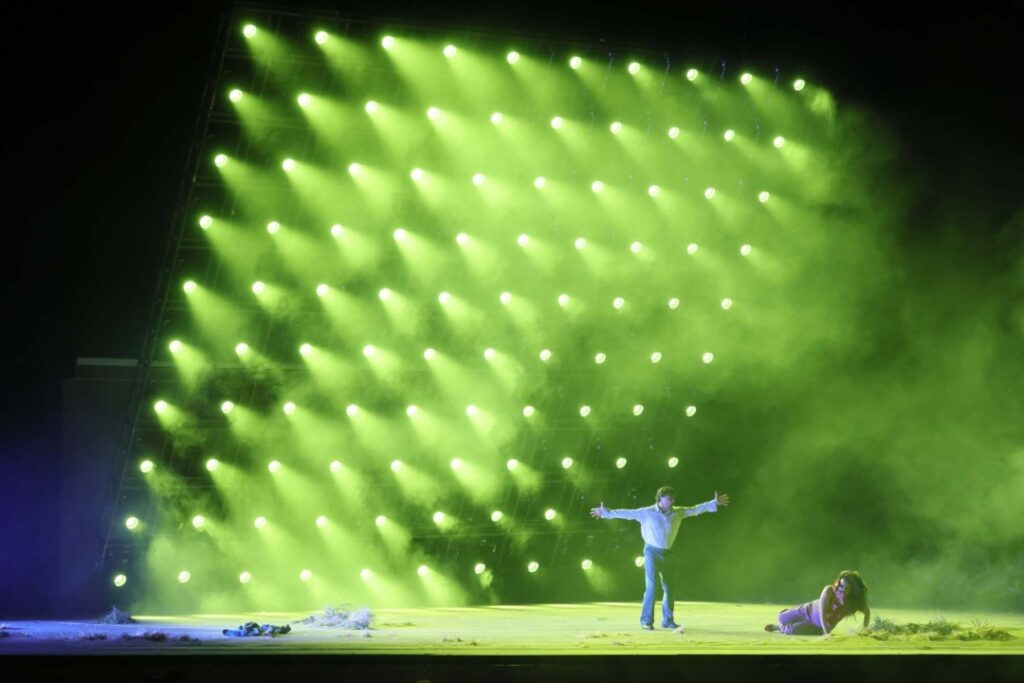
Alessandro Carletti’s lighting plays a decisive role in shaping the overall atmosphere through precise and expressive lighting effects, particularly effective in the final act. Carla Teti’s colorful contemporary costumes complete a coherent visual universe that deliberately avoids any temptation toward picturesque realism.
(Photo: Brescia e Amisano © Teatro alla Scala)
Maestro Myung-Whun Chung’s Musical Highlights
From the podium, Myung-Whun Chung offered a refined and transparent interpretation, aimed at highlighting the harmonic, timbral, and melodic richness of Bizet’s score. Leading the Orchestra of Teatro alla Scala, whose sound was luminous, balanced, and meticulously crafted, the Korean conductor favored detail and elegance throughout the musical discourse. The quality of the conducting was beyond dispute, especially in the orchestral passages, with a remarkably clear prelude and particularly inspired entr’actes. Always attentive to the singers’ needs, Chung shaped the opera’s changing atmospheres with great sensitivity, while the outstanding Teatro alla Scala Chorus, prepared by Alberto Malazzi, together with the Children’s Chorus directed by Brunella Clerici, delivered a performance of the highest standard, distinguished both by the quality of their singing and by the impressive fullness and power of the ensemble.
Clémentine Margaine as Carmen
Naturally, the audience’s attention centered on the vocal cast. Clémentine Margaine took on a role she has performed for years on the world’s leading stages. She possesses a substantial voice of attractive color, with resonant lower notes and solid projection. Nevertheless, her performance left mixed impressions. From a purely vocal standpoint, there were noticeable intonation inconsistencies and certain harshnesses in the emission, particularly in the upper register.
Margaine’s French diction remained exemplary, and her phrasing demonstrated considerable musical intelligence. However, the “Habanera,” “Seguidilla,” and “Chanson Bohème” failed to convey the full sense of fascination and freedom one would expect and it was surprising that none of the three numbers elicited applause.
In the opera’s darker, more fatalistic moments, however, Margaine found a brutal severity that perfectly suited Michieletto’s vision. Her death scene proved particularly striking, as Carmen is hanged rather than stabbed, as prescribed in the libretto.
(Photo: Brescia e Amisano © Teatro alla Scala)
Vittorio Grigolo as Don José
The undisputed triumph of the evening was Vittorio Grigolo’s portrayal of Don José. The Italian tenor offered a complex and deeply human characterization of the role. Vocally, he was in excellent form: the emission was firm, the instrument retained both breadth and brilliance, the high notes were secure, well placed, and deeply expressive, while the phrasing revealed thoughtful preparation and musical intelligence.
“La fleur que tu m’avais jetée” became one of the undeniable highlights of the performance, sung with sensitivity, dynamic control, and genuine emotion. Above all, however, it was in the final two Acts that the tenor achieved his greatest accomplishments. Most admirable was his acting, as he succeeded in conveying the character’s inner violence without ever descending into histrionic excess.
More Illuminating Cast Details
Slávka Zámečníková offered a highly musical and refined Micaëla. Her voice possessed a bright, agile, and very appealing timbre, supported by clean vocal production and a remarkable command of legato. The production presents the Slovak soprano as a shy, almost childlike young woman. Within those parameters, she created a character that was both believable and sincere. Her great third Act aria, “Je dis que rien ne m’épouvante,” was delivered with fine musicality and expressive sensitivity. Her duet with Don José, “Parle-moi de ma mère!” proved vocally solid and stylistically impeccable on the part of both singers.
(Photo: Brescia e Amisano © Teatro alla Scala)
More debatable was Giorgi Manoshvili’s Escamillo. The Georgian baritone possessed an attractive vocal instrument, with a robust middle register and resonant low notes, yet he failed to endow the character with the indispensable charisma it requires. The voice carried well throughout the theatre, although the upper register occasionally acquired a certain roughness. Above all, one misses a stronger stage presence. His Toreador lacks the necessary combination of arrogance, charm, and virility that defines the role. The final result is competent, but ultimately insufficient for a character of such prominence.
Among the supporting roles, Pierre Doyen and Loïc Félix stood out as Dancaïre and Remendado, proving equally effective both musically and theatrically. Likewise, Sarah Dufresne and Marine Chagnon, as Frasquita and Mercédès respectively, were responsible for some of the freshest and most vibrant moments of the performance. Simone Del Savio as Moralès and Xhieldo Hyseni as Zúñiga also delivered solid performances.
This Milanese “Carmen” ultimately leaves a complex and, in some ways, contradictory impression. It is not a revolutionary production, nor does it aspire to be one. Nevertheless, the audience–composed largely of tourists–responded as expected, warmly applauding the four principal singers while also giving Maestro Chung an enthusiastic welcome.