Opéra Royal Château de Versailles 2025-26 Review: Gasparini’s ‘L’Avare’
New Production by Le Poème Harmonique & Coproduced by Théâtre de Caen and Château de Versailles Spectacles
By Jennifer Pyron(Photo:
Francesco Gasparini’s “L’Avare” (“The Miser”) is an intermezzo inspired by French playwright Molière’s five-act comedy in prose also titled “L’Avare.” It includes three singers and one mime accompanied by a small ensemble that tells the story of a pathological miser (Old Pancrazio) turned widower with severe paranoia about his box of gold that he buried in his garden being stolen. Pancrazio ultimately spirals down a farcical turn of events that take place after someone does steal it. But who?
This year’s “L’Avare” at the Royal Opera House of Versailles is a new production by Le Poème Harmonique, Director Théophile Gasselin, Scenography and Assistant Director Louise Caron, coproduced by Théâtre de Caen and Château de Versailles Spectacles, with sets created by Espace & Cie in Vénissieux, costumes by Alain Blanchot, and lighting by Christophe Naillet.
Conductor and theorbist Vincent Dumestre led the ensemble Le Poème Harmonique and cast members including Eva Zaïcik as Fiammetta/Fichetto, Victor Sicard as Pancrazio, Serge Goubioud as Nutrice, and Stefano Amori as Valletto/mime.
Production Details
Italian composer and teacher Francesco Gasparini was considered a leading opera composer by the end of the 17th century, having composed approximately 60 operas. His dramatic style paired with traditional vocal compositions made his work appealing to audiences in the past and continues to entertain today.
“L’Avare’s” libretto by Antonio Salvi tells the story of Pancrazio from the perspective of a female character, Fiammetta. The fast paced production generated energy from the start and sustained the attention of audiences members entirely (I watched children leaning forward in their seats in awe and one in particular very curious about who actually stole Pancrazio’s gold!). The costumes by Alain Blanchot paired perfectly with the set design’s French painter Jean-Antoine Watteau aesthetic. The soft hues and constant motion of the performers brought to life a natural Baroque style, fitting neatly in Versailles’ Royal Opera hall.
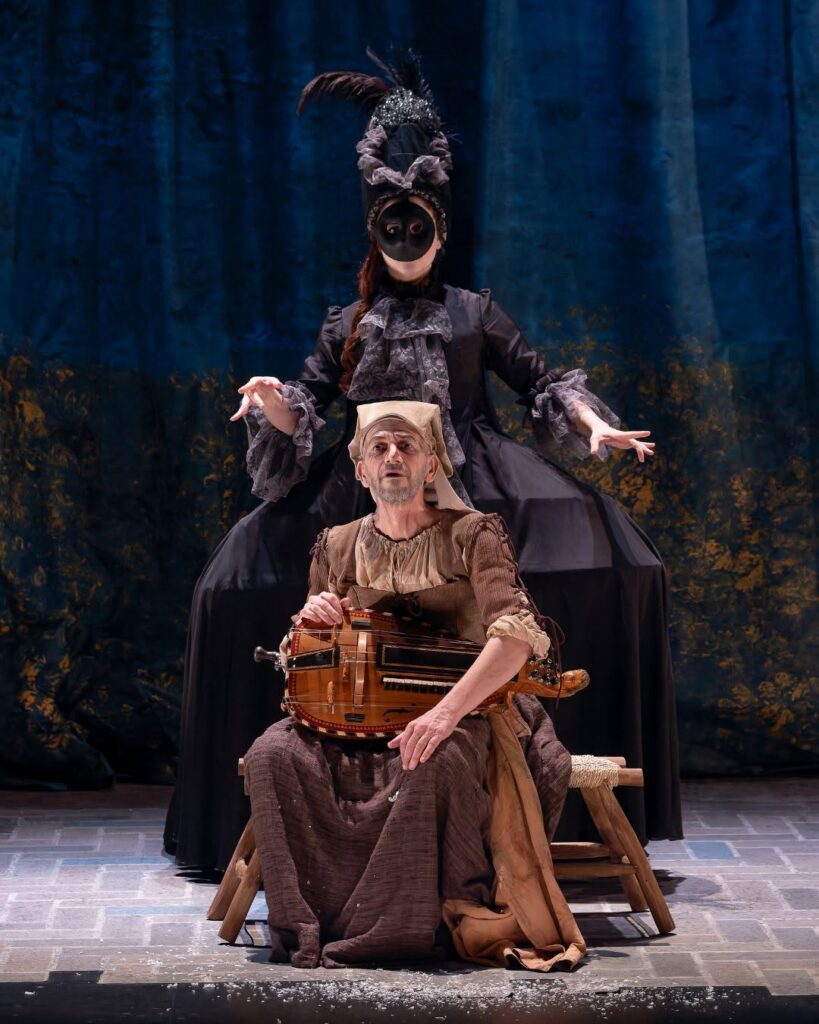
The opening scene revealed a dark curtain with candles lit and the last remaining servant of Pancrazio’s dilapidated mansion wearing worn down clothes, ready to tell his side of the story with a hurdy-gurdy drone playing in accompaniment. The opera hall’s decadence was cast in shadows and audience members sat upright to listen intently to him. Then a clanging of metal resounded loudly, interrupting his story only for a moment, before he returned to it. The servant’s voice grew louder as his story intensified.
Le Poème Harmonique was on stage left and they played enthusiastically as Fiammetta sang about her devious plan to dress as a servant and gain access into Pancrazio’s mansion to steal his gold. Pancrazio entered the stage dressed in attire from the rising bourgeoisie of the early 19th century. His manner was sloppy and old, yet rambunctious enough in his attempts to scurry about for Fiammetta. The ensemble’s tempi, led by conductor and theorbist Vincent Dumestre, drove the production forward while paying close attention to the set changes and performers acting the entire time. The most crucial factor was the ensemble and their placement on stage for the production. This made their performance vitally relevant to what the singers were doing with the libretto and together they embraced the farcical genius of “L’Avare.”
The two most striking moments in the production happened when Pancrazio pushed his way through the audience in desperate search of his stolen gold. He pressured audience members and asked others if they had seen his gold, accusing everyone everywhere of taking it from him. The audience rolled in laughter and a lot of kids were up in arms or seen walking around trying to help him find it. At one point, Pancrazio made it back on to the stage and dared a violin player to show him the gold in her violin. When she stayed put and looked at him in confusion, Pancrazio grabbed her violin and slammed it to the ground before then stomping heavily on it himself. The child who was curious from the beginning of this performance screamed in disbelief. Luckily, his guardian was able to inform him that the violin was a prop and not the actual violin being played. Yet, the child, and most of us in the audience, were in a state of shock. It really was quite the show stopper!
The servants interspersed moments of story-telling were beautifully captivating as it allowed the tempo to slow and everyone to catch their breath from all the excitement. The mime’s acting was also excellent in maintaining the quiet balance of action happening in between the notes. Watching him felt like a meditation of sorts, especially as he was doing tricks around Pancrazio’s madness. The slower motions made the harsh haste of Pancrazio that much more obvious and effective. All together this new production was an absolute success in its delivery and ability to engage audience members of all ages. Very rarely does a live performance find their magic recipe in this way. It was charming and delightfully absurd!
Stellar Cast
Soprano Eva Zaïcik as Fiammetta and Fichetto was a master at multitasking and maintaining her vocal stamina throughout her many roles and physical activity (especially while keeping up with Pancrazio’s insanity). Zaïcik’s grace in her presence made the stage feel bright and alive as she wove her web of deception. Her soft pink gown with gold details was particularly romantic.
Baritone Victor Sicard as Pancrazio gave an outstanding performance. His voice resonated fully and thoroughly in the hall. His diction was excellent and it was a pleasure to hear him sing. Even during his most exhausting activity his voice was intoned and on time with the ensemble. His various facial expressions and intelligent cadences made this production run like a clock in its ability to attract one’s attention and satiate one’s mind. Intelligent wit is a fine line to walk especially when performing and Sicard did so with complete aplomb. His sound effects when racing through the audience and snickering at everyone for stealing his gold was absolutely hilarious, even his exaggerated sobs made people laugh.
Tenor Serge Goubioud as Nutrice performed with true dedication to his vital role as story-teller and servant. His interludes of consciousness made the story feel more real and like the audience was in quite conversation with him in this realization. There was a mutual understanding that he developed with the audience and carried forward with him as the libretto unfolded. This made the production life-like in its approach. The broken fourth wall became a bridge to one’s own imaginary landscape.
Stefano Amori as Valletto and mime was the web that held all the action together in harmony. His precision and manner of gentleness in his performance was outstanding. Amori’s quiet disposition was the respite this production nurtured and one of the main reasons why it flowed effortlessly among such a tight-knit cast of grandiose personalities.