The Conductor-Singer Relationship, Centered on Speranza Scappucci and Her Masterclass at the Royal Opera House
By Dr. Zoran MilosevicThe relationship between a conductor and a singer is one of the least examined and most consequential elements of operatic performance. Audiences follow the voice. Critics assess the voice. The conductor, who shapes the tempo the voice breathes within, the space it is given, the dynamic world it moves through, tends to appear in reviews as a presence behind the music rather than a shaper of it. And yet the difference between a voice that sounds merely accomplished and one that sounds alive often has as much to do with what is happening in the pit as with what is happening on the stage.
Not all conductors approach the voice in the same way. There is a tradition, particularly in the symphonic world, that treats the singer as a soloist to be accommodated, a presence whose needs must be managed within a larger musical architecture that the conductor controls. The orchestra has its own integrity, its own argument, and the voice is one element among many. This approach produces results of a certain kind: precise, well-balanced, sometimes magnificent. But it is a different relationship from the one that the great opera conductors have cultivated, in which the voice is not accommodated but served, and in which the conductor’s primary task is to create the conditions in which the singing can become fully itself.
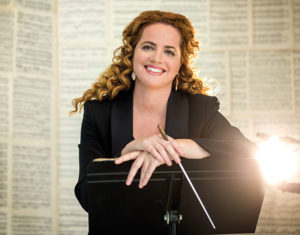
Speranza Scappucci belongs firmly to the second tradition, and her path to conducting makes clear why. Now Principal Guest Conductor of the Royal Opera House, she spent fifteen years as a répétiteur and coach in some of the most prestigious opera houses in Europe and America, including the Metropolitan Opera. Her transition into conducting came not through academic training in the art of the baton but from the inside of the music, from years of sitting at the piano beside singers as they learned roles, found their way into characters, and discovered what the composer had placed inside the score. She knows the voice not as a conductor who has studied it but as someone who has accompanied it, coached it, supported it and, on occasion, unlocked it.
Among the finest opera conductors working today, Scappucci was shaped decisively by her work with Riccardo Muti, with whom she spent eight years at the Salzburg Festival as pianist, coach and assistant, including on the celebrated 2011 “Otello” at the Chicago Symphony Orchestra. Muti is not primarily known as a singer-friendly conductor in the conventional sense. He is demanding and precise–a conductor for whom the score is sacred and interpretive liberty is to be earned rather than assumed. What Scappucci took from him was something more fundamental: a seriousness about the relationship between text and music, and the conviction that the orchestra is never secondary to the singing, nor the singing to the orchestra. The two must breathe together.
She has spoken directly about what her years as a coach gave her: “Having that experience of coaching means I know how to talk to singers, how to find solutions. No two sopranos will be the same as each other, so you have to adapt your own ideas and be flexible. That doesn’t mean being subservient to the singer. It just means working collaboratively.” The distinction is important. Collaboration is not compliance. A conductor who simply follows the singer, adjusting tempo and dynamics to whatever the voice happens to do, is not giving the singer anything. The conductor who collaborates is one who has a complete musical vision and knows how to draw the singer toward it, meeting them where they are and taking them somewhere further.
I witnessed this quality directly at a talk and masterclass Scappucci gave recently at the Royal Opera House. The soprano, Jette Parker Young Artist Hannah Edmunds, was singing the final aria from Donizetti’s “Anna Bolena.” The voice was capable and the preparation evident, but the performance was cool where the music demanded warmth, technically secure where it needed simply to breathe. What was missing was not in the notes. It was in the relationship between the notes: in the rubato, the breath, the sense of phrasing shaped by feeling rather than by training.
Scappucci worked first with words, on the rubato at the aria’s opening, on how the phrase should breathe. Then words gave way to demonstration. She moved to the piano and played the passage, not as an illustration of a technical point but as a complete musical statement, shaped with the confident freedom of someone who has lived inside this repertoire for decades. The phrase arrived as if it could not have been played any other way. The rubato was not imposed on the line but breathed into it, each hesitation and each impulse forward feeling like a natural consequence of what had come before.
Then she stepped back. The accompanist returned to the piano. Scappucci stood before the singer, not at the keyboard but in the space between singer and music, where a conductor lives. And Edmunds sang again, now with the musical image Scappucci had placed in the room still present in her ear, and with a conductor drawing her toward it through gesture and intention rather than instruction. The phrasing opened. The breath lengthened. The emotional nuance that had been absent arrived not as something added from outside but as something released from within. The singer appeared surprised by what she found herself doing; there was a quality of discovery in the voice that had not been present before.
What Scappucci had given Edmunds in those twenty minutes was not a correction. It was a destination. She had shown the singer, through playing and then through conducting, what the music contained and where it wanted to go. The demonstration had placed a musical image in the room; the conducting had drawn the singer toward it. The two phases were inseparable: the image without the conducting would have been an illustration, and the conducting without the image would have been instruction. Together they were a transformation.
This is what the greatest opera conductors know that others do not: that the voice has an inner life that cannot be reached by analysis or command, only by being shown where it might go and being given the space and the musical support to get there. It is a knowledge that comes from having worked beside singers, having accompanied them at the piano through hundreds of rehearsals, having understood their instrument from the inside rather than from the podium. Scappucci’s years as a répétiteur were not a prelude to her conducting career. They were its foundation.
Hannah Edmunds is a young singer at the beginning of a career that, on the evidence of that evening, will be worth following. But what she found in that aria, what she allowed herself to discover under Scappucci’s guidance, was something that no amount of solitary preparation would have given her as quickly. The conductor had been in the room. That made the difference.
Categories
Special Features