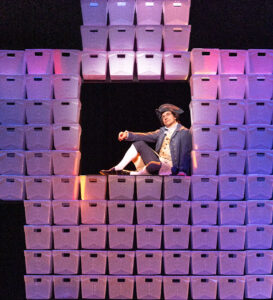
An Opera in Poems – American Opera Projects Brings Benjamin Franklin & ‘The Post Office’ to NYC
By Patrick Sauer(Photo Credit: Sarah Peet)
In 1753, a 47-year-old Philadelphia writer, editor, scientist and inventor was given a new title by his London overlords. The British Crown named Benjamin Franklin “Deputy Postmaster for the Colonies,” a position he’d sought, and financially lobbied toward, for a couple of years. The gig offered a way to spread publications and patronage. Multiple family members were given jobs, including the son he put in charge of Philly. Franklin wasn’t in it just for the perks though, the ever-ambitious polymath had a progressive vision for what the postal service could be. As described in Walter Isaacson’s authoritative 2003 biography “Benjamin Franklin: An American Life,” he hit the ground running:
“Franklin drew up typically detailed procedures for running the service more efficiently, established the first home-delivery system and dead letter office, and took frequent inspection tours. Within a year, he had cut to one day the delivery time of a letter from New York to Philadelphia.”
Franklin’s efforts to create a modernized system came twenty-three years before the colonies even fought their way into becoming a country. What’s remarkable is that in this year of the American Semiquincentennial, as the country exploded in size and population over 250 years, many of Franklin’s forward-looking initiatives haven’t changed or even needed improving upon. For the low price of .78-cents, you can still send a letter anywhere in the United States—even the 5,000-miles from Fairbanks, Alaska to Key West, Florida–and it will be get there in a few days regardless of snow, rain, heat or the much creepier “gloom of night.”
Since its modest colonial beginnings, the American mail journeys always begin in the humblest of buildings, your local post office. Maybe it’s been a minute since you had an errand requiring a trip there, but rest assured, they are still doing yeoman’s work to the 2025 tune of delivering 109-billion pieces of mail to 167-million addresses. The post office also serves as a bedrock small-d democratic institution, utilized in some fashion by all manner of citizenry, and a workplace for some 624,000 employees. From the grand ornate marble palaces of the country’s oldest cities, to the simple wooden country shacks, and every other version in between, post offices are among America’s greatest accomplishments. At the Brooklyn Academy of Music, one such place from Anytown U.S.A., serves as the contemporary setting of “The Post Office: An Opera in Poems,” a new work presented by American Opera Projects that runs from May 16-21 in its New York City debut.
“’The Post Office’ is about people of different backgrounds, beliefs, religions, races, sexualities, and so on, stuck together having all this drama and not getting along. It’s who we are as Americans right now,” says poet, critic, and first-time librettist Elaine Sexton.
“The Post Office” is a collaboration between Sexton and composer Laura Kaminsky, whose first confab was on a poem-into-song called “Marriage Equality,” part of a 2019 celebration of the 50th anniversary of the Stonewall Uprising. Their new opera expands upon the ideals of their first artistic partnership. In ‘The Post Office,’ three employees, a customer, the ghost of Ben Franklin, and the building itself, all play roles in trying to grasp, today, what truths are self-evident, who exactly is endowed with inalienable rights, and are all men, women, and LGBTQIA citizens really equal? (Created, yes; Legislated, no.) However, this is no dry-eraser C-SPAN lecture, it’s a rousing work built around old friends Frank, the white senior clerk, and Ben, the Black postmaster, clashing over the former’s impending wedding to his male partner. All that and singing stamps make it a must-see for the aria-loving philatelists in your life.
“I love going to the post office because I’m obsessed with ritual and bureaucracy, so I’m really excited to build the production in a visual way that represents the machinations of what goes on there, the repetitive taping, stamping, sorting, mailing, all while characters are wrestling with big questions,” says director Kevin Newbury, a recent convert to “Mailin’ It!,” the official USPS podcast.
It’s a lean operation, with a 70-minute runtime, roughly how long it takes to send out holiday packages two weeks before Christmas. Instrumentation comes from a lone piano animating Charles Renfro’s ingenious uncluttered office set constructed entirely out of mail bins. Busywork happens alongside a sorting desk, front counter, and a platform ladder for America’s spectral bespectacled Founding Father. Portraying Franklin as the Ghost of American Crises Past is a whimsical touch that also makes logical sense. Joining the fray is exactly what ole’ Silence Dogood is known for, if indeed, he’s really out-and-about haunting local PO Boxes.
“Franklin is watching these contemporary disputes over issues they battled over 250-years ago like separation of church-and-state, and he gets pulled in because so much of the utopian conception of American democracy is still to be realized,” says Kaminsky. “We’ve lost the ability to have civil discourse. The crux of the drama for me is the shattering of a long-running friendship between Ben and Frank, even more than the arguments over marriage equality, a toxic environment playing out everywhere.”
The connections formed-and-frayed between the Declaration of Independence written then and alive in the U.S. now is a central theme of “The Post Office.” When writing compositions, Kaminsky always comes up with a game to play, so she went back to the number thirteen–as in the original colonial America counting its lucky stars-and-stripes–to structure the piece. The majority of the music is in 13th, “a very difficult thing for people to count in music… the singers are all mad at me,” she says with a laugh, adding, “Elaine isn’t a musician, but the back-and-forth between the two of us was amazing. I would send her these digital sounds against the printed text so she could approximate what actual performers will sound like and if there is enough time musically for that particular emotion. She informed the music and I informed the words.”
“The Post Office” was commissioned by Queen City Opera, and workshopped by Cincinnati Opera and Cincinnati College of Music’s Opera Fusion: New Works program, featuring a performance of excerpts held a year ago, March. American Opera Projects, on a mission to discover worthy new works, liked what it saw and brought it to BAM, who was seeking new works. BAM liked it and fast-tracked the show as to be part of the nation’s 250th birthday. It’s been a whirlwind of a production.
“Pressure makes the diamond,” says Newbury. “I love jumping in and working quickly, because you have less time to second guess yourself, and have to trust your instincts when making fast decisions.”
Artistic alterations can be made on the fly, but the fundamental contradictions at the heart of the American experiment are eternal. Look no further than Ben Franklin himself. His household enslaved at least seven people and he profited by running ads for the sale of enslaved people in his newspaper, The Pennsylvania Gazette. At the same time, he also ran anti-slavery Quaker notices and later-in-life, publicly called for the end of slavery and served as president of the Abolition Society.
In 1776, all men weren’t equal and it’s still playing out in some form or another in 2026. All three principles nodded in agreement that gay marriage may be “settled law” today, but who knows what tomorrow brings? To say nothing of the constant torrent of inequitable abuse against trans-Americans. What’s fascinating about the gay creators behind “The Post Office” is that for them, these issues and situations are more than theoretical, moral, ethical or even theatrical. They’re visceral, literally driving a career a wedge between the desire to create vibrant, resonant art and up-to-the-minute political realities.
Newbury was part of the creative team that pulled the opera “Fellow Travelers”–based on a 2007 Thomas Mallon novel about the anti-gay “lavender scare” of the 1950s–from the 2025-26 Kennedy Center schedule. Stating in a joint letter to the Washington National Opera, “The expansion of freedom and liberty for all people are core values of the opera and the book upon which it is based. The current administration’s takeover of the Kennedy Center and many of its policies contradict those values.”
The flip side of this hideous commemorative coin is what Laura Kaminsky endured. Her successful 2014 chamber opera “As One“–which traces the coming-of-age experiences of Hannah, a small-town transgender woman–was derided by the White House for a 2022 production in Bogota, Colombia as part of a State Department goodwill soft power program. Press secretary Karoline Leavitt singled out the “transgender opera” as an example of $47,000 “waste and abuse” by USAID, getting both the production cost and funding body wrong in the process, but standing behind the sentiment nonetheless.
“Operas don’t have a gender,” Kaminsky wryly points out, adding that she had multiple projects shuttered in the wake of the White House harangue. The creators of “The Post Office” were not deterred. Pride over fear. As Franklin put it, either write things worth reading or do things worth the writing.
“I feel honored to be on the front lines of the culture war, especially with material that has a queer bent to it, made by a team of queer artists, taking on queerness as a central springboard for a larger conversation,” says Newbury. “I feel lucky, I wake up and get to do interesting work every day that speaks to this moment.”
At BAM the moment won’t last long, but since there are USPS branches everywhere, there will be future runs. Productions are in the works for the upcoming years in Cincinnati and Chicago, and conversations are being had about bringing “The Post Office” to New Mexico and Arizona. Combine the themes of democracy, harmony, belief in bedrock American institutions–how else are you going to get your jury duty summons?–with a small cast, a stripped-set and a single piano, and there is a clear path for the opera to become a community favorite, no matter the size of the company or audience.
“I’ve written five books of poetry, and this opera, which is also a book of poems, is the first to address subjects like democracy, decency, and truth head on,” says Sexton. “I’d be happy if these were things we didn’t have to talk about, but things Franklin would’ve assumed were settled are still undefined and up in the air today.”
The final word on this intriguing new work goes to Ben Franklin, as channeled through his 2026 librettist, “Even as the Earth’s axis shifts like a frisbee, the mail will get where it is expected to go.” “The Post Office” promises to deliver one and the same.
Categories
Special Features