Irish National Opera 2025-26 Review: The Cunning Little Vixen
A Largely Underwhelming Staging Saved by Charlotte Corderoy’s Compelling Musical Direction
By Alan Neilson(Photo: Ruth Medjber)
Irish National Opera’s production of Janacek’s “The Cunning Little Vixen” proved to be a valid, yet commonplace, sentimental, child-centered reading, which unfortunately failed to delve below the surface narrative, although this was not the intention of its director, Sophie Motley.
The Director’s Ideas Fail to Translate into Practice
In her program notes, Motley explained that her aim was to portray the life cycle of the vixen so that her “death is not sad but part of the natural cycle” and to present the animals so that they were “not bound by the longing for human emotions.” Furthermore, she wished to depict the Forester in a more positive light, in which he treated his forest in a more “equitable way,” respected the animals and became a “better human.” She concluded by stating that she wished the overall impression would be that of an adult fairytale. Such an array of disconnected aims was always going to be difficult to achieve, and in the end, she achieved none at all.
Of course, the idea of trying to present the animals without human emotions was always unlikely to succeed on so many levels. While a courtship between the two animals is perfectly acceptable, the other animals’ disapproval of the foxes immoral behavior is a fundamentally human response and the actual marriage ceremony overseen by the happy creatures of the forest is the stuff of a child’s imagination. Motley actually added to this impression by having the animals play up the fun element of their behavior in a very human way. At one point one of the animals spoke directly to the audience and managed to garner a few laughs from the audience — it would have been difficult to have presented the animals in a more anthropomorphic form, even if that had been the aim.
Occasionally, Motley’s decisions appeared to actively act against her desired aims, not least in having the Forester morph into a more sympathetic character, at one with nature, following his killing of the vixen. It was not only at odds with his fundamental outlook on life, but it also actually gave the performance a sentimental ending, which consequently undermined the natural condition that killing plays within the life cycle.
On the other hand, her staging of the vixen’s death was exceptionally well done. She was shot in a matter-of-fact way without drawing attention to the bloody nature of the deed. It was unlikely that even the young children in the audience would have been upset by the scene. It effectively captured the nature of the life cycle: the vixen dies but life continues without even a pause. Using it as a trigger to change the Forester’s outlook on life, however, did not work. There was nothing in his behavior of any depth to support his conversion — it was too easy, too superficial. The ending was thus turned into a piece of sentimental froth.
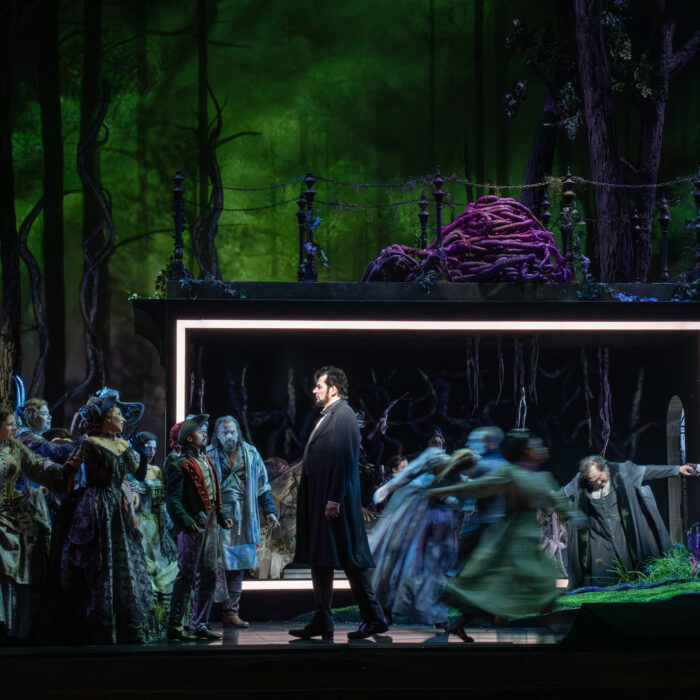
Maree Kearns’ simple set designs, consisting of a series of wooden panels fashioned to resemble the forest, were convincing. The use of ramps between the panels meant that the stage had a layered effect that provided depth and a secluded place for the foxes’ den, while Saileog O’Halloran’s bright, colorful costume designs exaggerated the animals’ cuddly features and added a humorous edge to their characters. It was a staging, however, that did nothing to contradict the child-friendly, comic book impression. It certainly bore no resemblance to an adult fairytale! Most fairytales contain a dark underbelly, a feature that adult fairytales accentuate. They can be bloody, terrifying, or viciously satirical, but the production had nothing of this nature at all. In fact, the production achieved the exact opposite by downplaying the death of the vixen and emphasizing the sentimental.
The use of video imagery, consisting of silhouetted figures against a rural background, added to the cozy, soft nature of the presentation, which again helped retain the interest of the children.
Motley failed to realize her vision for the opera. On paper, it sounded bold and imaginative, but in practice, she failed to deliver. Moreover, Janacek’s message that life can be brutal, yet when fully embraced can also be wondrous and invigorating, failed to materialize. Rather, what she produced was a child’s fairytale interpretation, which has been served up by many directors on many occasions. This is not a bad thing in itself — it is just that it is not particularly interesting. The children would definitely have related to the performance. The depiction and movement of the animals was beautifully thought through, there was plenty of humor to enjoy, and there was nothing to upset their young minds.
The Music Perfectly Captures Janacek’s Message
Thanks largely to the conductor Charlotte Corderoy’s splendid musical direction, the performance nevertheless proved to be very enjoyable. Although working with only a small orchestral ensemble, consisting of twelve musicians, Corderoy created a dramatically strong reading that captured Janacek’s fundamental message. Though the depth and richness of musical textures were, at times, compromised by the restricted musical forces, it was an otherwise excellent presentation. The management of the pace, the score’s rhythmic variations, and the energy that she was able to draw from the players were expertly realized to promote the onstage drama, while the glorious melodies were superbly crafted. The strong connection between the orchestra and the pit was such that the musical detail was clearly visible in the physical drama itself.
The cast responded positively and enthusiastically to Corderoy’s direction with a dramatic and lyrically compelling performance.
Soprano Amber Norelai proved herself to be an energetic, sympathetic vixen that downplayed the vicious side of her character. The slaughter of all the Forester’s chickens, for example, was played out as a dance-like comedy that managed to sidestep its brutal reality, and her eviction of the badger from his home was portrayed as mildly amusing. Her relationship with Gold Spur and her family of young cubs was a loving one. She was exactly as one would expect to find in the pages of a children’s comic book. Norelai’s voice was nicely suited to the role. Her singing was secure and flexible and displayed sensitivity in molding the line to bring out the full dramatic and emotional qualities of the character. There was an occasional piercing quality to her voice when she pushed into her upper register, but it was well-controlled and never unpleasant.
Baritone Benjamin Russell was not a particularly convincing Forester, although his singing could not fail to delight. He possesses a warm, alluring timbre and sings with a beautiful lyricism that allows the melodies to shine. His final aria, in which he reflects on the beauty of nature, was a delight and successfully conveyed his nostalgia as he entered his twilight years. His overall characterization, however, was a little too passive to convince. The best interpretations tend to be rougher and more aggressive. Even at his most boorish, it was impossible to dislike this Forester; he was just too pleasant.
Soprano Jade Phoenix has come a long way since her performance as Giulietta in Bellini’s “I Capuleti e i Montecchi” in 2021 as part of the Wexford Festival’s Factory program. For “The Cunning Little Vixen,” she added her first trouser role to her growing list of characters, playing the part of the male fox, Gold Spur, and it suited her beautifully. Her voice now possesses more weight and depth, furnishing her with a greater degree of expressivity, which she employed confidently to create a convincing male characterization. Her swaggering presence was the perfect accompaniment to the vixen, and together they made a believable foxy couple, in which they captured the emotional ties that bound their family together.
Bass James Platt possesses a resonant, firm, clear, and secure voice with a colorful, dark timbre, which he imaginatively shaped to characterize three very different roles: the Badger, the Priest and the Poacher, which he successfully provided with distinctive personalities. His presentation of the Badger was that of a grumpy old man, while the Priest, who has willingly decided to remain without a wife, was portrayed as a distant, fairly hollow individual. However, it was his unsympathetic reading of Harašta, the Poacher, whom he portrayed as particularly unpleasant, that proved the most satisfying.
Tenor William Pearson presented his character, the Schoolmaster, as a man adrift, unsuccessfully searching for love. In his final scene he appears to have almost given up, detached from the cycle of life, unlike the life-embracing vixen. His pleasing, lyrically attractive vocal interpretation beautifully captured the Schoolmaster’s fading sense of purpose.
Tenor Oisín Ó Dálaigh is proving to be a strong character actor with a fine, expressive voice. His interpretation of the Mosquito was flighty and amusing, which he coupled with a convincing showing in his role as Pásek the Innkeeper.
Mezzo-soprano Heather Sammon put in strong performances as Lapák the Dog and the Innkeeper’s Wife. Soprano Megan O’Neill produced an energetic, nicely sung reading in the roles of Pepik and the Jay. Mezzo-soprano Oryna Veselovska’s busy, noisy interpretation of the Forester’s wife was convincing. Soprano Niamh St. John strutted around the stage as the confident Cockerel and showed off her voice to good effect as the Fox Cub. Soprano Caroline Behan made for a fabulous-looking Owl, while her presentation of the child, Frantik, was suitably irritating.
Musically, this was a production that charmed. Dramatically, it was little more than a workaday performance with few insights and little to engage the interest unless, of course, you were a child or engaging with the work for the first time.