Deutsche Oper am Rhein 2025-26 Review: Turandot
By Bernardo Gaitan(Photos: Hans Joerg Michel & Andreas Etter)
To think of “Turandot,” Giacomo Puccini’s swan song, inevitably means evoking the Orient – and more specifically China – not only because of its plot, but above all because of its sonic universe. The premise of the production under review is particularly intriguing precisely because it arises from the encounter between East and West. It is the result of an international collaboration between the National Kaohsiung Center for the Arts (Weiwuying) in Taiwan and the Deutsche Oper am Rhein in Düsseldorf.
Production Details
The production premiered in Germany in December 2015 and was later presented at the Weiwuying Opera House in 2019. A decade later, this staging returns periodically to the stage of the Deutsche Oper am Rhein, and this February was no exception. The entire creative team is fully Asian, a group that consciously draws on scenic elements of clear Western influence, resulting in a concept that ultimately proves confusing.
At its core, this is a traditional production enriched with modern elements that generate more bewilderment than curiosity. Several of the decisions adopted by stage director Huan-Hsiung Li and his team were bold a decade ago and likely worked very well at the time. Today, unfortunately, they no longer do.
(Photos: Hans Joerg Michel)
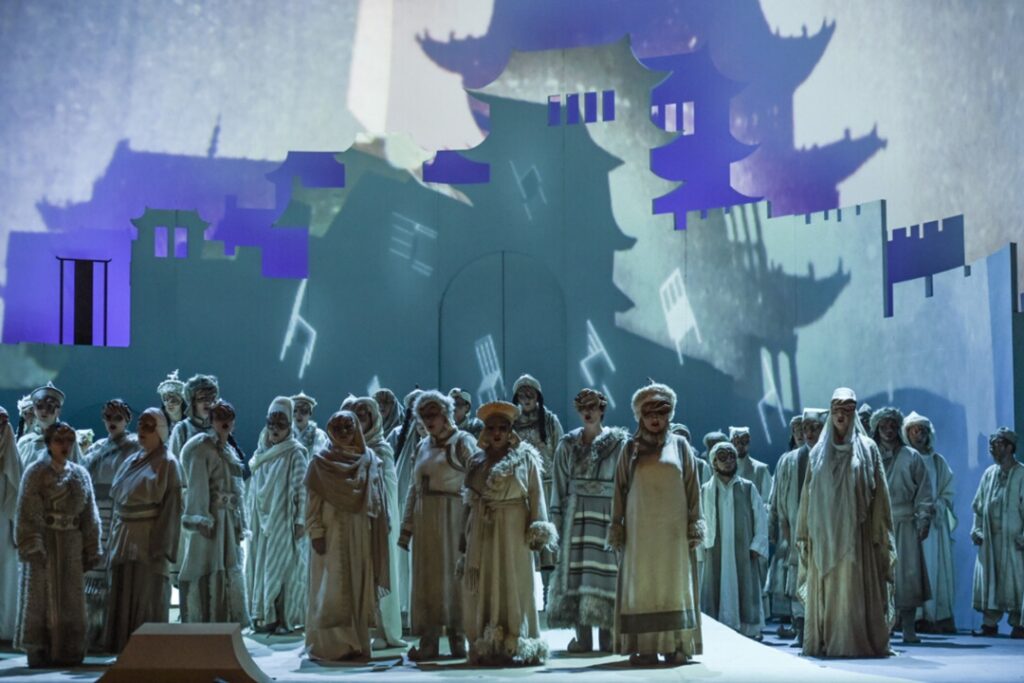
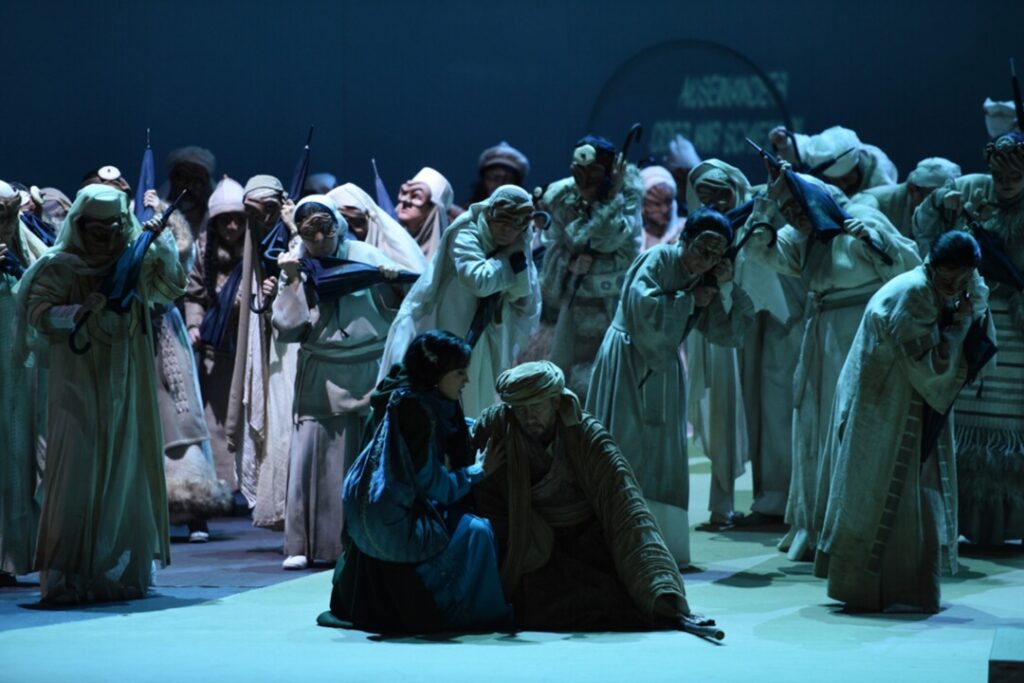
As the curtain rises, a video projection designed by Jun-Jieh Wang situates the action in September 2014, during Hong Kong’s well-known “Umbrella Revolution.” That episode of protest in which demonstrators protected themselves from pepper spray with umbrellas (an element that reappears silently throughout the performance, with open umbrellas placed in the corners of the stage). After this brief projection, the five mythical notes that open the score (A–E♯–B–C♯–F♯) resonate through the hall as the audience is confronted with a markedly traditionalist set.
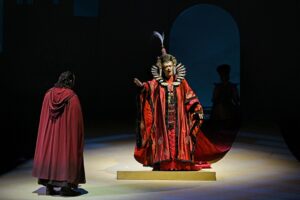
Set designer Jo-Shan Liang proposes the silhouette of Beijing’s Forbidden City, dominated by a long central ramp that remains unchanged throughout the three acts. This classical setting clashes with the location suggested by the opening projection, a contradiction further accentuated by the costumes designed by Hsuan-Wu Lai: classic, almost stereotypical Oriental garments, well executed, yet clearly unrelated to any reference to Hong Kong in 2014. All the traditional costumes function adequately, but the Emperor represents another element that makes little sense within this universe: he appears dressed in a suit and bowler hat, evoking the 1920s, with no connection whatsoever to the proposed context.
A dancer (Yasha Wang), dressed in timeless white, appears and disappears from the action without any clear logic, performing scenic movements that neither help nor hinder the dramatic development. And in the final scene, while Calaf and Turandot swear their love to one another, the figure of Giacomo Puccini appears in the middle of the ramp, adding even more confusion. Does everything take place in Turandot’s dream? In the composer’s mind? In some sort of multiverse? The answer is known only to the regista.
(Photo: Andreas Etter)
Musical Highlights
In the pit, the Duisburg Philharmonic Orchestra, under the baton of Antonino Fogliani, sounded with more force and vigor than sensitivity. The orchestra revealed a lack of experience in accompanying operatic repertoire; it is clear that its natural terrain is the symphonic repertoire and that opera does not form a habitual part of its activity. Under the Sicilian conductor’s baton, the orchestra accompanied the score without passion, without nuance, alternating almost exclusively between two dynamics: forte and fortissimo. The sound was flat, and the singers were almost constantly covered. Fogliani conducted with a firm hand in a quasi-academic reading, the result of which was not ideal for appreciating the meticulous orchestration and refined timbral treatment that Puccini considered essential in “Turandot.” As is typical of Fogliani – especially in belcanto – he proposed particularly interesting tempi in the riddle scene, lending it greater dramatic weight. The Chorus of the Deutsche Oper am Rhein, prepared by Albert Horne, delivered a solid performance, standing out for its stage security and clear, well-articulated diction.
The vocal side fared better. Soprano Olga Maslova, who made her debut in the title role at the Arena di Verona in 2024, has now accumulated eight productions of the role in theaters around the world. She demonstrated that she possesses all the necessary tools to successfully tackle the demanding role of Turandot. Her voice, sumptuous and powerful, asserted itself authoritatively in the upper register and displayed remarkable depth of sound. She commanded the stage with assurance, delivering “In questa reggia” convincingly and deploying a subtle play of colors and accents in the riddle scene.
When Turandot is announced, audiences go to the theater with the ‘hope’ of being thrilled by one of the most famous arias in the repertoire. In this case, paraphrasing Turandot herself, “la speranza che delude sempre” (the hope that always disappoints) was the Calaf of this production. Eduardo Aladrén’s performance as the Unknown Prince left much to be desired. His portrayal was stiff, devoid of dramatic intention and lacking any trace of the character’s customary heroism. He limited himself to singing while standing still, and uninterestingly so. Vocally, the result was even more disappointing: devoid of nuance, expressive intent, and plagued by noticeable intonation problems in the upper register. Curiously, his high notes – when not covered by the orchestral violence – carried without volume issues, yet remained disconnected from the rest of the phrase. His Italian pronunciation was correct; however, the strained high notes and poor acting undermined the overall result. Incredibly, “Nessun dorma” passed without glory or impact, failing even to provoke an attempt at applause. In the final duet with Turandot, his vocal performance was somewhat better, probably driven by Maslova’s presence.
(Photos: Hans Joerg Michel)
Illuminating Cast
Soprano Anke Krabbe offered an intense Liù, sustained by a flexible emission, precise phrasing, and a finely nuanced vocal line. Her voice seems better suited to more lyrical characters; nevertheless, despite not being ideal for the role, she constructed a highly convincing Liù. Her generous use of piano and pianissimi enriched a performance that elicited the first spontaneous applause from the audience after “Signore, ascolta!” Krabbe clearly opted for refinement, displaying well-controlled filati and pianissimi.
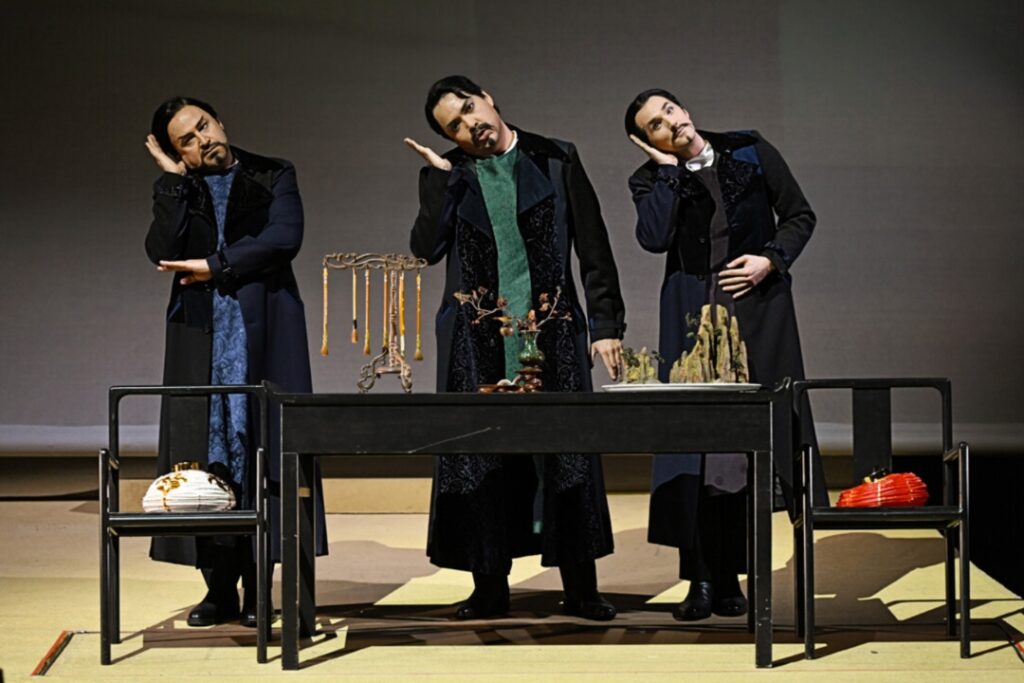
The trio of masks proved well integrated, with a balanced and homogeneous vocal ensemble. All three voices, of solid quality, demonstrated stage confidence and cohesion. Ping stood out, portrayed by baritone Constantin Moței, for both vocal quality and interpretative personality, alongside the solid and powerful Pang of tenor Florian Simson, and the occasionally inaudible but delicate Pong of tenor Cornel Frey.
A pleasant surprise was the Timur of bass Beniamin Pop, who offered a determined and vocally secure portrayal, with clear diction, fine timbre, round tone, and carefully shaped phrasing. Tenor Sergei Khomov, with only a few lines, fulfilled his task in a relatively decorous manner: he exaggerated his intervention to imitate an old man’s voice, yet ultimately delineated his brief appearance correctly.
Despite the confusion of the production and the tenor’s performance, the German audience proved particularly enthusiastic and applauded warmly. The protagonists received prolonged applause.