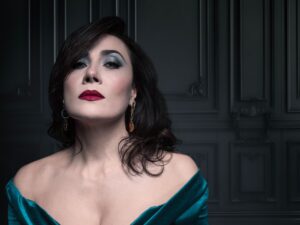
Valeria Sepe is one most sought-after Italian sopranos of her generation.
A graduate of the Conservatory “G. F. Ghedini” in Cuneo, she has performed at leading house in Firenze, Naples, Palermo, Parma and Verona, growing her reputation as a major Verdi, Puccini, and verismo interpreter.
This season, Sepe will make her debut as Maddalena in “Andrea Chénier” and will sing the new work “Bona Sforza,” continuing to expand her repertoire.
OperaWire had a chance to speak with the soprano about Maddalena, a recent tour with famed tenor Jonas Kaufmann, and singing in a new work like “Bona Sforza.”
OperaWire: You will debut as Maddalena in “Andrea Chénier.” What brings you to this role and when was the first time you saw it?
Valeria Sepe: “Andrea Chénier” is a very special title for me and is deeply connected to my artistic journey. It was the first opera in which I ever sang, back when I was still performing mezzo-soprano roles: I sang Bersi alongside Marcello Giordani, under the direction of Maestro Bignamini. From that very first experience, I was profoundly struck by Giordano’s music, by the power of the drama, and by the development of the characters—especially Andrea and Maddalena.
Maddalena is a deeply fascinating character who grows and transforms radically over the course of the opera, and I believe that this evolution requires not only vocal maturity, but also personal maturity. Over time, I began to feel that this role was becoming increasingly aligned with my artistic path, leading me to today, when I truly feel that the moment has come to take it on.
OW: What is your favorite moment in this score?
VS: It is difficult to choose just one. The final duet between Maddalena and Chénier is certainly one of the moments I feel most deeply: in this passage, time seems to expand, and the music becomes almost the shared breath of the two characters. The voices and the orchestra intertwine organically, creating an experience of great intensity, in which every phrase, every orchestral color, and every dynamic nuance amplify the emotional dimension. The love between Maddalena and Chénier takes on an almost suspended quality, as if it continues to resonate beyond the score.
At the same time, “La mamma morta” is a central moment of the opera, not only for its emotional power but also for its dramatic significance. It represents the culmination of a very complex inner journey, in which Maddalena reaches full awareness of herself and of her pain. It is a page that demands great focus, control, and truth, because it only works if everything that precedes it has been built with coherence.
OW: How do you see Maddalena as a character?
VS: Maddalena emerges as one of the most complex and surprisingly modern female figures in verismo. Her journey is a slow and painful transfiguration: from a young aristocratic woman, sheltered by privilege and a certain innocence, she becomes a woman profoundly marked by the wounds of History, by loss, and by the most extreme suffering.
Through pain, Maddalena gradually sheds every certainty. It is precisely this passage through suffering that leads her toward a new awareness—more fragile, yet also more authentic. In this sense, she is not an idealized character, but a deeply human figure who finds her truth at the very moment of greatest vulnerability.
OW: Why was it the right moment to debut this opera?
VS: Today I feel that I have the technical solidity and interpretative awareness that allow me to approach Maddalena without forcing anything. I strongly believe in respecting the right timing: some roles need to arrive when both the voice and the person are truly ready to welcome them, and for me, this is that moment. It is a role that requires a constant balance between delicacy and intensity, between control and emotional impulse. There are pages of great intimacy, where every nuance must emerge with complete naturalness, and moments of powerful dramatic force, in which the voice must expand with courage. Feeling able to inhabit both of these dimensions with serenity is what made me understand that the time was right to take on this debut.
OW: Tell me about your relationship with the Teatro Massimo di Catania? Why is the perfect theater to debut this role?
VS: For me, the Teatro Massimo di Catania is a very special place—it is home. I share a deep bond with this theater: it was here that I made my debut as Mimì in Puccini’s La Bohème, a role that is very dear to me, which I later performed in many productions in Italy and abroad and which marked an important chapter in my artistic journey.
Beyond the beauty of the theater and its extraordinary history, there is something truly unique: the relationship with the audience. Singing for the Catania audience means giving oneself completely and feeling genuinely welcomed, in an almost intimate way. It is an engaged audience, one that experiences opera with great intensity. For an important debut such as Maddalena, this theater represents the ideal setting—a place that truly values the artist’s work and where opera is lived with authentic passion. It is an experience that leaves a deep mark and stays with you forever.
OW: You toured with Jonas Kaufmann. What was that experience like? What did you learn from him as you were on the tour?
VS: It was an extraordinary experience. Beyond his immense artistic stature, what struck me most was his great humanity and his constant dedication to the work. Even within a concert setting, a deep musical and interpretive connection was established immediately, allowing us to communicate directly and reach the audience fully.
From a professional standpoint, I learned a great deal by observing how Jonas is able to combine technique and musicality in every phrase, how he shapes the vocal line without any forcing, and how he inhabits the character from within, with remarkable authenticity. Working with him was a true privilege and an experience that enriched me profoundly —not only as an artist, but also as a person—teaching me how essential it is to unite discipline, emotion, and naturalness on stage.
OW: What is special about touring and how does it compare to an opera production?
VS: A tour is special because it brings opera outside the traditional theater setting and allows the music to be shared in very different cities and contexts. Each performance has its own unique energy: the audience changes, the acoustics of the halls are different, the atmosphere varies, and this requires great adaptability and attention from all the artists. It’s a constant exercise in flexibility.
When performing different characters in a concert setting, the real challenge is being able to enter and exit their emotional worlds very quickly, giving each one a life that feels authentic and fully realized. Every character has its own identity, emotions, and voice, and it is the artist’s task to make them breathe and resonate in front of the audience. This work demands focus, technique, and empathy: you must fully immerse yourself in each figure, live it intensely, and then release it to welcome the next.
Compared to a staged opera production, touring also requires a constant ability to react: daily travel, different cities, hotels, changing climates. It is an intense and incredibly formative challenge, not only musically. Each evening becomes a unique and unrepeatable experience.
OW: You’ll be singing “Bona Sforza” at the Fondazione Petruzzelli. Tell me about this opera and the challenges of working on a contemporary opera?
VS: Tackling a contemporary opera is an incredibly stimulating experience. Unlike the traditional repertoire, it requires an even more conscious approach, because there are no established interpretive references or models. The character must be built directly from the score, often in close collaboration with the composer and director: everything must be lived, felt, and created from scratch.
The greatest—and at the same time most fascinating—challenge is bringing to life a completely new character like the Queen. It means entering her world, finding her inner voice, and being able to convey new and authentic emotions to the audience. It is a demanding process, but precisely for this reason, it is extremely formative, pushing you to grow as an artist and explore musical and dramatic territories you have never approached before.
From a musical standpoint, “Bona Sforza” stands out for its modern and intricate writing, which demands great attention to phrasing, vocal color, and dynamics. The Queen’s lines combine lyricism with dramatic tension, often featuring unexpected intervals and rhythms, testing both vocal technique and interpretive skill. There are moments when the voice must emerge with strength and authority, and others that require extreme delicacy and control. Working on an opera like this means learning to constantly dialogue with the orchestra and the modernity of the musical writing, finding a balance between fidelity to the score and interpretive freedom.
OW: How does this role compare to your Verdi and Puccini repertoire?
VS: The role of the Queen in “Bona Sforza” relates to my Verdi and Puccini repertoire in a very different way, and it is precisely this distance that makes it so compelling. In Verdi and Puccini, characters are shaped by a well-established interpretative tradition, with recognizable melodic lines and a lyrical phrasing that allows emotions to be explored within a clearly defined structure. In contemporary repertoire, by contrast, the vocal writing is more modern and at times unpredictable. It demands great attention to rhythmic detail, color, and precision of emission.
From a musical standpoint, “Bona Sforza” features an intricate score, with vocal lines that alternate between lyricism and dramatic tension, often supported by a highly present orchestration rich in nuance. There are moments when the voice must emerge with authority and strength, and others that call for extreme delicacy and control, allowing every emotional detail to resonate. It is a deeply enriching challenge, as it opens new vocal and interpretative horizons and enables me to maintain a flexible and versatile musical approach, constantly bringing technique, listening, and creativity into dialogue.
OW: What are some of your dream roles?
VS: The role of my dreams has always been Cio-Cio-San in “Madama Butterfly.” I was fortunate to fulfill this dream with my debut at the theater of my hometown, Naples, at Teatro San Carlo, directed by Ferzan Özpetek and conducted by Dan Ettinger. It was an unforgettable experience that left a deep mark on both my artistic and personal journey. I later had the joy of performing this role in other theaters, and each time it continues to bring me intense and ever-fresh emotions.
More generally, I don’t like to set strict limits or rigid goals. For me, the most important thing is not to debut a role as early as possible, but to do so at the right moment—when the voice, technique, and interpretive awareness are truly ready to embrace it. Only then can a character fully come alive on stage and touch the audience deeply.