Opéra National de Nancy-Lorraine 2025-26 Review: Dialogues des Carmélites
By Andréas Rey(Photo: © Jean-Louis Fernandez)
Co-produced by the Opéra National de Normandie, where it was first staged, Francis Poulenc’s opera Les Dialogues des Carmélites (The Carmelites dialogs) is now being performed in Nancy from Jan. 25 to 31. This production is nearly a complete success.
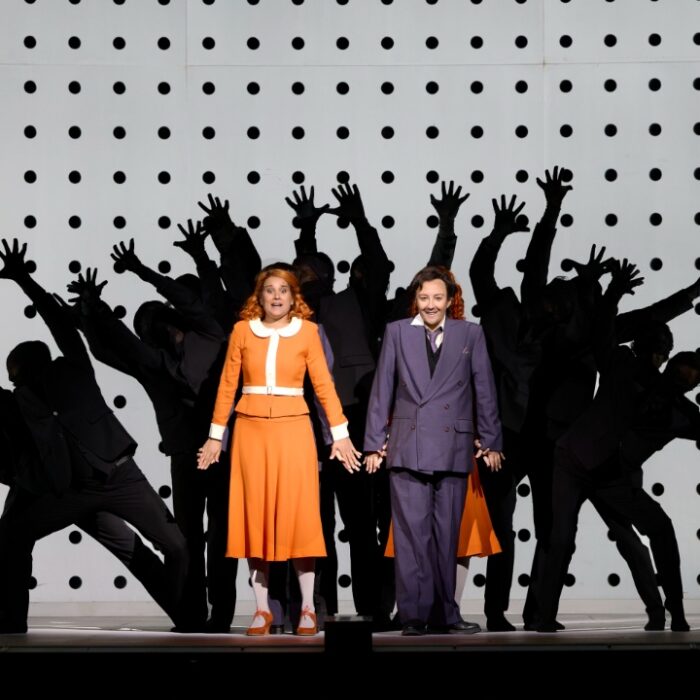
Tiphaine Raffier’s realistic staging lends rawness and extra humanity to certain scenes in the opera, such as the death of the Mother Superior, but this does not prevent her from creating certain tableaux vivants, such as at the beginning of the second act, when the nuns maintain the convent.
The staging is highly theatrical, both in terms of the careful set design. The French director’s team is remarkable, both for the tableaux vivants and the action scenes—and the very natural acting, which is so raw that it sometimes borders on discomfort. One memorable moment features Sister Constance going to the toilet and cleaning it. The dramatic climax, the execution of the nuns, emphasizes the sound of the guillotine, making this version of the opera one of the best productions in Nancy.
However, it is not without its flaws, unfortunately. The first is the use of a film that feels more like “Game of Thrones” and Luc Besson in lieu of a historically-accurate one. The film features Joan of Arc fighting a dragon before ascending to heaven without going to the stake. The intent of his film is to showcase Blanche de la Force’s imagination.
Another flaw is the use of different texts, ranging from revolutionary speeches to historical references, which not only add unnecessary complexity to the work, but also situate the drama in the contemporary era.
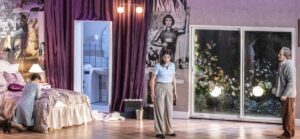
Some of Raffier’s ideas are also clumsy, such as the sisters’ visit to Blanche’s room to verify the sincerity of her vows, whereas the libretto has her questioned at the convent, as a first step away from her family environment. And above all, the opera begins with Monsieur de la Force senior, rising from his daughter’s bed, without us really understanding why, and Blanche coming out of her wardrobe to show her constant fear.
Otherwise, the emotion is always there and the updating of the drama to the contemporary era remains respectful and makes us reflect on aspects of today, such as religious tolerance.
Although soprano Hélène Carpentier as Blanche is a little dry vocally, the vocal texture is very pleasant and feels like satin that grows increasingly dark throughout the night.
The agony expressed by contralto Helena Rasker as Mother Superior Madame de Croissy is one of the emotional highlights of the evening. Raw to the point of indecency – she is in her underwear and a hospital gown on a stretcher – she oscillates between the character’s naked humanity and her duty to her sisters. And her voice, following this oscillation, vibrates with emotion for the audience.
Also of note is the acting and vocal performance of soprano Michèle Bréant as Sister Constance, who highlights the playful freshness of the young nun.
The flexibility of soprano Claire Antoine singing as Madame Lidoine, is enjoyable, contrasting with the relative harshness of soprano Marie-Adeline Henry as Mère Marie de l’Incarnation.
Tenor Pierre Derhet, as Chevalier de la Force, was remarkable in his freshness, showing the growing seriousness of the character.
The orchestra, conducted by Marc Leroy-Calatayud, was another major asset of this performance, blending well with the different scenes, sometimes abrupt when the revolutionaries enter the convent, sometimes more flexible and smoother when the nuns are among themselves. Leroy-Calatayud gave space to silence, allowing the emotion to linger in the listener. However, more continuity in the orchestral fabric might not have been amiss.