Emily No Prisoner Be – A Deep Dive Into New Kevin Puts Album Featuring Joyce DiDonato & Time for Three
By Alexandra SvokosWhat is it about Emily Dickinson that keeps us coming back? Perhaps that her life feels like finding a door to another world in the cupboard. She lived a quiet, isolated life, mostly confined to home. But after her death, a blooming inner life burst forward with the poems she left behind.
Her poems are an “endless trove of inspiration,” composer Kevin Puts said at a preview of his forthcoming album, “Emily No Prisoner Be,” at the legendary Power Station at Berklee NYC. He added that “the poetry doesn’t give up its meaning so easily,” as it “suggests an atmosphere” rather than a literal scene. By reading the poems and studying her life, Puts said he started to feel like they were in the room together. The album evokes that same illusion, with Puts centering the music on Dickinson’s words and allowing her emotions (as interpreted by the composer, anyways) to be more fully expressed than on paper alone.
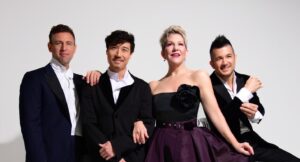
“Emily No Prisoner Be” was written for mezzo-soprano Joyce DiDonato and string trio Time for Three (Tf3), both of whom have previously collaborated with Puts. Some two dozen of Dickinson’s poems are covered in the album, which was originally commissioned by the Bregenz Festival and is set to be released January 30. Bringing DiDonato and Tf3 together, Puts said, was like setting up two friends you know “should really meet.”
He’s right about that. The trio, composed of Nick Kendall on violin, Charles Yang on violin and guitar, and Ranaan Meyer on double bass, is classically trained with an eye for modernity, as is DiDonato, who has gravitated towards new work in her operatic career. They complement each other well both in ethos and sound: The work calls for the string players to use their voices, like backup singers to DiDonato, and they meld well.
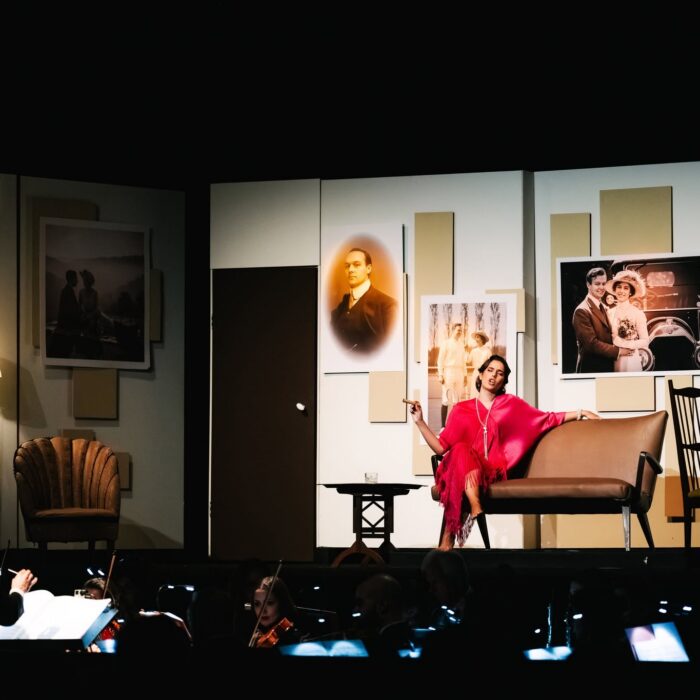
The work is being called a “theatrical song cycle;” while it’s immortalized in the recording, the group is also taking it on tour, making stops from California to New York throughout February. “We want people to completely fly away in their imagination with this,” DiDonato said, explaining she hopes people feel, as Puts did, that they’re sitting in Dickinson’s room with her, seeing the ricocheting vibrancy of her inner world.
As an all-American production, the music does feel distinctly American. The melodic compositions bring in shades of folk, at times feeling almost like a spiritual as Dickinson’s words swirl in the round. Puts often presents Dickinson’s words with urgency and immediacy, grabbing you in to see what she saw. In many cases, particularly the opening number “They shut me up” (“in prose,” Dickinson writes), the impression is a woman caged by society and expectations who finds self-fulfilling freedom, and defiance, through art.
But there are also moments that feel like meditation. The famed poem “Because I could not stop for death” sees DiDonato in captivated wonder that death did stop for her. She expresses awe and compassion in her vocal lines. Like many of the songs on this cycle, there’s an open curiosity on display – curiosity that, for Dickinson, was almost a preemptive rebuttal to the idea that she closed herself off to the world.
There is also a resounding feeling of generosity in this work. Puts seems to step back and let the words guide the melodies, rather than try to overwhelm or wrest them with his music, resulting in beautiful, fully appreciated songs. DiDonato gives voice to the poet’s words while also leaving space for the strings, while Time for Three, in turn, gives DiDonato harmonies to play with. It’s a wonderfully balanced, collaborative work that respects and honors Dickinson’s writings.
Time will tell if it will have the longevity of Aaron Copland’s Dickinson song cycle (which DiDonato performed in recital as a student, she said). This collaboration’s strengths may be a weakness on that front, as it’s hard to imagine the pieces without Time for Three. It comes together because of their musical ability both on the strings and vocally, and it would be an interesting exercise to try to transpose the compositions for a more traditional orchestra or accompanist.
All the more reason, then, to see a performance if they’re stopping by you – and, simultaneously, thank goodness they recorded it. This kind of exceptional meeting of talents to a unified purpose doesn’t come around often, and it’s not always guaranteed to result in success. Here, we have a new, beautiful piece of art, and that’s something to celebrate.
Categories
Special Features