The Relationship Between Swami Vivekananda & Emma Calvé
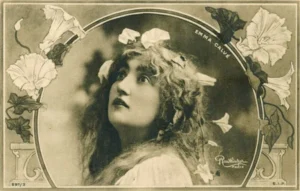
By John VandevertA dominant force in the world of opera at the turn of the 20th century, alongside contemporaries like Marguerite Bériza, Germaine Bailac, and Blanche Deschamps-Jéhin, French soprano Emma Calvé left more than a mark during her 28-year career. However, it is not her operatic achievements I wish to talk about today, but her relationship with Hinduism, particularly Swami Vivekananda — Hindu monk, spiritual lecturer, and follower of Ramakrishna Chattopadhyay, best known as Ramakrishna.
To honor the Indian national holiday surrounding Vivekananda’s birthday, known as National Youth Day, I wish to explore his relationship with Calvé and its significance. Extending past influence, the monk’s role in her life resembled more so the much-needed personal fortification of Calvé’s spirit amidst trying times following the death of her daughter and a stressful career.
Having made her operatic debut in 1881 and expanded her name considerably via French and Italian repertoire, in 1893 Calvé made her American debut at the Metropolitan Opera in Mascagni’s “Cavalleria rusticana.” This followed the high of her presentations of “Carmen,” scheduling her for 30 performances during the 1893-94 season. In 1894, however, tragedy struck. A fire killed her daughter while Calvé was performing in Chicago, on tour with the Met.
Once offstage, the ambiguity begins. While the more esoteric would say she sensed a power, others say it was her friend, Ms. Milward Adams, who first encouraged her to seek out Vivekananda following the tragedy. History records they were both in Chicago in the same year, though not simultaneously: Calvé was there in the Fall, while Vivekananda gave university lectures in March. This proximity seems to have been enough, however, to bring Calvé into Vivekananda’s orbit. Their first meeting left a strong impression on the vulnerable singer, as chronicled in Chapter 22 (“A Monk of the Order of the Vedantas”) of her 1922 autobiography “My Life.”
The statement was written not after their first 1894 meeting, but the second. It would be this second meeting that would leave a long-lasting impression upon her. Having been in Paris for the 1900 Exposition Universelle, Vivekananda left for the Middle East on October 24 aboard the famous Orient Express, accompanied by none other than Calvé herself. Also present was occult writer Henri Antoine Jules-Bois and American devotee Josephine MacLeod. This journey took the group through many countries including Austria, Turkey, Greece, and Egypt, concluding on November 26 when Vivekananda returned to India at Calvé’s expense.
Calvé was minorly attracted to the spiritualist movement that seized the West at the turn-of-the-century, with the likes of Aleister Crowley and Helena Blavatsky leading the charge. However, following her ‘Grand Tour’ in the company of Vivekananda, Jules-Bois, and Macleod, she never again engaged with the movement. She sang until 1910, accepting a global tour beginning in Australia and travelling to India, Singapore, Sri Lanka, China, and Japan. Following concerts in the United States of America, her last days were spent using her home (Château de Cabrières) as a summer teaching intensive for young women (one of those being Gina Cigna).
As Calve finishes Chapter 22 in her autobiography:
The monks of the Swami’s brotherhood received us with simple, kindly hospitality. They offered us flowers and fruits, spreading a table for us on the lawn beneath a welcome shade. At our feet the mighty Ganges flowed. Musicians played to us on strange instruments, weird, plaintive chants that touched the very heart.
A poet improvised a melancholy recitative in praise of the departed Swami. The afternoon passed in a peaceful, contemplative calm. The hours that I spent with these gentle philosophers have remained in my memory as a time apart. These beings, pure, beautiful and remote, seemed to belong to another universe, a better and wiser world.
Listen
Categories
Special Features