Ravenna Festival Review 2025: Alcina
Production Insufficiently Differentiated from the Festival’s Staging of ‘Orlando’
By Alan Neilson(Photo: Zani-Casadio)
Is it a wise decision to perform two independent works by the same composer on consecutive nights, using a very similar cast, the same stage director, the same basic set, similar or in some cases the same costumes with the same musical director and orchestra?
Well, this is exactly what the Ravenna Festival decided to do for its stagings of Händel’s “Orlando” and “Alcina,” and it did not work at all!
Pizzi’s Undifferentiated, Static Staging
Although both operas are based on tales taken from Ludovico Ariosto’s poem “Orlando Furioso,” they are distinct and complete pieces, requiring separate treatment. The attempt at linking the two through the sets, costumes and cast did more to diminish the impact of the second piece, “Alcina,” than bring to it any dramatic or artistic benefits, as exemplified by the case of the countertenor, Elmer Hauser.
Having essayed the character of Medoro in “Orlando” on the previous evening, he was then cast as Ruggiero in “Alcina,” and significantly, he was attired in the exact same costume. Not only did this unavoidably create a meaningless association between the characters, but it also drew attention to Hauser’s ability to interpret a role, and it was nigh impossible to detect a difference between his Medoro and his Ruggiero. There were certainly no visual differences to distinguish them, and vocally he was unable to create two distinct characters. This was not entirely Hauser’s fault, however, especially given that the two roles are very similar. He possesses a beautiful voice that he uses to charm the audience, and quite reasonably he plays to this strength; his ability to develop nuanced characterizations was, however, exposed as both characters came across as copies of each other.
The same criticism could also be made, albeit to a lesser degree, of the other singers who played roles in both operas.
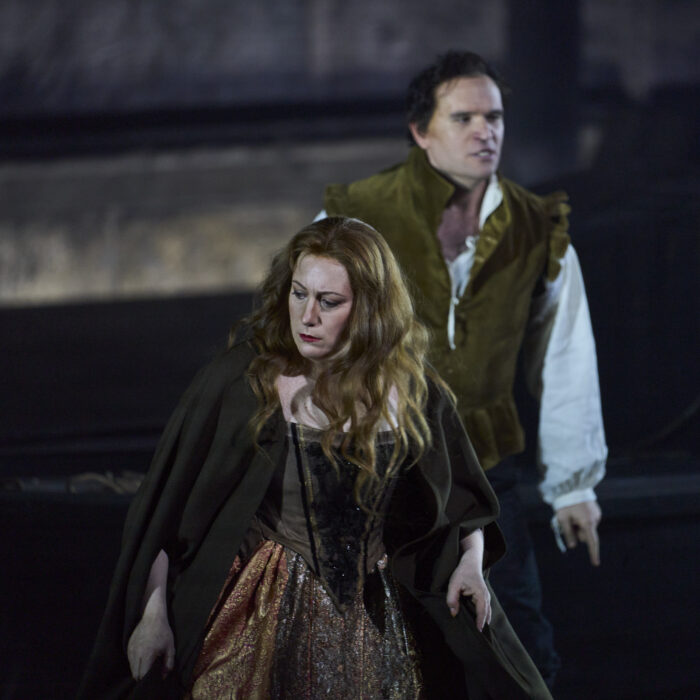
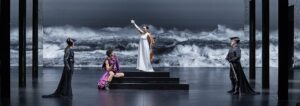
The problems, however, went much deeper, particularly with regard to Pier Luigi Pizzi’s staging and direction. The first problem arose from his decision to basically ignore the dramatic side of the production in order to create aesthetically pleasing stage pictures, within which the singers took up poses to delight the audience. There was little in the way of significant movement. The staging was static and passive, and the spectacle one associates with the baroque theatre was sidestepped; Alcina’s magic island, for example, was completely ignored. It was exactly the same approach that he had taken with “Orlando,” so that the two operas became more or less visually indistinguishable. This was further compounded by his use of a common set for both productions, consisting of mirrored walls and ceiling with the back wall used for computer-generated imagery. To be fair to Pizzi, he used them to create a different context for each work; rather than the wooded glades and trees of “Orlando,” he created a seascape to suggest Alcina’s island, along with other images to specify locations, such as a grand-looking hall, as well as an interesting revolving abstract geometric shape, which did provide a welcome and necessary degree of differentiation.
Although the costumes were not always identical to those used for “Orlando,” stylistically, they were the same and thus equally suited to both productions.
Also, as was again the case with “Orlando,” Pizzi made little effort to provide any interpretative depth apart from his inclusion of Cupid to emphasize the hold that love’s passion has over human behavior. Thankfully, Cupid’s appearances in “Alcina” were fleeting, sparing the audience the excessive, statuesque, at times, crude posturing of Giacomo Decol’s Cupid, who was ever present in “Orlando.”
So it was that the audience was served with two very similar stagings, in which their narratives were left undeveloped with little to distinguish between them. As pieces of theatrical drama, neither were satisfactorily developed. Being the second of the two productions, it was “Alcina” that was to suffer the most, as dramatically it was unable to assert a separate identity to differentiate it from the previous evening’s performance of “Orlando.”
Dantone’s Musically Sensitive Reading
The commonalities that connected the musical side of the production, while certainly affecting the dramatic appreciation of the presentation, nevertheless still had much to offer, not least thanks to Ottavio Dantone‘s sensitive and elegant interpretation. Guiding the Accademia Bizantina with a sure hand, he elicited a beautifully paced and well-balanced reading that both supported the singers and delighted the audience. Of course, as with “Orlando,” the lack of visual interest generated by the staging impacted negatively on the overall impression.
In one of the more dramatically successful ideas, Alcina the sorceress made her initial appearance by rising from beneath the stage, which immediately established the character’s importance and magical status. Soprano Giuseppina Bridelli, cast in the role, produced an expressively strong reading that captured her desperation to find love, underpinned by her cruelty–when tired of her lovers, she transforms them into wild beasts, trees, or features of the natural world. Her love for Ruggiero, however, is genuine, and throughout the evening Alcina battled with this love and her internal demons, who insisted she wreak vengeance on his betrayal. It was a conflict that Bridelli successfully brought to the fore in an animated performance, in which both recitatives and arias were crafted to highlight the strength and turbulence of her emotions.
In Alcina’s aria, “Si, non quella!,” she voiced her genuine love for Ruggiero with a gentle, attractive rendition, adorned with sensitive embellishments. Then later, feeling she has been betrayed by him, she fashioned a wonderfully controlled reading of the aria “Ah! Mio cor! Schernito sei,” in which she brilliantly contrasted her deep sadness with her anger, in what was a very moving and expressively painful interpretation. In her aria “Ma quando tornerai,” she again gave voice to her conflicted feelings with another emotionally painful reading; while the B section was delivered with a compassionate lilt and pleasing embellishments, the da capo was delivered with an impassioned energy, full of invective and threat, replete with an angry coloratura.
Following on from a fine performance as Dorinda in “Orlando,” soprano Martina Licari produced another impressive performance as a secondary love interest, this time in the role of Morgana, who has managed to entangle herself in a love triangle with Oronte and Bradamante, whom she believes to be a man. Her singing was beautifully woven, replete with attractive ornamentations, to successfully depict her emotional states, no more so than in her final aria, “Credete al mio dolore,” as she seeks to win back her lover, Oronte, for which she produced a sensitive, poignant and delicate rendition that, understandably, he was unable to resist.
Contralto Delphine Galou produced an inconsistent singing performance in the role of Bradamante; her voice, although often expressively convincing, lacked the necessary resonance and stamina on occasions and allowed the emotional force to dissipate too readily. Her acting was strong, in which she successfully presented herself disguised as Bradamante’s brother, Ricciardo.
Although Hauser did not manage to distinguish his character, Ruggiero, from his presentation of Medoro in “Orlando” on the previous evening, he still put in a fine performance. Each of the arias was given a delightful, refined interpretation that kept the audience fully engaged. His most accomplished presentation was undoubtedly “Sta nell’ircana,” to which he added a degree of expressivity to his singing that was not always present in his other arias; the voice was coated with a forceful determination, backed by strong coloratura that blended emotion with beauty.
Bass Christian Senn produced a neatly crafted portrayal of Melisso, Ruggiero’s former tutor. As with Hauser, his character had little to distinguish it from his characterization of his role as Zoroastro in “Orlando” from the previous evening, although he at least had the benefit of a different colored costume. He was emotionally more distant than the other characters and sang his arias with an authoritative air. Recitatives were clearly articulated.
At last year’s edition of the Ravenna Festival, tenor Ziga Copi made an excellent impression as Eurimaco in its production of “Il Ritorno d’Ulisses in Patria” and in his roles in the Purcell double bill of “Dido & Aeneas” and “Hail! Bright Cecilia.” Maybe this raised expectations a little too high, as his essaying of the role of Oronte was not quite up to the same standard. Although he created a well-defined reading of his character, his singing seemed less secure. He had a tendency to swallow his words at the end of his lines, which was somewhat disappointing, although there was still plenty to admire in his singing, particularly his innate lyricism and ability to furnish the line with detailed contrasts.
It was almost impossible to relate to “Alcina” as a separate, distinct production; it simply had too much in common with the company’s production of “Orlando,” which Pizzi’s passive approach simply exacerbated, although his use of colorful computer-generated imagery did add a degree of differentiation and interest. Musically, it had its high points, notably Dantone’s sensitive orchestral interpretation, and Bridelli, Licari and Hauser produced magical singing.