San Francisco Opera 2025-26 Review: Rigoletto
By Lois Silverstein(Photo:
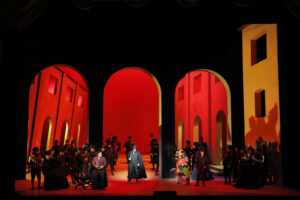
Another grand Opening Night at San Francisco Opera Fall 2025 Season, its 103rd. Glamor in sequins and sparkly platform heels, green and mauve brocaded would-be pashas, feathery boas and head-dresses – and this was just the lobby – on the tail of the Annual Opera Ball. Inside, magenta and rose heart-shaped flower-masks adorned the parterre, while colored lights oscillated across the walls, curtain and orchestra pit. Then, onto the Ducal Palace, à la style o Giorgio di Chirico paintings, Verdi’s great tragic human drama, “Rigoletto,” a revival of the 1997-1998 production. The libretto for the opera, written by his frequent collaborator, Francisco Piave, was based on Victor Hugo’s play, “Le Roi s’amuse,” which was first performed in 1832, then not again for 50 years, largely because of its anti-authoritarian subject. Verdi and Piave did not shrink from this but instead went on to create a masterpiece of human conflict and suffering.
Production & Musical Details
The San Francisco Opera production was directed by Jose Maria Condemi and conducted by San Francisco Opera Music Director Eun Sun Kim, with the San Francisco Opera Orchestra, with a reprise of the set designed by Michael Yeargan, costumes by Constance Hoffman, and Justin A. Partier recreating Mark McCullough’s original lighting design. Colm Seery, company dance master did the choreography and John Keene, Chorus Director, prepared the San Francisco Chorus.
The international cast starred Amartuvshin Enkhbat as the jester, Rigoletto, a Verdi baritone from Mongolia. This is a role he has performed over 100 times world-wide. Enkhbat, who appeared as Renato in San Francisco’s 2024 “Un Ballo in Maschera,” sang with a beautiful and burnished tone, actively transmitting the dual nature of his role as side-kick of the degenerate Duke of Mantua, doing his dirty work, and as fierce protector of his beautiful daughter Gilda, from that very world. In his stunning multi-colored jester outfit, we follow him through the dramatized world of this conflicted situation. He performed with skill and aplomb but it was with understanding that we felt his suffering, rather than with our hearts. He remained largely static throughout and lacking as much moral stature as he might command. Even in his great aria, ‘Corteggiani, vil razza, dannata,’ the powerful condemnation, so strong and implosive, did not damn the world around him with as much power and gusto as it deserved. As “the storm” didn’t entirely become a downpour, the condemnation didn’t rouse us from our seats in response. Yes, we cared but we were not going to set fire to the palazzo.
We never forget that this is the man who gets the Duke his latest female, conquest, and then, swiftly doffing his brilliant outfit for the drab cloak of the overly-responsible father to the lovely Gilda, hidden away from both his dark and devious side and the court that is himself contaminated with evil. When the degenerate courtiers capture the one and only part of Rigoletto’s life that has not sunk into a cesspool, he shares his anguish but he has had more than a part in it all.
Gilda, the up-to-this point angelic offspring of the Angel mother, up in heaven, is naïve and lovely enough to love her father and keep secrets from him, and is a breath of clean air in the midst of the fetid degeneracy of court life in Mantua. Until the wiles of the Duke, the young man who eyes her, “Gaultier Maldè,” gets his talons into her and lead her to temptation and out the door of purity, albeit not without her consent either. These mixed actions contribute to the essence of the drama throughout.
Romanian soprano Adela Zaharia, on the other hand, singing Gilda, invoked more feelingful response with her full-throated sound and coloring all she sang with lustrous beauty. Her presence too, her dynamic fullness, gave life to however rhythmic and theatrical the chorus of degenerates were in the previous scene, thrust the action into a more sensuous and richly emotional realm. The ‘Caro nome’ she sang impressed with its flute-like beauty, suave and caressing, fetching even; her note choices for its graduated emotional shifts, however, seemed a bit more pointed staccato rather than lightly touched legato.
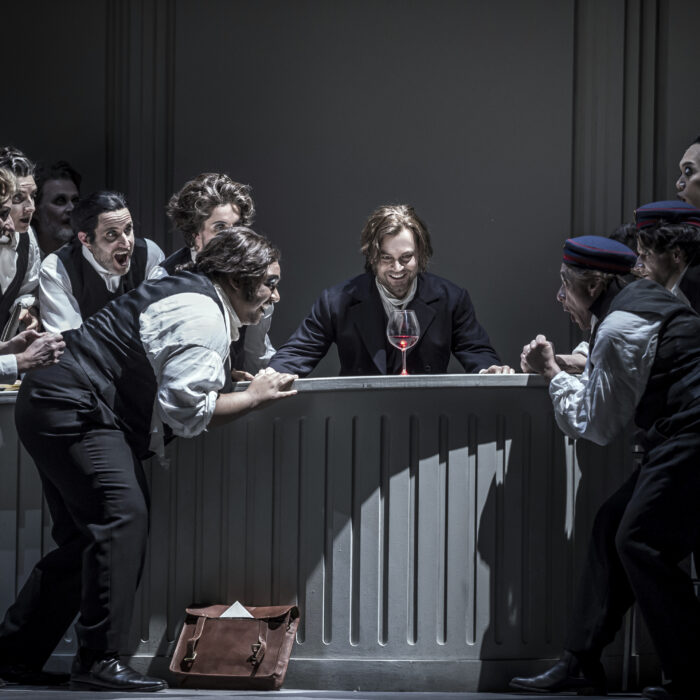
Even the Duke, performed by tenor Yongzhao Yu, making his San Francisco Opera debut, seemed moved by her and when he sang ‘Parmi veder le lagrime,’ he sang with more conviction and authenticity than in his ‘Questo quella,’ which remained shopwork and not particularly convincing. In this latter aria, he finessed his feelings with genuine lyricism and tenderness. He seemed to step out of his manipulative self and into a believable and caring lover. It was quick work, however, and he, just as quickly, slipped back into his base persona. From time to time, Yu’s phrasing and endings of words seemed slippery, although it did not detract from his handling of the complexities of the character. We frequently ask ourselves: how can someone sing such lustrous and ardent music and at the same time, be so morally repugnant? Here again is Verdi’s gift at work. Yongzhao Yu pointed effectively in that direction. The chicanery through which Gilda got abducted by her father Rigoletto himself, also remained as chilling as ever.
Baritone Aleksey Bogdanov as Monterone, making a strong and melodramatic entrance, reminiscent of the appearance of the Ghost in “Don Giovanni,” performed well as a father in distress rather than an other-worldly presence out to damn the whole palace of people. It was effective but did not send the ripples necessary through the whole ducal assembly. This would would have helped emphasize his role as the crucial lynchpin of the ensuing action. Instead it remained realistic.
In fact, the whole tone of the production remained in this world of action and behavior, display rather than depth, worthy of the subject, yes, but any suggestions of the influences of the beyond did not deeply resonate. Neither the spells of Gilda’s mother, Rigoletto’s wife as an angel of heaven nor the ghostly overlay of Monterone’s curse seemed quite believable. Rigoletto’s grief and guilt, while vocally but not overly articulated, ruled the roost. He pointed several times to that alternate influence, but it was just not encompassing.
That meant that we were cast on the ground of ordinary human nature. And, it didn’t look good. Particularly in the final scene between Sparafucile and Magdalena, although the performance of that, along with the glorious quartet, was well-executed and dramatically effective. Each of their parts in the Verdi’s masterpiece, were strong and moving, although the sound occasionally got – pardon the pun – overpowered by the orchestra.
More Cast Highlights
Mezzo-soprano J’Nai Bridges performed a colorful and dramatic Maddalena. Her physical actions, facial expressions and her vocal agility were excellent. Although, she too got covered at times by the orchestra. But the overall energy and dynamic of the music and the four soloists, kept the whole scene alive and pulsating and dramatically decisive. Bridges sang with appealing warmth as well as piquant wickedness, flirting and moving around with great aplomb. She was a convincing and bewitching temptress with the Duke and Sparafucile. Peixin Chen as Sparafucile remained a little less relaxed. He enabled the situation to unfold with skill and dexterity. Together the two set a nice contrast to Gilda and Rigoletto as they encountered each other.
As always, conductor Eun Sun Kim brought her gallant energy to the score, bringing the San Francisco Opera to the forefront and enabling the singers and excellent chorus to sing fulsomely throughout. Although her pace seemed a little fast and precipitous, she reconciled the energy of a score of textural richness with the unfolding story. As usual, the Verdi instrumentation was rich and varied, with 40 instruments in total, including double oboes, multiple trumpets, horns and trombones, the abundant strings, plus, an array of backstage musicians including strings, winds, percussion and chimes.
Eun Sun Kim made sure we remained throughout in the colorful land of emotion and human conflict without shrinking away from its ugliness. Nothing felt ugly or repugnant. The beauty of both evil and good she made sure to intermingle. She is a vigorous conductor, determined, from the outset, to fit the stage scene and the score together with mastery.
Two additional production comments: in the last act, the shift to outdoors with its moving of the building seemed awkward and unnecessary. Perhaps an alternative that didn’t jar the mood would be more welcome. The final shift of the lighting at the end seemed errant. While symbolically to “see” what degeneracy was actually going on in the Duke’s world is well-intentioned, its suddenness diminished the power of the dark tragedy unfolded before us.
Verdi’s “Rigoletto” was first performed in 1852, and has remained an active performance piece in so many opera houses since. Its rich and accessible music and its strongly human conflicts enable audiences like the opening one in San Francisco to experience its critique of selfish human behavior and its support of genuine love across the spectrum. Even Gilda’s sacrifice of self for the conniving Duke shows Verdi’s humanity. “Rigoletto” in Verdi’s musically capable hands and powerful human understanding, manages every time to cut to the quick of our human impulses and conscientious nature, showing us how we struggle and how we come away from that struggle with a chastened, if not fully compassionate soul. Despite the emphasis on display instead of depth, the Shakespearean atmosphere of the story, did not descend on the performance. Even so, San Francisco Opera patrons left the opera house on opening night with music in their hearts and query on their lips.