Wiener Staatsoper 2025-26 Review: Luisa Miller
Nadine Sierra & Freddie De Tommaso Star in Disjointed Production of Verdi’s Early Work
By Laura Servidei(Credit: Susanne Hassler-Smith)
“Luisa Miller” by Giuseppe Verdi is a tragic tale of love destroyed by social hierarchy and political intrigue. The young peasant Luisa Miller is in love with Rodolfo, who is in fact the son of the powerful nobleman Count Walter, though he has been living in disguise. Their relationship is opposed by Rodolfo’s father, who intends him to marry the Duchess Federica for political advantage, and by the scheming courtier Wurm, who desires Luisa for himself. When Luisa’s father is arrested, Wurm ruthlessly exploits the situation: he threatens that unless Luisa writes a letter falsely declaring her love for him and renouncing Rodolfo, her father will be executed. To save his life, she submits. The letter convinces Rodolfo of her betrayal, and in despair and rage he poisons both himself and Luisa; as they die, the truth emerges, and he recognizes her innocence too late, sealing the opera’s tragic conclusion.
The Inherent Absurdity of 19th-Century Opera
Nineteenth-century Italian opera can appear rather absurd when viewed from the outside. Plots are often implausible, in the manner of contemporary feuilletons, filled with extreme emotions, all-consuming love, characters torn between passion and duty, villains of almost diabolical cruelty, and a general tendency for everyone to die in the end. On top of this, everything is sung without amplification, in a vocal technique entirely foreign to modern pop artists, bursting into ornamentation and coloratura at dramatically unlikely moments, and performed by singers often twice or three times the age of their characters. What holds this apparent madness together is, of course, the music: some of the finest composers of the time created extraordinary scores for these improbable figures, so that opera can still move us deeply—provided the conductor and director trust the music and take it seriously. This of course does not exclude irony, or a tongue-in-cheek approach, or modern reinterpretation.
Disjointed Imagery and Directorial Excess
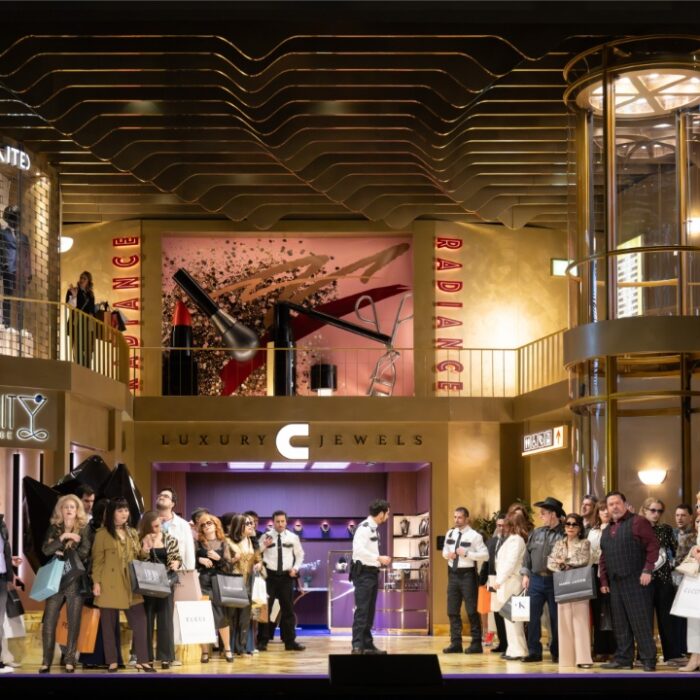
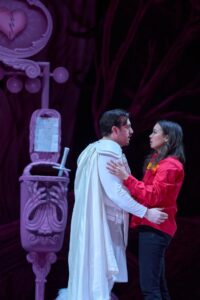
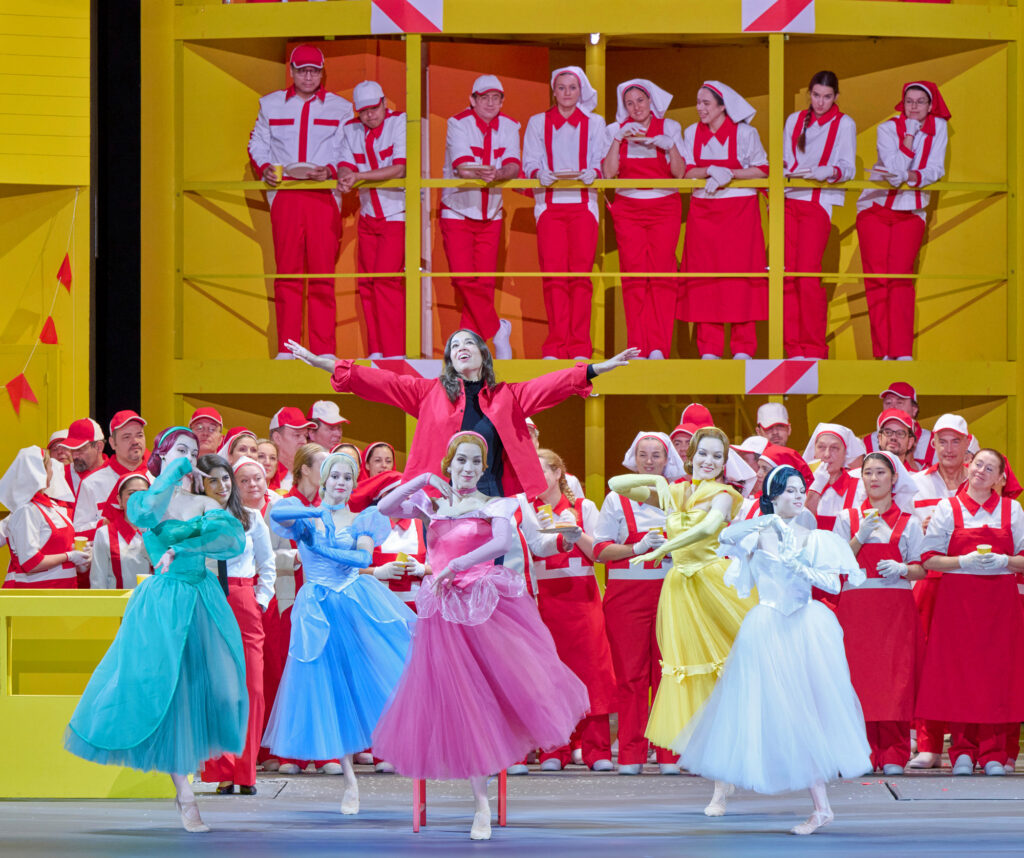
In Vienna, however, the impression was that the director Philipp Grigorian had little faith in the work. The production resembled a stream of consciousness, as though every passing idea had been placed on stage without critical filtering; the results felt superficial and lacking insight. The only discernible concept—that the story is recalled by Luisa’s father, shattered by her death, while sitting at a Viennese bus stop—was neither original nor consistently developed. Thus the “village square” became a brightly colored Amazon-like warehouse, with workers in red and yellow uniforms. Rodolfo appeared as a delivery driver, oddly reminiscent of a color-coordinated Super Mario, or else in a caricature of knightly armor made of gleaming white plastic, complete with plume. Wurm was recast as the facility’s supervisor. Count Walter’s palace in Act two became a sauna, populated by dancers in Moulin Rouge-style costumes giving massages, while in Act three Duchess Federica entered dressed as a Valkyrie in hot pink patent leather.
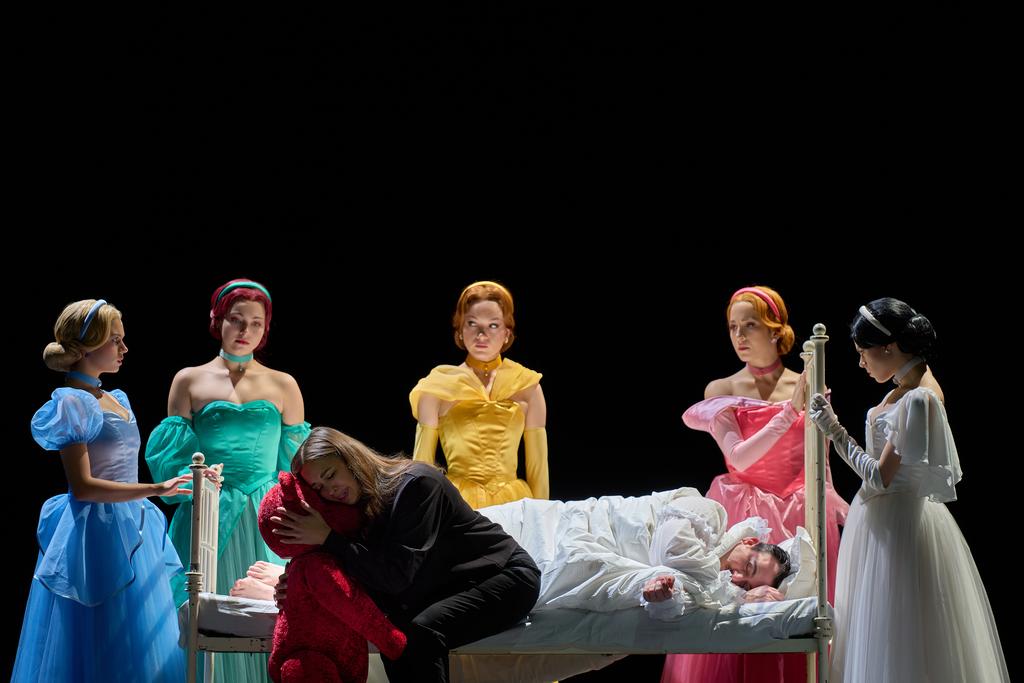
Luisa was accompanied throughout by five ballet dancers in multicolored tutus—white, pink, yellow, green, and blue—like distorted fairy godmothers from Sleeping Beauty. When she contemplated suicide, they reappeared as skeletal figures in black. And then there was the red teddy bear—best left undescribed.
The overall impression was that Grigorian was mocking the entire enterprise, as though the audience were naïve for finding such a work meaningful or culturally significant. It felt less provocatively confrontational than, say, Calixto Bieito at his most controversial, and more like a gesture of condescension: “how can you possibly take this seriously?” There was little sense of engagement with, or even respect for, the opera itself.
Susanne Hassler-Smith
Musical Integrity from the Pit
Fortunately, Michele Mariotti, on the podium, provided exactly the commitment that was missing on stage. His affinity for the music was evident throughout: he drew from the Vienna State Opera Orchestra a distinctly Italian sound, full of tension and foreboding, yet refined by sensitivity and careful dynamic control. He shaped Verdi’s dramatic arcs with clarity and maintained constant, attentive support for the singers.
A Triumphant Luisa
Nadine Sierra delivered a splendid Luisa. Her impeccable technique supported even the most demanding coloratura, executed with intelligence and always in service of the drama rather than mere display. Her radiant high notes shone brilliantly, while the darker shading of her timbre lent the role genuine emotional weight. The result was a truly triumphant performance.
A Passionate but Uneven Rodolfo
Rodolfo was sung by Freddie De Tommaso, whose robust tenor conveyed the passion of the young lover, with secure and well-focused high notes. At times, however, he seemed less at ease in bel canto style: “Quando le sere al placido,” the opera’s most famous aria, lacked the sustained legato Verdi demands. One sensed the need for more refined breath control and more nuanced dynamic shaping. Even so, his performance was engaging and warmly received.
A Verdian Father
Miller, Luisa’s father, was George Petean, whose velvety baritone proved ideal for this quintessential Verdian paternal role. The character clearly anticipates the title role of “Rigoletto,” composed just two years later; indeed, the duet “La tomba è un letto” strongly foreshadows the emotional world of that later masterpiece. Petean and Sierra offered a deeply affecting interpretation, marked by expressive phrasing, fine legato, and stylistic authority.
Strong Villains, Strong Voices
The Duchess Federica, Luisa’s rival for Rodolfo’s affections, was Daria Sushkova, her deep mezzo nicely contrasting with Sierra’s brilliant soprano. In her duet with Rodolfo she effectively expressed love, jealousy and nobility, her middle and low register powerful and solid. The two principal villains, Count Walter and Wurm, are both bass roles. Roberto Tagliavini brought his customary bel canto elegance to Walter, with smooth, honeyed legato, well-covered high notes, and an effective balance of nobility and menace. Marko Mimica was a convincingly sinister Wurm, his metallic bass voice well suited to the character’s darker qualities.