Washington National Cathedral 2026 Review: Angels & Demons
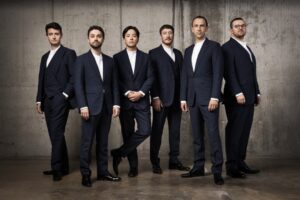
By Arnold Saltzman(Photo: The King’s Singers press)
The King’s Singers, a celebrated a cappella ensemble, were a singular factor in the revival of unaccompanied vocal music.
Fifty-Eight years ago, in 1968, six choral scholars from King’s College, Cambridge formed the ensemble known throughout the world as ‘The King’s Singers.’ Two counter-tenors, a tenor, a baritone, and a bass have continued this vocal formation since its inception. Two of its dedicated members are retiring soon: Patrick Dunachie, countertenor and Christopher Bruerton, baritone. The four members who will remain include: Edward Button, countertenor; Julian Gregory, tenor; Nick Ashby, baritone; and Piers Connor Kennedy, bass.
Program Details
The featured work in this program for two sold out performances in the cavernous Washington National Cathedral, was composer Geoffrey Poole’s “Wymondham Chants” the first commissioned work by The King’s Singers in 1971.
This was the first of 200 commissions by this vocal ensemble which also maintains The King’s Singers Global Foundation (see their website). Their concert schedule for 2026 is breathtaking in its scope for concerts reaching venues around the world.
The featured work served as an organizing principle for the program with Geoffrey Poole’s composition serving as framework for contrasting vocal works by William Byrd, Arvo Part, Judith Bingham, Palestrina, and Duruflé. The compositions of Geoffrey Poole are steeped in the knowledge of chant, Medieval and Renaissance music and technique, including polyphonic settings such as the Regina Coeli by Palestrina, double choir effects, melismatic singing on single syllables, early counterpoint, and sometimes changing meter.
Breaking up the four movements of “Wymondham Chants” was an effective way of presenting other choral works, yet the impression was, that while it might have some risk, Geoffrey Poole’s four-movement work could easily stand on its own without the contrasts. Its harmonies are richly sonorous and dissonant throughout the four movements. The most effective and humorous, darkly humorous, was the second movement Scherzo: Tutillus, “named after a medieval demon who disrupts and interferes with the liturgy in the old Abby of Wymondham in Norfolk.” The singers have outbursts akin to someone with schizophrenia seated in the congregation interjecting whenever they are moved to do so.
Another moving, emotionally packed section was the Epilogue: Blessed Jesu (from “Wymondham Chants”) which makes use of two vocal trios, one placed at the Apse of the Cathedral with their backs to the audience and facing the alter, their distant sound creating an effective sense of mystery, while the second trio is situated in the center of the Transept and facing the audience or congregation. These trios are based on a 15th century carol text, sung in different keys and modes at the same time with profound effect and “increasingly desperate tones,” until they resolve together with stunning open harmonies.
The King’s Singers signature is pure vocal blending, stunning dynamic sensitivity, pure vowels, fine arrangements, and power when needed. Many in the audience were eager to hear some of their contemporary arrangements in the second half of the generous program which included: “Danny Boy;” “Rhythm of Life” (from the musical “Sweet Charity”); “Our Love is Here To Stay” by George and Ira Gershwin; “Cruella De Vil” by Mel Leven (101 Dalmatians Film). The program included expressions of concern and support for the memory of Rev. Dr. Martin Luther King Jr. during this time of Black History Month, and the recent holiday commemorating the great leader of the Civil Rights Movement.
This was a remarkable program given by one of the world’s great vocal ensembles.