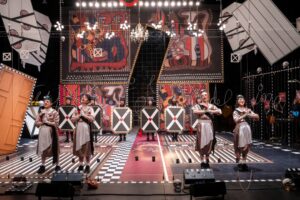
The Brooklyn Academy of Music (BAM) & Prototype by Beth Morrison Projects (BMP) 2026 Review: What to wear
By Jennifer Pyron(Photo: Stephanie Berger)
The Brooklyn Academy of Music (BAM) and Prototype by Beth Morrison Projects (BMP) presented “What to wear” at the BAM Harvey Theater on January 15, 2025, to a sold out audience on opening night. The premiere of this work initially took place at REDCAT in LA in September 2006, under the direction of Richard Foreman, and remains just as vital to the art world today as it was back then.
Foreman’s works are a spontaneous combustion of art mirroring the complexities of human existence. However, this is not to be confused with chaos through means of disorganization: his works bring to life every detail as a meticulously arranged, symbolic, and emotionally guttural reflection of reality itself. One’s reaction when experiencing his work live cannot be measured by an “expert’s mind,” and some might discover themselves laughing out loud with tears in their eyes the entire time. For me, I felt held by a creative community who dares to see this world differently and celebrates differences for exactly what they are.
(Photo: Stephanie Berger)
Watch Out for the Duck!
“What to wear” illuminates “otherness” and creates a whole universe beyond the veil of objectification, allowing art to spew forth and create anew. This work’s potency, now 20 years later, proves how Foreman’s playful intelligence in a “sad, sad world” stirs one’s own understanding of reality backed by a keen sense of comprehension ahead of its time. In writing this review, I decided to revisit the work of Alfred Jarry’s “Ubu Roi” (Paris, 1896) in order to gain more clarity surrounding the beginning ideals of surrealism and live performance. Also ahead of its time, “Ubu Roi” challenged everything and turned critics on their heads for the better. I was also taken to a deeper level of philosophical reflection when I learned that the name “Ubu Roi” is based on the Bantu term “Ubuntu.” According to Dr. Michael Onyebuchi Eze, a teacher of post-colonial African studies, in his “Intellectual History in Contemporary South Africa,” the core of Ubuntu (humanity) is best described as: “’A person is a person through people,’ [this] strikes an affirmation of one’s humanity through recognition of an ‘other’ in his or her uniqueness and difference. It is a demand for a creative intersubjective formation in which the ‘other’ becomes a mirror (but only a mirror) for my subjectivity. This idealism suggests to us that humanity is not embedded in my person solely as an individual; my humanity is co-substantively bestowed upon the other and me. Humanity is a quality we owe to each other. We create each other and need to sustain this otherness creation. And if we belong to each other, we participate in our creations: we are because you are, and since you are, definitely I am. The ‘I am’ is not a rigid subject, but a dynamic self-constitution dependent on this otherness creation of relation and distance.”
(Photo: Stephanie Berger)
Musical & Production Highlights
Composer Michael Gordon worked with Foreman on “What to wear” from its conception up until Foreman’s passing just last year. Together they enjoyed bringing to life a production meant to disrupt “expert minds,” while also paying a loving tribute to Foreman’s “duck.” In this, Gordon’s composition is surreal post-rock at its finest. Conductor Alan Pierson and the iconic members of the Bang on a Can All-Stars, including Darian Donovan Thomas (violin), Arlen Hlusko (cello), Lizzie Burns (bass), Mark Stewart (electric guitar), David Cossin (percussion), Vicky Chow (keyboards), and Ken Thomson (clarinets and keyboards), made the music feel urgent and sound addictively beautiful. Every transition was met with a deeper level of nuance and awesomeness, combined with precision and a profound panoply of percussion. While listening to the music, my body wanted to get up, dance, move – do something more than just sit and observe. It is very rare to feel this way when also in a state of shock about where we are as a “whole” in today’s world, and I left the performance feeling more alive than ever. “What to wear” saved me.
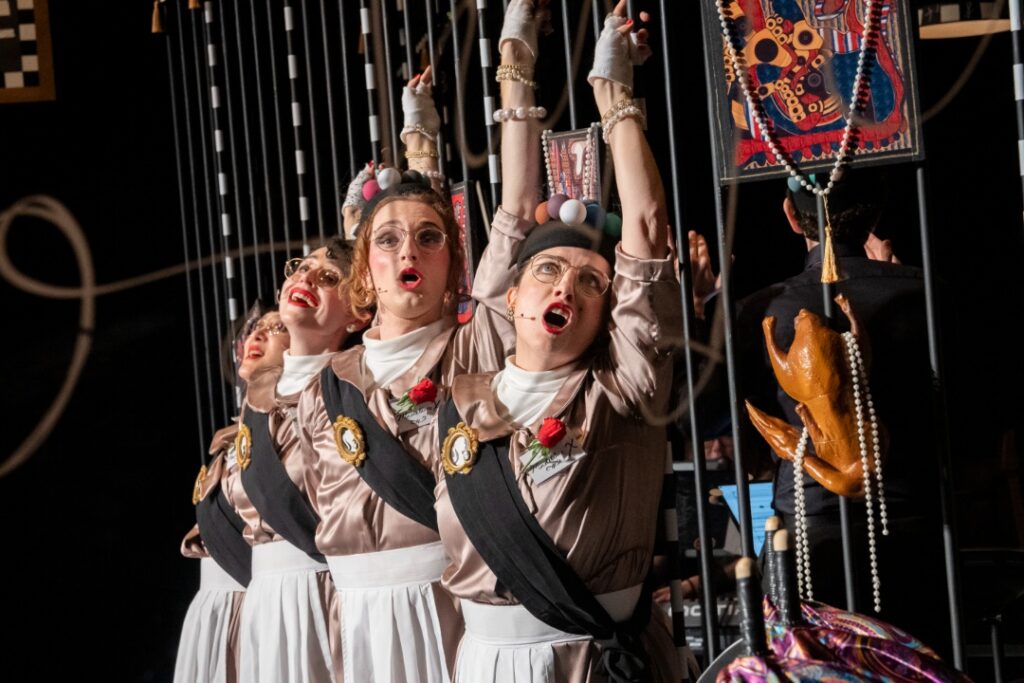
The vocalists as a collective force were outstanding in their performance. The role of Mad’line X and her fantastic fury while trying on many different looks was performed by four principal vocalists including soprano Sarah Frei (original cast member), soprano Sophie Delphis, mezzo-soprano Hai-Ting Chinn, and tenor Morgan Mastrangelo. Additional vocal ensemble members included Kira Dills-DeSurra, Jordan Jones, Kaileigh Riess, Leilah Rosen, Weiyu Wang and Zen Wu. The excellent vocal technique and physical skills required for this work are no mean feat. Voices were challenged to sustain long, forced sounding straight notes that might peel paint off the wall. The notated vocal quirks were a fun surprise! I felt like I had lifted the glass on a surrealist painting and could hear background music and eerie sounding voices making sound effects that fitted to their moods and momentary whims. It was unlike anything I have heard yet!
(Photo: Stephanie Berger)
The movement ensemble played an important role in smooth transitions between musical movements that stopped abruptly and left listeners on the edge of their seats. The ensemble included Movement Captain devika wickremesinghe, Hallie Chametzky, Chloe Claudel, Lindy Fines, Celeste Goldes, Addie Levandowski, Lilly Lorber, Annika Mankin, and special guest St. Vincent. Each performer’s exacting attention to timing and precision in their delivery was off-the-charts phenomenal. I felt as if I were watching the inner-workings of a finely tuned watch, whirling in its mastery of design.
Gordon’s composition is complex yet simple: new yet nostalgic, bizarre yet brilliant. His gift for composing for the voice is magical, and the vocal layers throughout “What to wear” changed my life. The opening number, “This is Mad’line X,” is still replaying on a loop in the back of my mind. The opportunity to experience this work live, and with Gordon in the audience, is something I will cherish forever. During this performance, I also observed audience members laughing, crying, looking around to see if anyone else “was getting it,” and some members even bobbing their heads in a “rock on” type of way.
“Mad’line X lives in a world of lies,” “Mad’line X, who understands now,” and “Experts are confused,” pressed on in a wild discovery of musical unfurling. Gordon’s composition uniquely deemed its own path while Foreman’s hyper-surreal imaginings and raspy recorded vocals interwove a wild and unobstructed lens on humanity’s creation, obsession, demise (spoiler alert: the duck gets roasted in a fine dining restaurant!), and rediscovery. The oddness at play in this work fed into the chaos that is this life and the humanness felt while living it. Foreman and Gordon tell a story like no other in a celebration of “otherness” that must continue in order for humanity to thrive.
Illuminating Details
Soprano Sarah Frei gave the performance of a lifetime. She is an original cast member and so all of her interpretations were front and center, guiding everyone down the rabbit hole and directly into Foreman and Gordon’s universe. Her facial expressions, bulging eyes, glaring white teeth and military style marching movements were iconic.
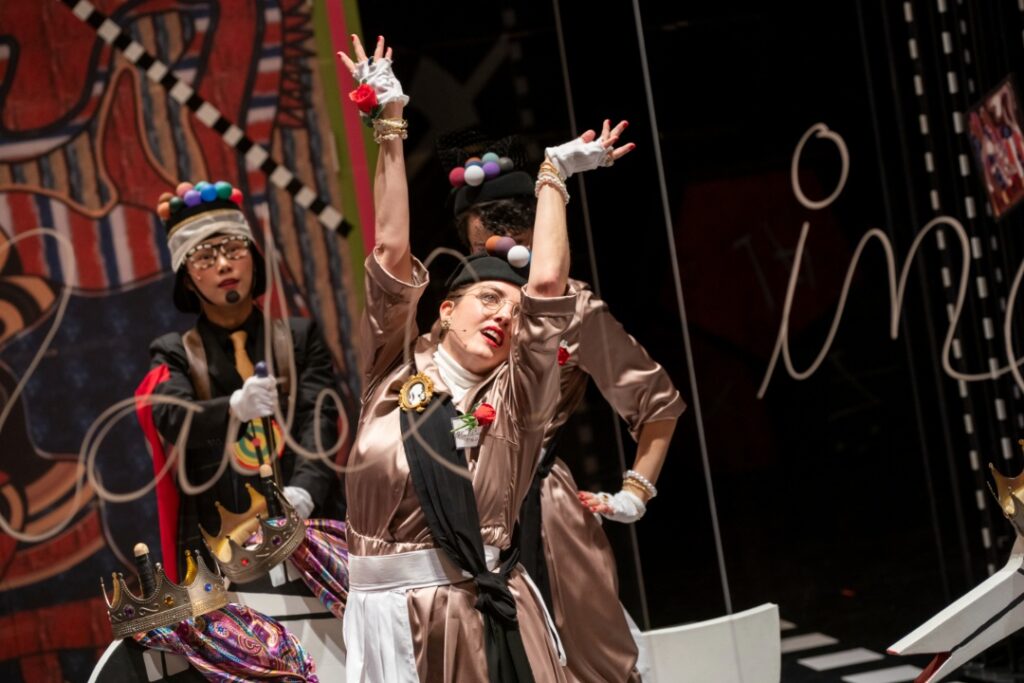
(Photo: Stephanie Berger)
Mezzo-soprano Hai-Ting Chinn left a lasting impression as well. Her performance of “Am I still beautiful?” resonated beyond the art-filled stage, guarded by plexiglass panels that created a literal fourth wall. Her voice added vitality and character to Gordon’s composition, making her role very much her own despite everything else that was always going on all at once.
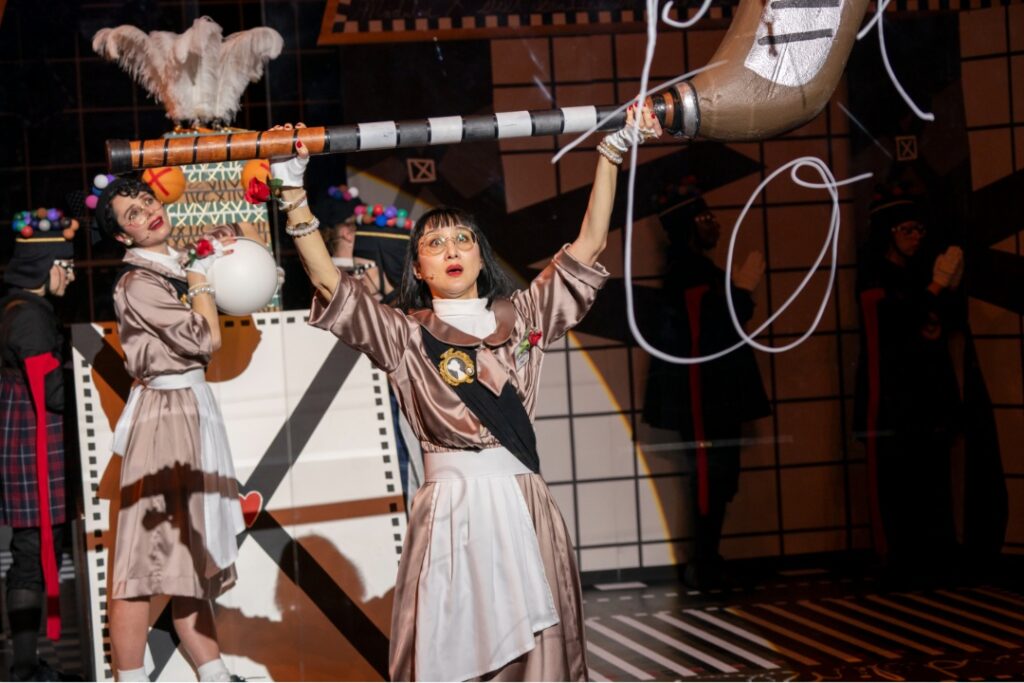
(Photo: Stephanie Berger)
St. Vincent’s special performance of “So sad but I reject you” was another musical highlight. Her voice was grounded in a delicious mix of respite and release. She sounded rich, warm, and intoxicating. Time stopped when she sang and a vast spaciousness filled the stage, evoking a sense of underlying peace through absurdity.
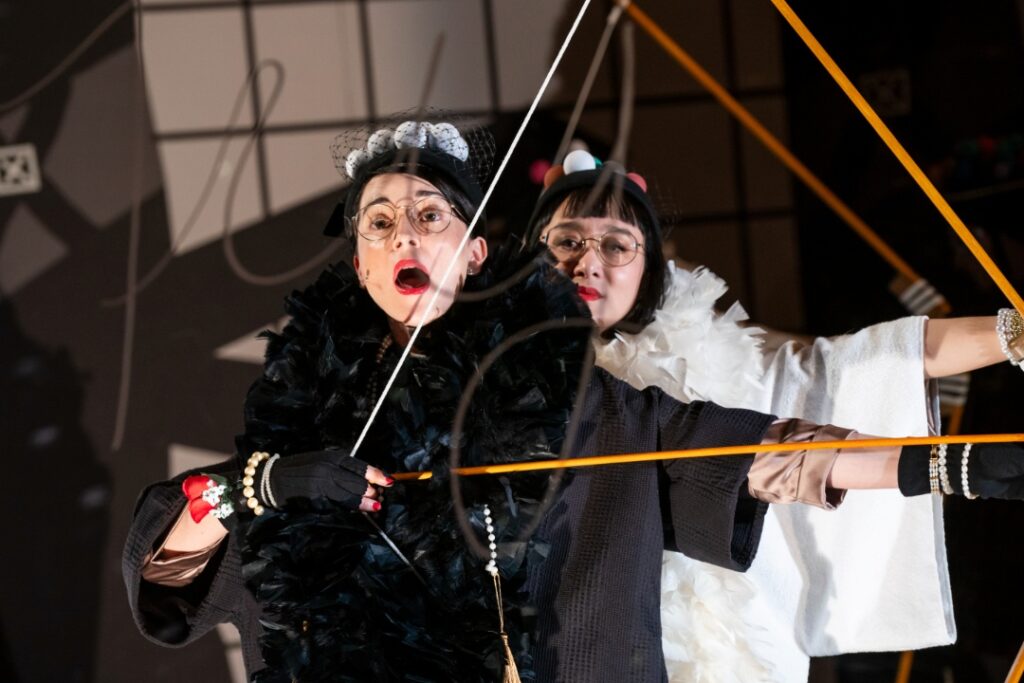
(Photo: Stephanie Berger)
“What to wear’s” brilliant creative team included Creative Director Paul Lazar, Co-Creative Director Annie-B Parson, Music Director Alan Pierson, Costume Designer (Original and Current) E.B. Brooks, Associate Choreographer Elizabeth DeMent, Associate Director Rebecca Miller Kratzer, Scenic and Props Recreator Michael Darling, Lighting Designer Joe Levasseur, Sound Designer Garth MacAleavey, Creative Producer Beth Morrison, Technical Director and Consultant (Original and Current) Michael Darling, Director of Production Roderick Murray, Associate Producer Gabrielle Niederhoffer, Production Manager Aislinn Curry, Production Stage Manager Jason Kaiser, Assistant Stage Manager Caren Celine Morris, Props Associate Oscar Escobedo, Costume Associate Katie Friedman, Assistant Conductor and Rehearsal Pianist Matthew Stephens, and Assistant to the Directors Talia Feldberg.
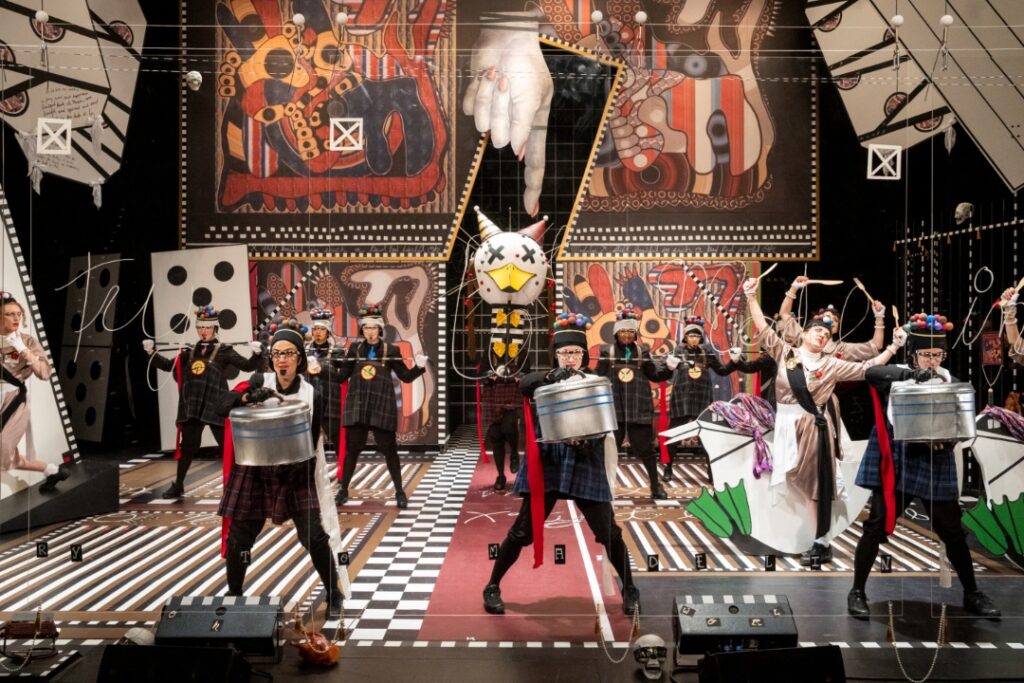
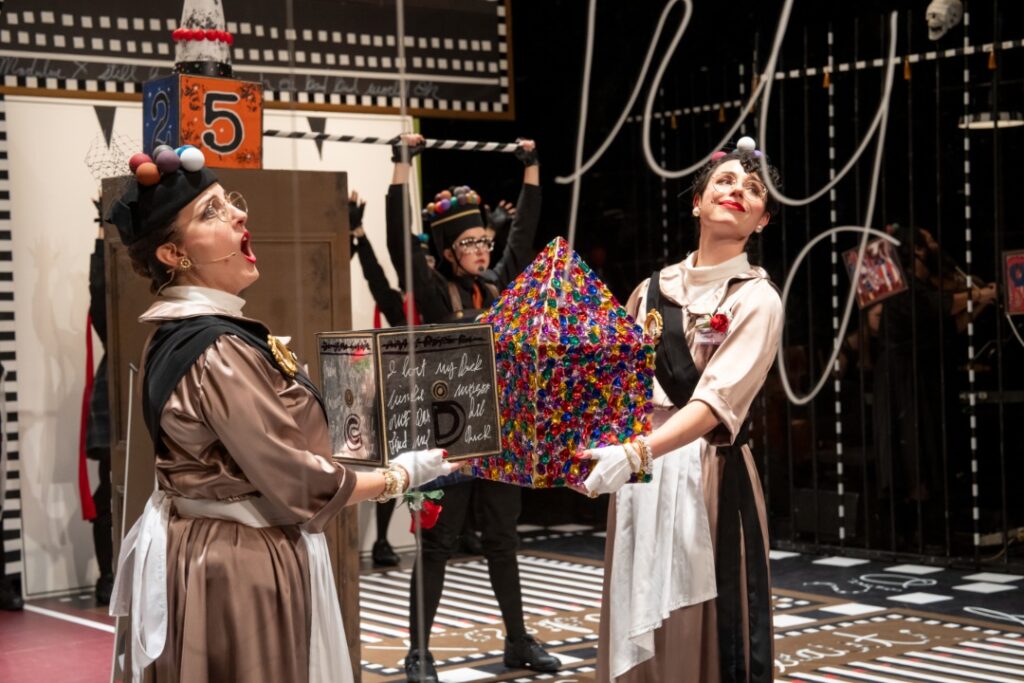
The plexiglass panels that separated the audience from the stage bore writing that read, “do try to Mad’line X do try to.” At times, the plexiglass would reflect back the faces in the audience and it reminded me of Alexander McQueen’s legendary fashion show, “Voss,” for his spring/summer 2001 collection, where members of the audience were forced to wait for the show to start while looking at themselves. While the plexiglass reflection was less severe, it did add to the curiosity of the mix seen onstage. Skulls, target boards, number sequences, bird heads, a huge golf club, feathers, a gem-stoned box, checkered details, lots of capes, a big pointing hand with red finger nails, marching people holding life-sized playing cards reminiscent of “Alice in Wonderland,” paired with multiple duck variations (ranging from a duck-tank military style to à la roasted duck on silver platter, some with pearls dangling from them) made this production supremely authentic and personal to Richard Foreman’s imagination. It felt like he too was in the audience, watching his universe reveal itself again – unapologetic and right on time.