Teatro Real de Madrid 2025-26 Review: I Masnadieri
Lisette Oropesa Triumphs in Verdi’s Early Work
By Ossama el Naggar(Credit: Javier del Real | Teatro Real)
In recent years, Madrid’s Teatro Real has programmed many “operas in concert.” Sometimes they’re well-known, such as “Orfeo ed Euridice,” “Idomeneo,” or “Die Fledermaus” that I attended at the venerable theatre over the last three seasons. On occasion, they present more obscure works, such as Verdi’s early opera “I masnadieri”(1847). In the past, a touring production was employed, with conductor and cast performing in several European cities. For “I masnadieri,” the forces of the Teatro Real itself performed, and some sensed that the main justification was the presence of Cuban-American soprano Lisette Oropesa.
“I masnadieri” is in fact one of Verdi’s weakest operas. Its music is typical of early Verdi, with the bandmaster’s son’s Umpapa rhythms and ubiquitous “tempo di Walzer” that he eventually shed before maturing into Italy’s greatest operatic composer. The libretto, based on Schiller’s play “Die Räuber” (1782), is by the forgettable Andrea Maffei, a competent translator and salon revolutionary patriot in the days of the Italian Risorgimento, but far from an ingenious librettist. The work’s claim to fame is that it’s Verdi’s only opera written for London. The role of Amalia, written for the coloratura Jenny Lind (“The Swedish Nightingale”), has always been the reason for its occasional revival. Joan Sutherland and Cristina Deutekom are two singers who’ve played the protagonist in our time.
And the verdict, you ask? Musically, it sounded like lackluster Donizetti with early Verdi Umpapa. Dramatically, it lacked balance between the four protagonists: the older son Carlo; his fiancée, the orphaned Amalia; his father, the elderly Count Massimilian Moor; and the envious younger son, Francesco. But by any optic, the fact remains: the characters aren’t sufficiently developed. One simply cannot identify with any of them. At the absurd finale, Carlo learns he cannot abandon his merry band of bandits (to whom he’d sworn an oath of loyalty), nor can he bear to lead his beloved Amalia to perdition with his life of crime. So, he stabs her to death. This opera makes the plots of “Il trovatore” and “La forza del destino” seem credible in comparison.
Despite the opera’s dramatic shortcomings, Oroposa has an obvious affection for this early Verdi opera. In June 2019, I was fortunate enough to attend her debut in the role of Amalia in this opera at the Teatro alla Scala in David McVicar’s production. It was an odd choice to debut in such a forgotten work that is unlikely to leave much of an impression. Nonetheless, it was a remarkable debut that elicited a positive reaction from critics and public alike. This past summer, Oropesa chose to appear again in this role at the Münchner Opernfestspiele where she was vocally thrilling, but was sadly marred by Johannes Erath’s inane staging.
Indeed, the peril of this dramatically weak opera is that unless a brilliant director is at the helm, “I masnadieri” will almost certainly leave the audience disappointed. Perhaps this is why the “in concert” formula is a good decision. Oddly enough, this was my first of three “I masnadieri” productions, all three with Oropesa, in which I found the work musically interesting. Perhaps it’s because it’s the first time I wasn’t distracted by a misguided staging.
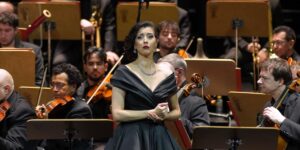
The role of Amalia was written for a register similar to Gilda’s in “Rigoletto.” However, dramatically it would be more suitable for a voice similar to Elvira in Ernani. This discrepancy can further weaken the opera, but the nature of Oropesa’s voice is ideal for the role for this very reason and may explain her attachment to it. Despite the absence of direction, Oropesa conveyed Amalia’s nobility and strength of character. Her rich voice has a rare quality: it’s immediately recognizable, thanks to its distinct timbre and natural trills. Her interpretation of its most famous aria “Tu, del mio Carlo” was spot on – initially sad and then brilliantly joyous in the cabaletta “Carlo vive,” with clean coloratura and brilliant high notes. When she finished, there was pandemonium in the theatre. The crowd would not stop their applause and loud cheers until Francesco Lanzillotta gave in and had Oropesa give a bis of the aria’s cabaletta. This time, ornaments were added in the tradition of the great coloraturas, to the delight of the Cuban-American diva’s many fans. Astonishingly, this was Oropesa’s third bis at the Teatro Real following the sextet in “Lucia di Lammermoor” in 2018 and the second in “Addio del passato” in “La traviata” in 2020. Even in this little known opera, miracles can happen!
Another reason for my enthusiasm is that this time, unlike in Milan and Munich, the rest of the cast was also solid.
The role of Carlo was written for a dramatic tenor with impressive high notes. Though not a truly dramatic tenor, lyric tenor Piero Pretti has transitioned into a heavier dramatic tenor Fach over the years. Pretti’s brighter lyric voice imparts youth to the role. What is marvellous about this tenor is he never forces; his high notes are booming and resplendent without effort. Moreover, his voice has an appealing squillo. He sounded glorious in his Act three duet with Amalia, “Lassu risplendere,” a melodious piece but also regrettably rich in Umpapa.
Russian bass Alexander Vinogradov was a noble Count Massimiliano. He gave a moving interpretation of his Act three racconto“Un ignoto, tre lune or saranno,” in which he recounts his ordeal. My only reproach was his diction, which was not as clear as the rest of the cast.
Though the role of the evil brother Francesco is awkwardly written and the character development weak, baritone Nicola Alaimo made quite an impression. The role is so uninterestingly brutal, evil from beginning to end, that few can do much with it. Alaimo’s rendition of “La sua lampada vitale langue” was appropriately menacing, with clear diction and emphasis on key words such as “tremate,” “debole” and “carcere.” His final aria, “Pareami, che sorto,” was movingly interpreted. At this stage, the surprisingly remorseful Francesco evokes Macbeth at his end. Alaimo aptly conveyed the character’s pathos and remorse.
Francesco Lanzillotta led the Coro y Orquesta Titurales del Teatro Real with aplomb, managing to downplay the Umpapa passages. Moreover, as a conductor deeply entrenched in the Italian tradition, he provided great support to the singers, especially Pretti and Oropesa in their difficult passages. Chorus master José Luis Basso led a well-prepared chorus.