Teatro Municipale di Piacenza 2025-2026 Review: Don Giovanni
By Bernardo Gaitan(Credit: Gianni Cravedi / Teatro Municipale di Piacenza)
The great collector of women arrived in Emilia-Romagna, specifically at the Teatro Municipale di Piacenza, before moving on to Modena, as part of a co-production between the two cities’ theaters. The scenic concept was devised by Andrea Bernard. A statement of his opens the program booklet, in which he explains that he has always considered Don Giovanni the least interesting character in the opera: not for lack of action, but for lack of confrontation. According to the director, Don Giovanni is experienced in entering the lives of others without ever truly connecting with them: he does not listen, does not engage in dialogue, and never commits himself. He yields only to death, the sole presence that cannot be seduced or transformed; it is therefore the one force that compels him to confront something beyond his control.
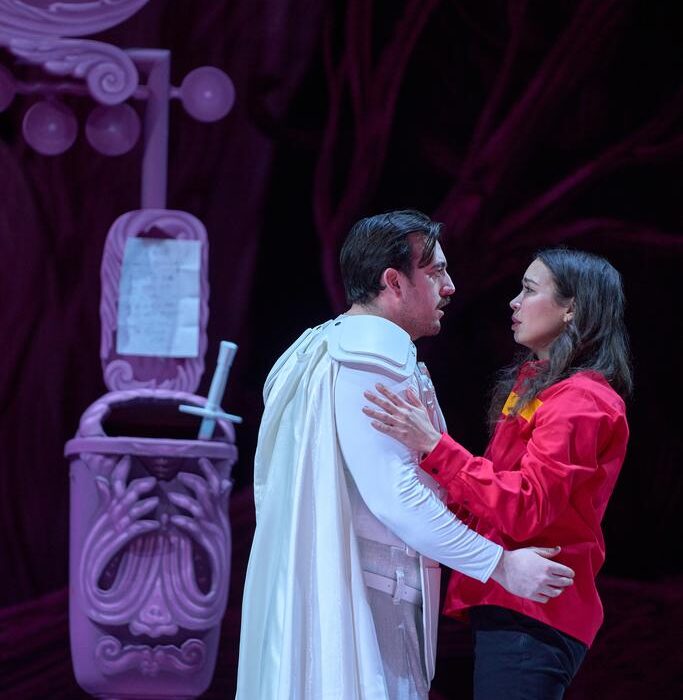
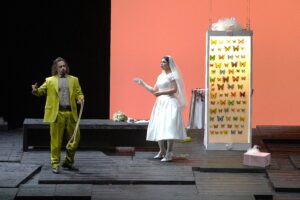
This intriguing premise raised considerable expectations about what would unfold onstage. Unfortunately, the result was disappointing. What emerged was yet another “Don Giovanni” production that adds nothing new, and whose few attempts at innovation proved ill-conceived. The 38-year-old director’s idea is to portray Don Giovanni as a collector of women, treated like butterflies. The seducer seeks to add yet another conquest, Zerlina, to his collection. The entire action takes place inside a black box, reminiscent of the space in which Leporello preserves his master’s collection of butterflies/women, a poetic solution meant to justify the well-worn — and hardly novel — black-box staging technique, dispensing altogether with traditional scenery.
The scenic space — if not simply an empty darkness — designed by Alberto Beltrame becomes Don Giovanni’s “mental archive.” This is an abstract, vague, and undefined place where everything is supposedly catalogued. This strategy generates significant confusion for the audience, as the same space is used to suggest different settings through a minimal use of props: masks and streamers for the party, a bouquet of flowers for the wedding, a picnic basket with the characteristic red checkered tablecloth for the dinner with the Commendatore, among other items. The only truly novel element is the floor, made up of underground compartments — some containing mattresses, others left empty — used as storage spaces from which props are retrieved. Elena Beccaroh’s costumes are equally atemporal and incoherent: they combine elements of the Ottocento with contemporary plastic garments, such as elegant early nineteenth-century attire with a modern wedding dress. All are visually attractive and elegant, yet they lack any clear temporal logic. What is entirely successful in the production is Marco Alba’s carefully crafted lighting, which manages to lend a degree of movement and depth to the otherwise plain black box.
Serious dramaturgical flaws undermine the credibility of the concept: when Donna Anna describes her father’s murder with the line “Quel sangue, quella piaga, quel volto” (“That blood, that wound, that face”), and there is no-one onstage; during the serenade, Don Giovanni sings not to Donna Elvira’s maid beneath her balcony but to a toy gondola; and the “Statua gentilissima” is not a statue at all, but a heap of shattered bones strewn across the floor. All of this comes across as a bad joke and an affront to the memory of Lorenzo Da Ponte. Added to this is a kiss between Don Giovanni and Zerlina — despite the well-known fact that Don Giovanni never kisses anyone — and Masetto’s unnecessary sexual groping of his wife, with whom he ends the scene beneath the bedsheets. During the overture, the protagonist appears as a child already playing with a winged girl his own age: his first conquest, the first butterfly in the collection. To be fair, the final scene, in which Don Giovanni is dragged to hell along with the concluding sextet “Questo è il fin di chi fa mal,” was genuinely effective. The preceding three hours, from a theatrical standpoint, are entirely dispensable.
Trained in orchestral conducting, cello, and composition, Enrico Pagano — born in Rome in 1995 — offered from the pit a softened, sweetened reading. Overall, it was competent but lacked that distinctive Mozartian spark, that stylistic depth which, curiously enough, Pagano does possess in the Bel canto repertoire, as demonstrated in last November’s diptych at the Donizetti Opera Festival. Pagano’s conducting — he is 31 years old, the same age Mozart was when composing the opera — was nonetheless overall positive. For a work like “Don Giovanni,” an entire lifetime would not suffice to probe all its details or uncover new layers of its characters. Still, his sonic refinement in the finales and his command of varied atmospheres stood out for their clarity. Obsessed with highlighting nuance, Pagano delivered two unforgettable moments in the arias of Don Ottavio and Donna Anna, deliberately ignoring the tempi indicated in the score to create a melancholic, deeply introspective climate through pianissimi of extraordinary emotional intensity. The Orchestra Filarmonica Italiana, consistently attentive to his gestures, delivered a solid performance. Overbearing and at times stylistically inappropriate was the harpsichord accompaniment by Andrés Jesús Gallucci, who indulged in unnecessary chromaticism and acrobatics during the recitatives. The Teatro Municipale Chorus, prepared by Corrado Casati, contributed cohesion and dramatic weight to the choral scenes, confirming its musical and theatrical reliability despite its limited participation.
Undoubtedly, the most successful aspect of the evening was the vocal department, with all singers delivering performances of a high standard. Markus Werba portrayed Don Giovanni as a compulsive seducer, the object of desire for the three women and the absolute dominator of their will. The baritone boasts a flexible voice of appealing color, particularly evident in the second-act serenade “Deh, vieni alla finestra.” He moves confidently onstage and exudes charisma, though his overall emission could be more rounded. Despite the staging, he successfully navigates the libertine’s many facets: a young, insolent Don Giovanni with a generous vocal line and excellent Italian diction, always precise in intention and phrasing.
Tommaso Barea offered a Leporello of extraordinary theatrical energy. With irony and sharpness, he portrayed a man who transcends the traditional buffoonish servant, revealing the weariness of someone who has suffered too much. His performance confirms the Italian baritone as a major interpreter of the role, which he has already sung successfully in Berlin and at the Metropolitan Opera in New York. With an attractive timbre and natural emission, he deploys a mobile phrasing and dynamics pushed to the extreme. His command of text and stage is absolute, further supported by impressive physical preparation.
A most welcome surprise was Claudia Pavone as Donna Anna, whom she approached with professionalism and sensitivity. Her voice is luminous and agile, with carefully shaped phrasing. Both of her arias were prepared in meticulous detail, earning her warm applause. Particularly noteworthy were the clean coloratura and elegant phrasing. Her acting is solid, and her vocal control convincing.
The role of Don Ottavio often goes unnoticed, likely due to the banality of his dramatic function and his brief stage presence. Yet Mozart gifted the tenor two true masterpieces which, when properly performed — as was the case here — steal the scene without question. Marco Ciaponi portrayed Don Ottavio with a pleasant timbre, secure high notes, crystalline coloratura, and assured diction. Young and vibrant, he crafted a solid character. From the pit, Pagano supported him attentively in a truly outstanding “Dalla sua pace.” Taken at an extremely slow tempo and sung in pianissimo, the interpretation was spine-tingling. The coloratura in “Il mio tesoro intanto” was equally clear.
Probably the soprano with the greatest experience as Donna Elvira on the European scene is Carmela Remigio, who has sung the role more than 450 times worldwide. This is immediately apparent: her character displays remarkable emotional intensity, alternating desperation with outbursts of restrained fury. She is not a victim, but a woman who refuses to be erased from the life of the eponymous seducer. Remigio demonstrated her ability to gradually win over the audience, drawing them in despite some timbral limitations in the first act. After a few scenes, she delivered an impressive Elvira. Vocally, she no longer possesses the brilliance of a young debutante, but she brings immense stage experience and solid musicianship, handling the role with ease. Her rendition of “Mi tradì quell’alma ingrata” was particularly strong, marked by excellent control and a refined vocal texture, especially in the middle register. The high notes were well-centered and reached without difficulty.
Alberto Petricca brought to life a Masetto far removed from the stereotype of the naïve young man whose bride is easily taken from him. The baritone stood out for his vocal solidity, with a richly colored instrument and firm vocal line. Désirée Giove, in turn, offered a fresh and precise Zerlina, with a crystalline timbre capable of balancing innocence and coquettishness. In “Vedrai carino,” she delivered a moment in which grace and sensuality coexist in perfect harmony, embodying what Don Giovanni will never attain: the simplicity of true, mutual love. The bass Renzo Ran provided a correct Commendatore, shaping a character — when visible, due to the staging — of gentle vocal quality, more comfortable in the middle register than at the extremes, slightly throaty, yet endowed with authority.