Teatro Carlo Felice in Genoa 2026 Review: Il trovatore
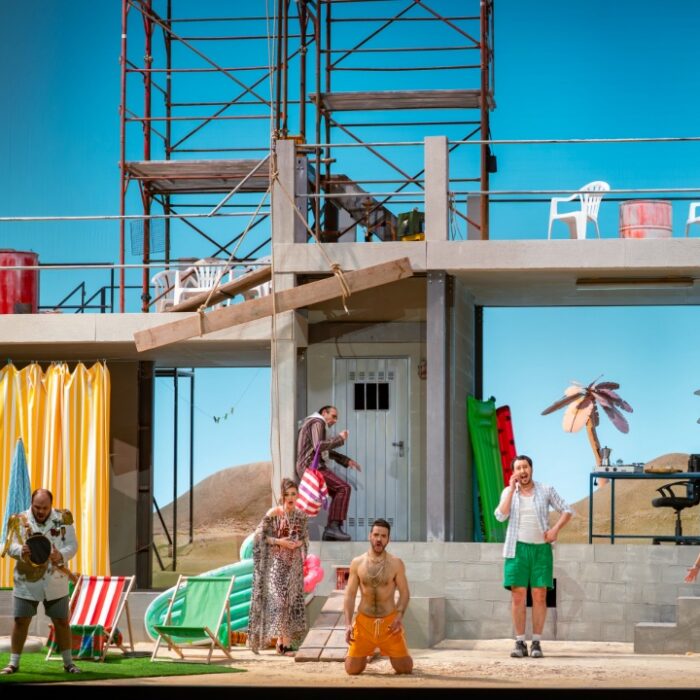
By Ossama el Naggar(Photo: Marcello Orselli)
The seventeenth of Verdi’s twenty-six operas, “Il trovatore” (1853) is considered the archetypal senseless opera, thanks to its convoluted and highly implausible plot. So absurd is its premise that it was used in the Marx Brothers’ “A Night at the Opera” (1935) to elicit laughs. But despite this, “Il trovatore” has remained one of the most popular operas in the repertoire since its premiere. Implausible to the non-operatically inclined, its appeal among opera lovers lies in its unforgettable melodies, its appealing arias and its superlative ensemble writing.
For an aficionado such as director Luchino Visconti, it was used as a backdrop for his film “Senso” (1954). The impossible love between noblewoman Leonora and the gypsy troubadour Manrico parallels that of his film’s protagonists, a Venetian countess and an Austrian lieutenant during the Venetians’ struggle against the ruling Austrians in 1866, before its liberation by the young Kingdom of Italy. The riveting opening scene takes place at Venice’s stunning opera house La Fenice during a performance of “Il trovatore.”
Legendary tenor Enrico Caruso (1873-1921) believed that a successful “Il trovatore” requires the world’s four greatest singers. This is indeed the case, as they are among the most demanding roles for the soprano Leonora, the mezzo Azucena, the tenor Manrico and the baritone Count di Luna.
Often considered the last bel canto opera, “Il trovatore” is a transitional work between bel canto and grand opéra. At the time Verdi composed it, his style, though original and unique, had its roots entrenched in Donizetti’s bel canto. In the mid-nineteenth century, Giacomo Meyerbeer (1791‑1864) reigned supreme over Paris, then the centre of the musical world. The perspicacious Verdi heeded the winds of change and adapted his style accordingly. Meyerbeer’s grand opéra formula calls for a quartet or quintet of different voice registers, usually a soprano and tenor amorous couple, a baritone villain, a mezzo rival or mother and a bass father or villain. Verdi’s subsequent operas “Les Vêpres siciliennes” (1855), “Simon Boccanegra” (1857), “Un ballo in maschera” (1859), “La forza del destino” (1862), “Don Carlos” (1867) and “Aida” (1871) all follow this Meyerbeerian model.
Stellar Cast & Musical Details
Leonora is a bel canto role, full of ornamentations, requiring masterful technique. However, it is also a grand opéra role, requiring a much heftier voice than the typical bel canto nightingales. Though the tenor role is thought of as the most demanding in the opera, Leonora is often more problematic. Some think that a spinto or even a dramatic soprano is the voice most suited for Leonora. However, it requires more agility than other Verdi spinto roles. Often coloraturas are too lightweight for such a tragic role. The ideal Leonora must be a first‑rate lyric soprano capable of fulfilling these demands.
Over the past decade, Erika Grimaldi has impressed in myriad roles thanks to a polished technique and strong stage presence. She impressed me as Donna Anna in “Don Giovanni” in Turin in 2018, and as Tosca in Parma and Manon Lescaut in Turin in 2024. However, Leonora requires more “bite” than these. Grimaldi’s Leonora was technically exemplary and dramatically moving, but it lacked the right colour. A slightly darker voice would have been ideal, but Grimaldi’s Leonora was quite impressive nonetheless. Both her Act one aria “Tacea la notte placida” and Act four aria, “D’amor sull’ali rosee” were masterclasses in bel canto. In addition to immense stage presence, Grimaldi is endowed with a beautiful timbre and impeccable diction. This helped make the pivotal Act two finale truly moving.
Believing Manrico to be killed in battle, Leonora is set to enter a convent. Di Luna waits at the gate of the convent to abduct her. Manrico rushes to the rescue; the bewildered and ecstatic Leonora is incredulous in Act two’s intense finale, “E deggio e posso crederlo?” Thanks to her admirable phrasing, Grimaldi managed to ardently convey Leonora’s immense joy at seeing Manrico alive, despite the ensuing duel with di Luna. Likewise, the final scene with Manrico in his prison cell, “Che! Non m’inganna!” was shattering thanks to Grimaldi’s beautiful phrasing of phrases such as “Oh, quanto ingiusto, crudel sei meco!” and “Senti! la mano è gelo…toccandosi il petto, ma qui… qui foco orribile, arde…,” making Leonora’s death truly memorable.
For over 15 years, French mezzo Clémentine Margaine has been admired for her French mezzo roles, such as Carmen, Léonor de Guzman in Donizetti’s “La favorite,” Dulcinée in Massenet’s “Don Quichotte,” Eboli in the French language “Don Carlos,” and Charlotte in “Werther.” Though I enjoyed her in 2020 in Barcelona as an excellent Amneris in “Aida,” she is not usually associated with Verdi’s mezzo roles or Italian roles in general. Nonetheless, her Azucena was superlative and elicited huge applause from the audience. Mercifully, the Genova public is refined enough not to insist on the vulgar chest notes that often plague this role and are often expected by concertgoers. Therefore it was refreshing to hear this role free of such histrionics. Margaine‘s prowess is impressive and her voice has acquired a slightly darker hue that is suited for Verdi’s mezzo roles. Dramatically, she portrayed an appropriately broken woman, traumatized and psychologically damaged, having mistakenly immolated her own child and raised her nemesis’s offspring instead. Her “Stride la vampa” was impassioned, with impressive low notes, yet devoid of the aforementioned chest notes. Thanks to Margaine, Azucena’s final utterance, “Egli era tuo fratello” (“he was your brother”), to di Luna after he had killed Manrico, was measured yet effective.
Usually the weakest link in stagings of “Il trovatore” is its demanding tenor role, Manrico. In this portrayal, Fabio Sartori was an excellent choice. For over a decade, this lyric tenor has been singing Verdi roles, such as Gabriele Adorno in “Simon Boccanegra,” Carlo in “I masnadieri,” Don Carlo and even Radames in “Aida,” and is well versed in the style. In the past two or three seasons, Sartori seems to have improved his skills and has learned to move with more agility.
This was the case in recent performances as Gabriele Adorno in “Simon Boccanegra” in Berlin and as Pinkerton in “Madama Butterfly” in Barcelona. In this performance, Sartori impressed vocally and even dramatically. He can soar effortlessly in the upper reaches, singing brightly and with great beauty. For a lyric tenor, he has a substantial and dramatic voice and is blessed with a strong middle and lower register. He sang the difficult Act three aria, “Di quella pira,” effortlessly and with panache. Mercifully, Sartori eschewed the vulgar antics in which tenors often indulge in this aria (sadly, to the public’s delight). He delighted with his expressive phrasing in the preceding duet “Di qual tetra luce – Ah sì, ben mio.” This was a paragon of elegance and stylishness.
The revelation of the evening was Mongolia’s Ariunbaatar Ganbaatar as Count di Luna. This young baritone impressed with his beautiful timbre, excellent diction and expressiveness. He elicited at least as much applause as his co-stars and rightfully so, though he is relatively new to Italy’s opera scene. Watch out for this young man; he promises to be a leading Verdi baritone. The thirty-seven-year-old Ganbaatar seems to be following in the footsteps of another Mongolian, Amartuvshin Enkhbat, possibly the best Verdi baritone of our time.
Ganbaatar’s Act two aria “Il balen del suo sorriso,” Verdi’s most beautiful baritone aria, was delightfully interpreted, lovelorn in the opening passages and defiant in the second part. This anti-hero is not inherently evil. Being spurned by the woman he desires and knowing that she prefers a man of far inferior rank infuriates him. In his Act four duet with Leonora, “Mira di acerbe lagrime,” he was able to solicit sympathy: a despised lover promised the object of his desire under reprehensible circumstances. In addition to his vocal prowess, he personified the aristocratic demeanor of a nobleman. By his deportment and posture, he positively exuded authority.
Ferrando, the bass role, is often mentioned as the fifth pillar of opulent voices needed to mount “Il trovatore,” but he has just one aria at the beginning of the opera, and only a few lines thereafter. Most often, little effort is done in casting the role. It was therefore a great pleasure that a first-rate bass was cast in the role. South Korea’s Simon Lim opening aria “All’erta! All’erta!” and ensuing narration, “Di due figli vivea padre beato..Abietta zingara” set the proper tone for the tragic story. Even the small role of Ines, sung by Genova native Irene Celle, sounded ravishing in her brief appearance, a rarity in this opera.
More Highlights
Giampaolo Bisanti, for the past three seasons Music Director at L’Opéra Royal de Wallonie in Liège, has rendered the Belgian city a mecca for opera lovers thanks to original programming and great musicianship. Bisanti has a great affinity for both bel canto and Grand opéra, as proved by the operas he conducts and in his Liège assignment. He led this performance with elegance and style, producing an orchestral sound that only inspired players make. The strings sounded appropriately majestic or idyllic, depending on the scene, and the woodwinds were particularly gorgeous in the solo arias, especially those supporting the female roles.
Alas, Marina Bianchi’s staging did not match the calibre of the cast. While nothing was overly offensive (already a blessing), nor were there any remarkable ideas. Bianchi doesn’t seem to believe the audience can concentrate only on singing; diversions were legion during many dramatic moments. At the opening of Act three, two women from Manrico’s gypsy encampment doubled as prostitutes catering to di Luna’s men, reinforcing negative stereotypes. One also picks her John’s pockets and is then raped over a barrel. Why the need for such obscenity?
One cannot deny “Il trovatore” is an opera with a lot of violence. But Bianchi seemed to revel in this aspect by overdoing the gore. In one scene, di Luna’s men horse around and attack one of their own, enacting a mock execution. In Ferrando’s Act one account, an effigy of Azucena’s mother, who was burnt at the stake, is brandished. In Act four, a skeleton in a cage hangs over Azucena in her prison cell, distracting from the action. In all fighting scenes, whether involving di Luna’s men, those in the gypsies’ camp or the two fighting each other, excessive sword fighting was featured. Given the ballabile (danceable) nature of much of the score, several fights and duets were tastefully choreographed. Once or twice would have been enough, but Bianchi seemed to have thought the distraction essential. This overkill took away from our overall enjoyment.
Kazakhstan’s Sofia Tasmagambetova and Pavel Dragunov produced appealing yet unspectacular sets and costumes. Thanks to a revolving stage, changes between the opera’s many scenes (two per act) were astoundingly fast. With one intermission between Acts two & three, this was a pleasantly short evening. The predictable Count di Luna’s dark castle in Act one also served as Manrico and Leonora’s dwelling in Act three. The gypsy camp was dangerously behind di Luna’s castle, and strangely enough, the final prison scene had brighter lighting than the opera’s other scenes.
While the costumes were faithful to the period and location, it was hard to distinguish di Luna’s men from Manrico’s. Mercifully, Azucena was modestly dressed, in contrast to many productions where, being a gypsy, she’s often dressed as subtly as a carnival attraction. In Act two’s finale, Leonora appeared in a nun’s white robe prior to taking her vows. The convent’s nuns were dressed anachronistically (and ex loco). They wore cornettes, headwear with starched white cloth folded upward in such a fashion that they resembled horns, typical of 1800s France. Clearly, this was for mere visual effect. Though set in a dystopian future, it may have been a nod to Margaret Atwood’s “The Handmaid’s Tale.”
Despite its erratic staging, this was a memorable evening, thanks to five first‑rate singers, the necessary recipe for a successful “Il trovatore,” according to the great Caruso.