Staatstheater Meiningen 2025-26 Review: Didone abbandonata
A Claude Lorrain Dream at Harbour, Trapped in a Chamber Frame
By Mengguang Huang(Photo: Christina Iberl)
The revival of Domenico Sarro’s “Didone abbandonata” (1724) at the Staatstheater Meiningen marks perhaps the first scenic production of this Neapolitan gem since its 1724 premiere in Naples. While this staging offered a rare opportunity to witness Pietro Metastasio’s debut libretto in full staged form, there was a lingering sense that the interpretation was perhaps too cautious. By leaning into a meticulously intimate aesthetic, the production risked compressing the grand, public architecture of opera seria into something far more static and cosy. The performance at times felt reduced to the scale of a chamber cantata, trading the stakes of the public stage for an almost domestic stillness.
Production Details
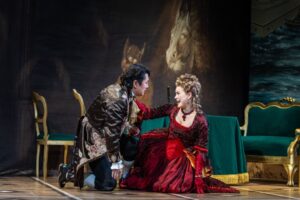
The scenic design was dominated by a panoramic backdrop paying exquisite homage to Claude Lorrain’s “Dido.” The towering classical porticos, the hazy maritime horizon, and the meticulous interplay of golden light and lengthening shadows evoked the idealized Mediterranean vistas of the 17th century. Central to this visual architecture was a door, frequently used for the singers’ entrances and exits. For much of the drama, this portal remained firmly shut, confining the performers within a pressurized, intimate space. This “chamber” effect forced the audience to focus on the raw psychological turmoil of the characters as if trapped in a small royal cabinet. Occasionally, the doors opened to reveal the tumultuous world outside, offering a fleeting glimpse of Carthage’s instability.
Complementing the architectural depth of the set was a dramatic use of curtain showing the ghostly, ethereal silhouette of the Trojan Horse, rendered in haunting, translucent tones. This specter served as a silent, omnipresent narrator; it was not merely a piece of scenery, but a psychological weight that loomed over the stage.
While the production’s visual language was largely cohesive, the presence of modern makeup vanities at the edge of the stage introduced a curious metatheatrical layer. These stations serve as a practical anchorage for the singer ensemble before they step into the limelight. However, in the context of drama, one might wonder if these contemporary touches slightly soften the immersive impact of Dido’s world, somewhat apart from the intense, tragic pulse of Metastasio’s narrative.
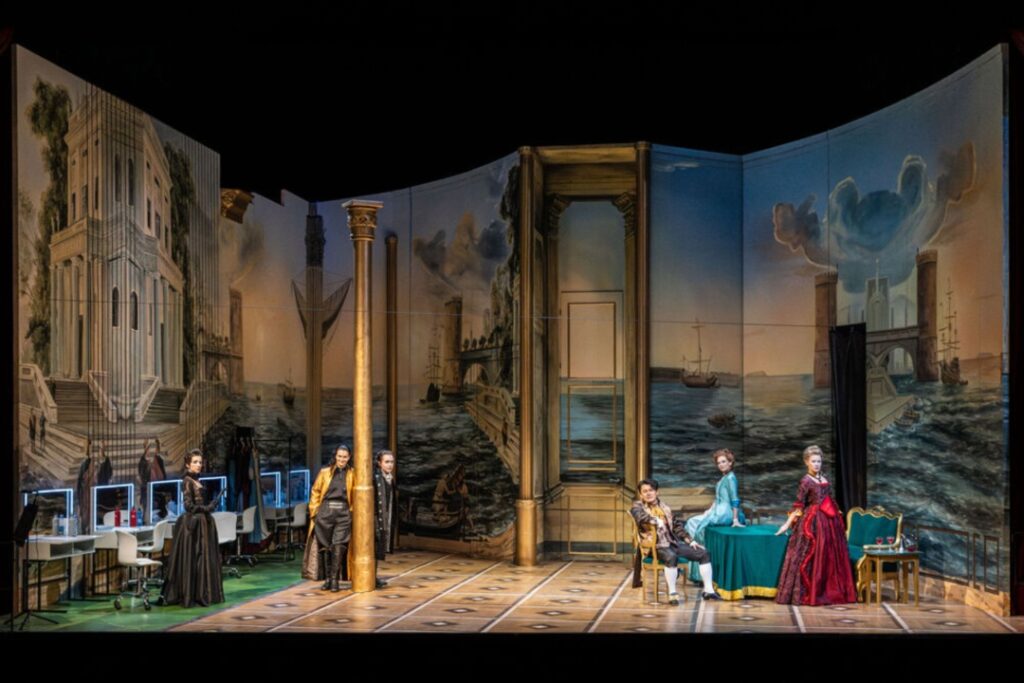
(Photo: Christina Iberl)
Musical Highlights
Musically, despite the Meininger Hofkapelle’s effort to adopt the scale and form of a Baroque group, the musical execution was disappointing. The basso continuo, largely relied on isolated solo efforts from the lute, harpsichord, or chest organ. It left the singers to wander through a thin, tonally impoverished soundscape. Most baffling, however, was seeing the harpsichordist transition to the modern piano for a significant portion of the second half, creating a puzzling anachronism.
Furthermore, the orchestra itself was given limited opportunity to shine due to the substantial cuts in the score. There were fleeting moments of brilliance from the wind section that hinted at the ensemble’s true potential. Most notably, during Aeneas’s exit aria, the horns provided an impressively secured and evocative performance, momentarily injecting the production with the heroic scale it otherwise lacked.
The critical caveat remains regarding the musical curation. While Sarro may not possess the sheer inventive fire of Hasse, Vinci, or Porpora—who would later set the same Metastasian libretto—his score contains moments of genuine brilliance that were perhaps obscured here. The production relied on substantial cuts, which had a palpable impact on the work’s dramatic arc. Evidence from the complete manuscript and existing recordings of Sarro’s “Didone” suggests a composer capable of significant dramatic weight; yet, in this heavily edited version, the performance failed to justify his merits.
Despite the restricted dramatic scale and the sparse instrumental support, the cast delivered performances of considerable focus. Lubov Karetnikova portrayed Dido’s descent from regal authority to suicidal despair with gravity. She navigated the character’s emotional unraveling with a voice that possessed a searing dramatic edge, executing complex passages while maintaining a sense of genuine distress.
Meili Li, as the conflicted Enea, was a particular highlight; he brought a haunting, ethereal quality to the stage, portraying Aeneas not as a stoic warrior but as a man torn by duty. Crucially, Li stood out for his stylistic mastery, displaying a nuanced Baroque articulation, imaginative ornamentation, and a natural theatrical flair that felt convincing.
Marianne Schechtel as Jarba provided a needed dose of vocal heft and menace, serving as a sharp catalyst for the few moments where the production’s “cosy” atmosphere was truly threatened. The supporting ensemble—Monika Reinhard as Selene, Garrett Evers as Araspe, and Hannah Gries as Osmida—rounded out the cast with precision, ensuring the courtly betrayals felt vital.
However, a polite but necessary observation must be made regarding the overall vocal approach. While each singer was vividly distinguished through Christian Rinke’s striking costumes, they seemed less differentiated in their musical delivery. While Li appeared instinctively ‘at home’ in the Baroque idiom, his colleagues—though vocally secure—often opted for a more polite, steady interpretation. This stylistic divide reinforced the production’s tendency to favor safety over the explosive individual characterization typical of Baroque opera seria.
It is, of course, unrealistic to expect every revival of a Baroque rarity to be realized through a strict period lens. However, when the musical expression fails to capture the spontaneity, technically daring, and natural flow of passion that defines the Baroque spirit, the audience is left somewhat unfulfilled. Meiningen’s “Didone abbandonata” is a beautifully crafted recovery, but by treating the work with such chamber-like reverence, it remains a delicate but remote museum piece rather than the engaging tragedy it was born to be.
Categories
Reviews